Is your marketing agency AI-ready, or just AI-adjacent?
Most marketing agencies think they’ve made the shift. They’ve added “AI-powered” to their website, run a few ChatGPT prompts for client deliverables, and nodded along at the last industry conference when someone said the future is now.

It’s no secret that AI is reshaping marketing agencies, but we wanted to know how.


In our latest survey, we identified that clients aren’t just expecting AI fluency anymore. And agencies that haven’t made the hard structural shift from execution to strategy are losing ground, not gradually, but fast.

To access our marketing agency AI report, we asked you to answer one simple question:

  • If you work at an agency → what skills will matter most going forward?
  • If you work with agencies → how have your expectations changed?

And a lot was revealed.

What the data actually showed

We didn’t just want theory. So we asked, and here’s what the data revealed.

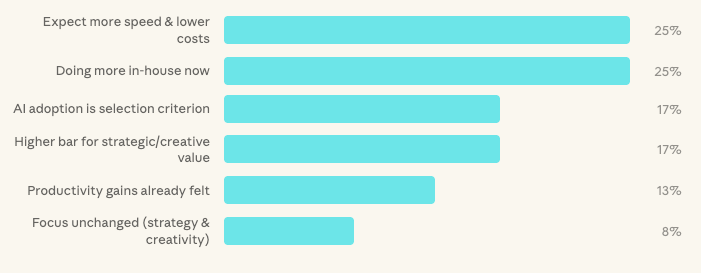
  1. How have your expectations towards agencies changed?

bar graph showing how expectations towards agencies have changed

On the client side: Expectations are moving toward: 

  • More speed
  • Lower costs
  • A growing willingness to bring execution in-house 

This all hinges on the fact that AI can now handle a big part of execution, which is a huge plus for lean internal teams.

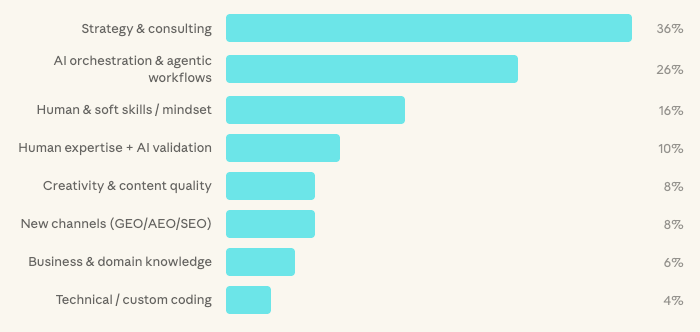
  1. What skills matter most for agencies moving forward?

A bar graph showing what skills matter most for agencies moving forward

On the agency side: The value proposition is moving toward strategy, consulting, and anything AI still struggles with, plus some new capabilities. 

The work that retains (and grows) client relationships is moving toward three things:

  1. Strategic consulting: Helping clients figure out what to do, not just doing it
  2. AI orchestration and agentic workflow design: Building and managing the systems that make AI output useful at scale
  3. Mindset, expertise, and AI validation: Taking the flood of AI-generated content, data, and analysis and turning it into decisions

None of that is surprising. What’s surprising is how few agencies are structurally repositioned to deliver on it.

How AI-ready is your agency?

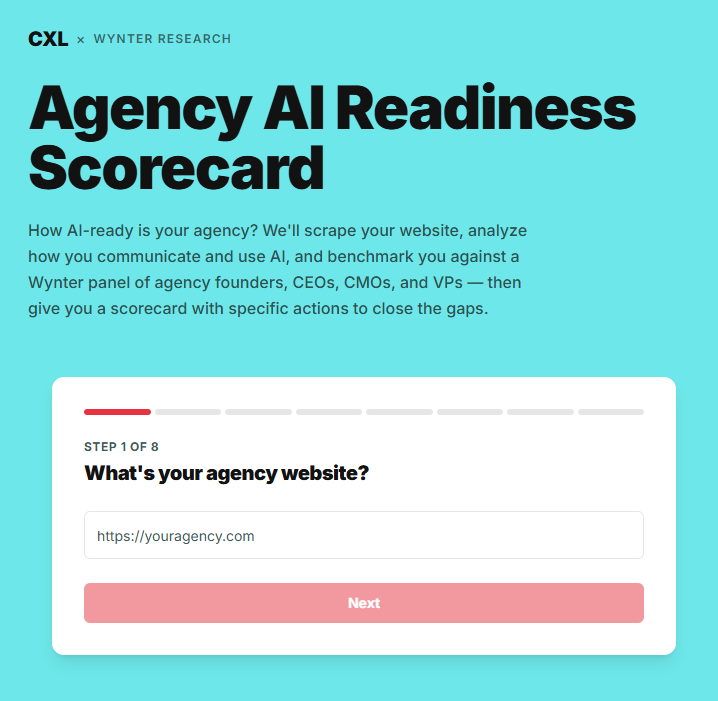
Screenshot of CXL's AI marketing agency assessment

We didn’t want this to just be insights, so we turned all of this into something usable–an AI marketing agency assessment.

Here’s how it works:

  1. It asks you a few focused questions about your team, your workflows, and how you’re actually deploying AI day-to-day. 
  2. Then it scans your website to see how AI shows up (or doesn’t) in your positioning.

What you get back is a breakdown of: 

  • Your readiness level
  • Specific gaps
  • The opportunities you’re likely missing
  • How you stack up against the data we collected from agencies and their clients.

It takes a few minutes. The output is direct. If you’re curious about where you actually stand, you can take the assessment here.

If your scorecard surfaced real gaps, the next move is structured learning, not more content to read and forget. And CXL’s B2B Marketing and AI and AI Agents for B2B Marketing programs are the perfect place to start.

For live and on-demand AI-focused sessions:

→ Don’t miss out on our 5-day n8n webinar series — ditch manual tasks and lean into automation with leading B2B marketing experts.

Most marketing agencies think they’ve made the shift. They’ve added “AI-powered” to their website, run a few ChatGPT prompts for client deliverables, and nodded along at the last industry conference when someone said the future is now.

It’s no secret that AI is reshaping marketing agencies, but we wanted to know how.
Keep reading

Most agency leaders are asking the wrong questions: “How do we use AI to do our work faster?” and “Do we need fewer content writers?” The question that actually matters—the one that clients are already asking—is simpler and more brutal: “Do we need an agency at all?”

That shift is already happening.

Keep reading

Static data visualization is a silent engagement, productivity, and conversion killer. Marketers have been uploading data to tools like Flourish, Datawrapper, and Tableau for years—then manually formatting, exporting, and embedding the results.

It works, but it’s also slow and what took weeks to create is often lost and forgotten in a four-second scroll.

Keep reading

Google’s AI Overviews don’t just summarize the top result. They cite whoever answers the query best, regardless of whether that page ranks first, fifth, or not at all. 

Your brand could be invisible in AI answers while your domain authority sits at 60. That’s the new reality, and most SEO dashboards won’t tell you it’s happening.

Most marketers probably don’t even know if they’re being cited or not. There’s no standard report for this. No toggle in Search Console. No widget in Semrush that shows you, clearly, how often your brand appears in AI-generated answers versus your competitors.

So we built one.

Keep reading

LLM hallucinations are a known issue. But as frustrating as they may be, hallucinated AI citations are just a symptom.

Every time an AI assistant invents a URL to your site—confidently, wrongly—it’s doing so because a real person asked a real question. The model expects your site to have an answer, and when it can’t find one, it fills in the blank.

That’s the gap worth paying attention to.

Keep reading

For the past two years, tracking AI visibility and citations has largely been a black box.

Third-party tools like Semrush and Ahrefs introduced ways to estimate AI visibility by monitoring search results and citations. But until recently, we didn’t have first-party data directly from the search engines themselves confirming when and how often content was used inside AI-generated answers.

That changed a few weeks ago.

Keep reading

The problem with competitor content analysis isn’t that it doesn’t work. It’s that doing it manually at any meaningful scale is unsustainable. 

You either do it rarely enough that it’s useless, or you burn your team’s time on a process that collapses under its own weight the moment you try to run it across more than a handful of keywords.

Keep reading

Categories

B2B Marketing and AI courses

How people search, compare and buy products and services is changing. Your marketing should change too.

This 5-track program is designed to keep you up-to-date with B2B marketing and AI.

Check out the program