Most agency leaders are asking the wrong questions: “How do we use AI to do our work faster?” and “Do we need fewer content writers?” The question that actually matters—the one that clients are already asking—is simpler and more brutal: “Do we need an agency at all?”
That shift is already happening.
We surveyed CMOs and VP-level marketers on how they’re evaluating agencies today, and the answers were telling.
27% of marketing leaders said they’ve already started replacing parts of agency work, specifically copywriting and basic production, with internal AI tools or agents.
One CMO put it plainly:
“My first consideration is whether I can build an agent in Claude to do the work a marketing agency would have initially done. If not, I’ll consider the agency.”
Read that again.
You’re no longer competing with other agencies. You’re competing with a $20/month Claude subscription.
The agencies that survive this won’t do it by getting faster. They’ll be the ones who reposition their B2B marketing agency strategy entirely; the ones who’ve stopped selling execution and started selling what AI genuinely can’t replicate: judgment, taste, domain expertise, and the ability to tell a client what not to do.
Table of contents
- Execution is no longer a competitive moat
- “AI-powered” is the new “full-service.” Don’t believe the hype.
- The agency gap is widening, and most are stuck in the worst position—the middle.
- Where the value actually lives: upstream decisions
- AI capability is now a selection criterion—not a differentiator
- How to evaluate AI marketing agencies: Four questions that reveal “readiness”
- What the AI marketing agency assessment is actually measuring
- The case for in-house AI capability (and where it breaks down)
- What to do next
- The question isn’t whether. It’s when.
Execution is no longer a competitive moat
For the better part of a decade, agencies built moats around operational capability. We can run your paid media. We can produce your content at scale. We can manage the campaign calendar.
The pitch was fundamentally: we can do things you can’t do efficiently in-house.
That moat is being drained.
AI handles high-volume, pattern-driven output at a fraction of the cost and time of a human team. Copy variants, research synthesis, basic creative production: the kind of work that used to justify a healthy retainer is now something a sharp in-house marketer can spin up in an afternoon with the right prompt and a connected workflow.
Clients are doing the math, and the data confirms this.
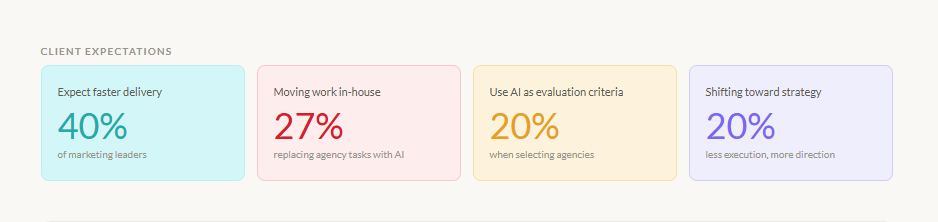
47% of marketing leaders surveyed now expect agencies to move faster or deliver better results in less time, with the implicit assumption that if AI exists, timelines should compress accordingly. Long onboarding periods, slow research ramp-ups, multi-week production cycles: all of these are becoming harder to justify.
What’s more telling is where budget is actually shifting.
20% of marketing leaders said they’re redirecting spend toward higher-level work: positioning, creative direction, and domain expertise.
The market is sending a clear signal. Less execution. More strategy.
But this doesn’t mean execution is worthless. It means you can’t charge premium prices for execution alone. The margin has to come from somewhere else.
“AI-powered” is the new “full-service.” Don’t believe the hype.
Using AI for content drafts and Midjourney for visual concepting is table stakes. Even simple workflow automation is basic at this point. None of it indicates whether the agency has structurally adapted—whether AI has changed how they think, not just what tools they open.
The agencies that are genuinely “AI-ready” aren’t just using AI to execute faster. They’re using it to empower team members to do things they couldn’t do on their own before:
- Deeper competitive analysis
- Real-time creative testing
- Audience segmentation
They’ve redesigned workflows around AI outputs rather than retrofitting AI into old workflows.
The agencies that are falling behind are doing the opposite. Same process, same team structure, same deliverables—just with AI shaving time off individual tasks.
“The value is moving toward strategy, consulting, and anything AI still struggles with—plus new capabilities like AI orchestration and workflow design.”
The agency gap is widening, and most are stuck in the worst position—the middle.
Not all agencies are responding the same way. There’s a clear split forming between agencies that are experimenting with AI tools and agencies that are rebuilding how they operate around AI.
Here’s what we found buried in the data.
- The experimenters are using AI to generate copy faster, summarize research, and maybe automate a few reporting tasks. They’re still selling the same services, to the same buyers, with the same pitch. They’ve plugged a new tool into an old workflow.
- The rebuilders are asking harder questions: what do we uniquely know that AI can’t replicate? What decisions can only humans make? What does our client actually need to be true in six months, and what’s the fastest path there?
The problem is that most agencies haven’t crossed that line. They’ve adopted some AI tools, which is smart, but they’re still positioning around deliverables: SEO, ads, content, production, and campaigns.
At the same time, they’re facing internal headwinds.
33% of agency leaders are worried that as AI tools get cheaper and better, clients will start questioning whether high-touch delivery is worth the premium. And they’re right to worry.
“Will AI-related software become so good—at a super low cost—to the point where our high-touch delivery will not matter?”
— Agency principal, B2B marketing firm
Most agencies are trying to answer this by adopting more AI tools. That’s not necessarily wrong; it’s just incomplete.
The strategic question isn’t “How do we use AI?” It’s “What are we actually selling that AI can’t replicate?”

A majority of agency leaders haven’t shifted their core service offering yet. And the window to make that shift proactively, before clients force it, is closing.
The middle is the riskiest place to be. You’re spending on AI tooling without capturing its efficiency gains, you’re not differentiated on speed or cost, and you’re not yet positioned on strategy or expertise.
Essentially, you’re paying twice and winning on neither axis.
The internal resistance
The response inside many agencies is fragmented, but agency leaders surveyed flagged two recurring issues:
- Team resistance: employees who see AI as a job threat, not a workflow upgrade.
- Tool overwhelm: Tool stacks are ballooning (one agency leader called it “honestly a bit overwhelming”). No clear sense of which platforms to actually commit to, creating decision fatigue and shallow adoption across too many tools simultaneously.
And on top of that, the agency’s external positioning hasn’t caught up to any of it.
That’s a real operational problem. You can’t rebuild your marketing agency strategy
around AI capabilities if your team is working around the tools instead of with them.
The fix isn’t a training day. It’s a sequencing problem. You need to:
- Simplify the stack first (commit to two or three tools that cover 80% of your workflow needs).
- Then build upskilling around specific workflows—not generic “how to use AI” sessions.
The goal is fluency with a small set of tools, rather than awareness of a large number of them.
“Agencies will spend less time doing production work… and more time providing things that AI is bad at, such as domain expertise, design taste, etc.”
— VP Marketing respondent, CXL Agency AI Research
Where the value actually lives: upstream decisions
The agencies that are hardest to replace aren’t the ones doing the most things. They’re the ones doing the right things—and having the credibility to say so.
If your agency is adapting correctly, you’re buying three things:
- Strategic judgment that AI can’t replicate: The ability to make the right call when the data is ambiguous, the client relationship is complicated, or the market is moving fast.
- AI orchestration: The skill of designing workflows, sequencing models, and QA-ing outputs at scale so you get leverage without losing quality control.
- Synthesis under pressure: The ability to look at a mountain of AI-generated output and decide what’s worth using, what needs reworking, and what should be scrapped.
If your agency can’t articulate how they do those three things, you’re probably still paying execution-era prices for execution-era work. Just with fancier tools bolted on top.
Upstream value looks like this:
Defining the right problem.
Most clients come to agencies with a solution in mind. “We need more content.” “We need to run more ads.” “We need to rebrand.” The strategic work is figuring out whether that solution actually maps to the problem, or whether the problem is something else entirely. AI won’t tell a client their go-to-market positioning is wrong. A good agency will.
Designing systems and workflows, not campaigns.
A campaign ends, but a system compounds. Agencies that help clients build repeatable marketing infrastructure—lead scoring, content operations, attribution models, nurture flows—are selling something that has ongoing value. That’s harder to cut than a campaign retainer.
Interpreting and improving AI output, not just generating it.
This is underrated. The bottleneck in most AI-assisted workflows isn’t generating content; it’s knowing which content is actually good, which message will resonate, and which insight is worth acting on. That editorial judgment is not in the model. It’s in the person who’s seen what works (and what doesn’t).
AI is bad at knowing what problem is actually worth solving, at pushing back on a client’s expectations or assumptions, and at creative taste with stakes attached.
It’s bad at knowing not just that something is technically correct, but that it’ll land differently in a specific market with a specific buyer psychology.
It’s bad at the kind of institutional knowledge that lets you say, “We tried this in Q3 last year for a similar client and here’s what happened.”
That’s the work agencies should be re-centering around. Not the output. The judgment that precedes it.
Prioritizing ruthlessly on behalf of the client.
The most valuable thing a trusted advisor does is tell you what not to do. AI will generate twenty ideas. An expert agency tells you which three matter and why the other seventeen are wrong for your situation.
AI capability is now a selection criterion—not a differentiator
20% of marketing leaders said an agency’s AI strategy is already a factor in how they vet and select partners: positioning, creative direction, and domain expertise. They’re not necessarily cutting agencies. They are, however, changing what they want from them. And that number will grow, but leading with tools is the wrong move.
Clients don’t care if you use Claude, GPT-4, Midjourney, or a proprietary workflow stack. They care about the output. They care about speed.
“Now when I’m evaluating marketing agencies, a significant factor is how they use AI to speed up the production process and make it more efficient,” one CMO noted.
They care about whether you can tell them what to do next, not just execute what they asked for.
One marketer put it:
“Agencies will spend less time doing production work and more time providing things that AI is bad at, such as domain expertise, design taste, and so on.”
Notice the framing: AI as evidence of operational discipline, not as the primary value.
Your AI capability should surface through the outcomes it enables: faster time-to-market, sharper synthesis, and tighter feedback loops—not through a “we use AI” badge on your website.
Instead of leading with your stack, lead with what your stack makes possible for your client.
The value shift: What agencies used to sell vs. what clients actually need
| Dimension | Old positioning | Where the value lies now |
| Primary offer | Execution and production capacity | Strategy, decisions, system design |
| Speed advantage | We can move faster than in-house | We know what’s worth moving fast on |
| Content/copy | We produce at volume | We know what message actually converts |
| Research | We gather and synthesize data | We interpret what it means for your situation |
| Differentiation | Tool access and headcount | Domain expertise and judgment |
How to evaluate AI marketing agencies: Four questions that reveal “readiness”
Stop asking whether your agency uses AI. Start asking how.
- How has your team structure changed in the last 12 months?
If the answer is “it hasn’t,” that means they aren’t anywhere near “AI-ready”. Agencies that have genuinely integrated AI have usually restructured around it—fewer junior execution roles, more senior strategists, new hybrid roles that didn’t exist before (prompt engineers, AI QA leads, workflow designers).
Stasis suggests they’re using AI as a productivity tool, rather than a structural advantage.
- What does your AI-assisted workflow actually look like for a campaign like ours?
Push for specifics.
- Which models?
- Which steps are human-led vs. AI-assisted vs. fully automated?
- Where are the QA checkpoints?
A vague answer (“we use AI throughout the process”) is a red flag. A specific answer—even if it’s imperfect—signals genuine operational maturity.
- Where does AI fail in your work, and how do you catch it?
This is the trust question. Agencies that understand AI well enough to work with it effectively also understand its failure modes:
- Hallucinations
- Brand voice drift
- Cultural tone-deafness
- Overconfident or generic outputs
If they can’t articulate where AI goes wrong in their specific context, they’re not supervising it closely enough. And you’re the one who’ll deal with the mistake that gets published.
- What are you doing for clients that AI makes possible that wasn’t feasible before?
Not “what are you doing faster.” What are you doing that couldn’t happen at a reasonable budget pre-AI?
- ABM personalization at scale
- Weekly creative iteration instead of quarterly
- Real-time SEO response to SERP changes
If the answer is just “we’re more efficient,” they’re optimizing, not innovating.
What the AI marketing agency assessment is actually measuring
The four-question diagnostic above maps directly to where the real gaps tend to be.
| AI maturity diagnostic | What it reveals | What good looks like |
| Operating model and talent evolution | Whether AI has triggered real organizational change vs. surface-level adoption | Clear shift in team design; evidence of restructuring around speed, leverage, and decision-making |
| Workflow architecture and systemization | Depth, clarity, and repeatability of execution systems | Step-by-step breakdown of process: tools used, human vs. AI roles, QA checkpoints. Feels like a system you could audit or replicate |
| AI governance and quality assurance | Understanding of risk, failure modes, and control mechanisms | Specific, contextual failure examples (e.g. hallucinations in long-form SEO, tone drift in brand copy) and clear safeguards and review processes |
| Innovation and value expansion | Whether AI is unlocking new value vs. just reducing costs | Clear examples of net-new capability (e.g. real-time SEO iteration, scaled personalization, rapid creative testing). Tied to business outcomes |
The case for in-house AI capability (and where it breaks down)
Some of what you’re currently outsourcing should probably be in-house now.
Content production, social copy, first-draft email sequences, performance dashboards—if your team has a couple of people willing to learn the tooling, you can own a lot of that execution at a fraction of the cost.
But there’s a limit to the insourcing argument, and it matters.
The skills that are genuinely hard to build internally—sophisticated paid media strategy, cross-channel attribution modeling, enterprise-level creative concepting, AI workflow design at scale—still require depth that most in-house teams can’t develop quickly.
The mistake is trying to do everything in-house because some things are now feasible to do in-house.
The practical framework: In-house vs. agency
- Own your strategy and your data.
- Outsource depth you can’t realistically build in 12 months.
The middle—execution and production—is where you should be pushing back hardest on agency scope and pricing.
What to do next
- Audit your current agency retainer against the three value pillars. Map every deliverable to either strategic judgment, AI orchestration, or synthesis. Anything that doesn’t fit one of those categories—ask yourself whether it still belongs in the agency scope or whether your team could own it.
- Reframe your positioning around what you’re actually selling. Pull your last three proposals or sales decks and tag all deliverables. Count how many value claims are about what you produce versus what you decide, advise, or prevent. If more than 60% are output-focused, that’s your exposure. That work is being repriced right now. Rewrite the core value prop around decisions and outcomes.
- Run the four questions in your next agency QBR. Don’t frame it as an audit, but rather as strategic alignment. “We want to understand how you’re evolving so we can evolve our partnership.” The quality of the answers will tell you everything you need to know.
- Simplify your AI stack to two or three tools before expanding it. Pick the tools your team will actually use consistently: likely a large language model for synthesis and drafting, an automation layer for workflow (n8n, Make, or Zapier , depending on complexity), and a project management tool that connects them. Kill everything else. Fluency in a small stack beats shallow familiarity with 10 platforms.
- Build one AI-enabled workflow that visibly reduces turnaround time. Pick a high-frequency deliverable, like a brief, a competitive analysis, or a reporting summary, and rebuild it around AI assistance. Document the before/after time. This becomes your proof point with clients and an internal confidence-builder for your team.
- Shift at least one service line from deliverable-based to advisory-based pricing. Deliverable pricing commoditizes you. Advisory pricing prices your judgment. This doesn’t mean monthly retainers for undefined “strategy,” it means scoping a specific decision or system design engagement where the output is a recommendation, a framework, or an architecture. Test it with one client. See how the conversation changes.
- Set explicit expectations in your next contract or scope renewal. Vague commitments to “AI integration” don’t protect you. Specific commitments do: turnaround times, workflow documentation, escalation protocols when AI outputs miss the mark.
- Train your team on workflows, not tools. Have the hard conversation with resistant team members early. Frame AI adoption as a skill expansion or workflow redesign rather than a headcount reduction. Show specifically how AI handles the low-leverage parts of a task, like first-draft writing, data synthesis, or reporting, so the human can focus on the high-leverage parts: interpretation, positioning, and client judgment. Nobody resists a tool that makes their actual job easier.
The question isn’t whether. It’s when.
Speed and efficiency matter. But they’re table stakes now, not differentiators. Any agency with a halfway competent AI workflow can compress timelines. The sustainable advantage belongs to agencies that are clear about something more important: what they know that clients don’t, and why that knowledge compounds over time.
The shift is already underway.
Clients are building internal agents to replace execution work. Marketing leaders are reallocating budget toward strategic counsel. And the gap between agencies that have rebuilt their model and those still selling production services is widening every quarter.
The marketers who navigate this shift well won’t be the ones who fire their agencies reflexively or try to build everything in-house. They’ll be the ones who get precise about what they’re buying, relentless about evaluating whether they’re getting it, and clear-eyed about where the line between AI marketing agency value and in-house capability actually sits now.
The question isn’t whether you’ll need to change your positioning. You already do. The question is whether you do it before or after your next renewal conversation.
CXL’s B2B Marketing and AI and AI agents for B2B marketing programs will give you the foundation you need to turn strategic judgment into work that actually lands with clients.
Or go straight to implementation with one of our live and on-demand AI-focused sessions:
- Measuring the modern AI-powered funnel
- Build content automations for lead generation with n8n
- SEO automation with n8n and Claude Code
- B2B buyer pain-led GTM strategy
- B2B ad campaigns with Claude Code and n8n
- Optimizing B2B content funnels with AI
- Build apps as content with AI
- AI ready agencies: what clients see
- Unique positioning for agencies
→ Join our upcoming Claude Code webinar focused on using Claude Code to move from manual marketing workflows to fully systemized, automated execution.
