The problem with competitor content analysis isn’t that it doesn’t work. It’s that doing it manually at any meaningful scale is unsustainable.
You either do it rarely enough that it’s useless, or you burn your team’s time on a process that collapses under its own weight the moment you try to run it across more than a handful of keywords.
Here’s what actually works: build an AI agent SEO workflow that handles the scraping, the comparison, and the prioritization, so your team only touches the part where human judgment matters.
The first agent surfaces the top 10 pages with the highest realistic ranking potential (keywords where we’re already getting impressions but haven’t cracked the top five).
The second SEO agent’s job is to answer a deceptively simple question: why are competitors outranking us, and what specifically do we need to change?
Here’s how we built it, and what we learned.
TL;DR
- AI can automate competitor content analysis using two agents. The first finds ranking opportunities in Google Search Console; the second compares your article with the top five organic competitors.
- The workflow uses SearchAPI and Firecrawl to retrieve Google results and extract page content, then an LLM identifies content gaps and prioritizes recommendations.
- CXL tested the system on its “value proposition” article. The output identified specific structural and content gaps, but recommendations still needed human validation.
- The biggest limitation is strategic judgment. AI can identify what competitors cover, but it can’t reliably determine which changes will improve rankings or fit your content strategy without further evidence.
Table of contents
The stack most teams skip past
Before the SEO workflow can produce anything useful, it needs two inputs: what’s actually ranking on Google, and what’s inside those pages.
That means two tools doing specific jobs.
- Searchapi.io handles the SERP layer, fetching the top organic results for any target keyword. It comes with 100 free searches, which is enough to validate the workflow before you commit to anything.
- Firecrawl handles the content layer, scraping competitor pages and extracting their text. Its free tier currently includes 1,000 credits per month, enough to test a small version of the workflow. Paid plans start at $16/month billed annually, depending on your scraping volume and requirements.
Most teams either skip the SERP-fetching step (they manually Google and copy URLs) or skip the scraping step (they skim pages by eye).
Both shortcuts destroy the workflow’s ability to operate at scale. You need both, automated, feeding a structured document.
How does the automated competitor SEO analysis workflow work?
The workflow connects Google Search Console data with live competitor content. One agent identifies pages worth optimizing; a second retrieves the competing articles, compares their content, and produces a prioritized list of potential improvements.
The process starts with a spreadsheet containing output from the first agent. This agent is connected to Google Search Console and surfaces keywords where you’re getting impressions but not ranking in the top five.
Two columns in this spreadsheet matter: your article URL and the target keyword.
The first agent selects ten pages worth investigating. The second runs a separate analysis for each selected page, comparing it with the top five organic results for its target keyword. Those are two different parts of the workflow.
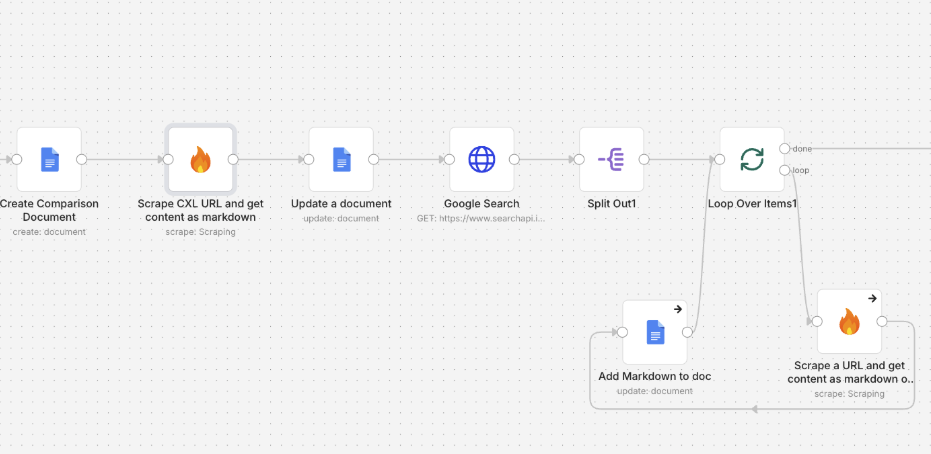
From there, the second agent takes over:
- A Google Document is created automatically to hold everything that follows.
- Firecrawl scrapes your article first and drops the content into that doc.
- Searchapi pulls the top five organic results for the target keyword.
- A loop runs: Firecrawl scrapes each competitor page, stores the content in the same document, and repeats five times until all articles are captured.
One thing worth capturing alongside the scraped content: the source URL, retrieval date, page title, and whether the scrape was complete. If Firecrawl misses a section or extracts the wrong content, that error gets passed straight into the analysis.
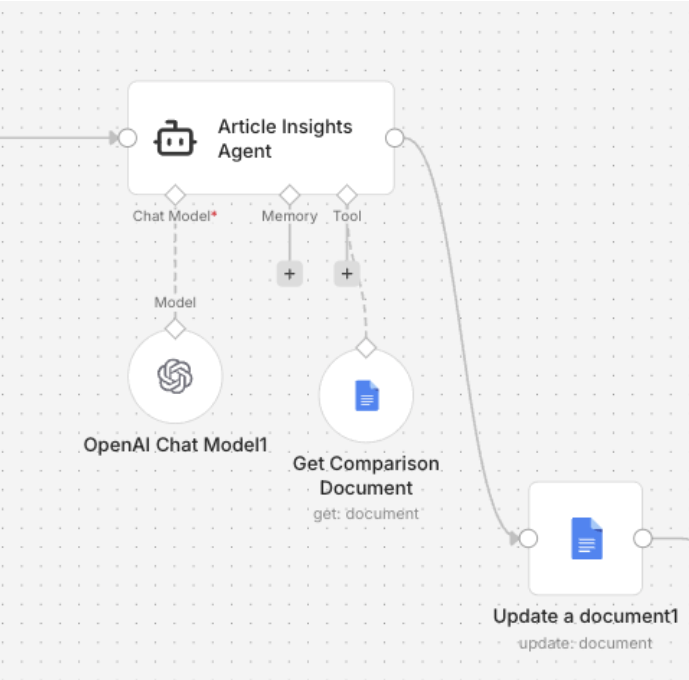
Now the analysis agent has something real to work with—not summaries, not abstracts, but full content from six pages (yours plus five competitors) in a single structured document.
The agent identifies patterns shared across the top-ranking articles: structural choices, depth of coverage, content formats, and heading hierarchies.
Then it turns the lens on your article: what’s working, what’s missing, and where the gaps are.
The output is a prioritized recommendation list: high, medium, and low impact.
That last part matters more than it sounds. Most audits produce a flat list of “things to fix,” whereas this SEO workflow produces clear, actionable recommendations.
This makes it much easier to focus on the high-impact changes that need to be implemented first.
The output is far from generic, but it isn’t final either
The automated SEO workflow was tested against the keyword “value proposition.” The output was specific, providing concrete structural gaps, prioritized actions, and recommendations tied to what competitors were doing that the original article wasn’t.
But here’s the caveat: a human still needs to validate it.
AI-generated competitor content analysis surfaces patterns, but it doesn’t know your brand positioning, your audience’s actual reading behavior, or which recommendations would undermine your editorial voice.
Some of what it flags may be exactly right. However, some of it may be technically accurate but strategically wrong for your context.
The useful output isn’t just “add an FAQ” or “expand this section.” It should show exactly which competitor pages support the recommendation, what your article is missing, and why that gap matters for the searcher’s question.
For each recommendation, ask the agent to return:
- Finding: What’s missing or different?
- Evidence: Which competitor URLs and passages support it?
- Suggested change: What specifically should be added or improved?
- Estimated priority: High, medium, or low, with the reasoning.
- Human review: What needs checking before the change is approved?
That gives the editor something they can actually act on, rather than another AI-generated SEO checklist.
The speed-versus-quality gap shows up in broader SEO research, too. In a 2026 Semrush study of 224 SEO professionals, 70% cited faster production as a benefit of AI, but only 19% said it improved content quality.
That’s self-reported content production data, not a test of competitor analysis. But the distinction matters here: generating recommendations faster isn’t the same thing as generating better ones.
Build-test insights
At this stage, a human in the loop is still essential to validate the recommendations and decide which changes truly make sense.
At the same time, reviewing this output surfaced new ideas we hadn’t considered before.
We’ve seen the same problem in other CXL agent builds. In our AI-powered AEO/GEO research engine, it took 22 test runs to get the workflow working. Seventeen failed, including nine silent failures that only became obvious during manual review.
That’s a different workflow, not a failure rate for this SEO agent. But the lesson applies: a completed run doesn’t mean the analysis is correct. You need to inspect the output, not just check whether the automation finished.
Where the first agent determines everything
The second agent is only as good as what the first agent feeds it.
Right now, the first agent targets keywords where there’s existing search impressions but no top-five ranking—the middle ground where small improvements can produce real rank movement. It’s a reasonable starting point. But it’s not the only one.
There are two other keyword pools worth building toward: low-traffic pages sitting outside the top 10(high-effort, high-ceiling plays) and net-new keyword research to guide content creation rather than content optimization.
Different keyword pools, different use cases, different expected timelines to results.
Remember, the current SEO automation workflow is a foundation. Don’t mistake it for a finished system.
Comparing LLMs before you commit
One variable the workflow hasn’t locked in yet: which model produces the most actionable analysis.
The plan is to run the same competitor content document through ChatGPT, Gemini, and Claude and compare outputs side by side.
Different models have different strengths when it comes to structured analysis vs. synthesis vs. creative reframing. Until that test runs, the model choice is a hypothesis, rather than a decision.
If you’re building a similar system, don’t skip this step.
Testing three models on a handful of documents is relatively cheap. Running the wrong model across hundreds of automated audits is another matter.
How do you build and test an automated competitor SEO workflow?
Start with one keyword and one article you already understand. Connect the SERP and scraping tools, verify the extracted content, and compare the AI recommendations with a manual audit before scaling the workflow.
- Audit your current keyword targeting process: Map out where human time is going before you automate, e.g manually selecting keywords for content updates, otherwise you’ll automate the wrong things.
- Set up the SERP and scraping layer: Start with Searchapi and Firecrawl. Get the tools connected before you build the agent logic around them.
- Build the document-generation step first: The structured Google Doc is what makes the analysis agent useful. Don’t skip ahead to the AI layer until you’ve confirmed clean content is flowing into a clean document.
- Run your first analysis on a keyword you already know well: Pick a page you’ve manually audited before and compare the agent’s output to your own analysis. This is your calibration step: it tells you where to trust the system and where to keep human review mandatory.
- Test models in parallel before committing: Run the same document through at least two LLMs before you bake one into your SEO workflow. The analysis quality difference is real, and it’s worth the extra hour to find out.
How do you know if the automated SEO recommendations worked?
An AI-generated content gap isn’t a ranking improvement. You need to measure what happens after the changes go live.
Before updating an article, record its organic clicks, impressions, CTR, and average position for the target queries in Google Search Console.
Then:
- Document which recommendations you implemented and when.
- Compare performance over a suitable period after the update, using equivalent reporting windows.
- Check whether rankings, impressions, and qualified organic traffic improved.
- Record which recommendations were useful and which were rejected.
A ranking improvement doesn’t prove the AI recommendation caused it. Competitors, search demand, and Google itself are changing at the same time.
But tracking the outcomes gives you something useful: evidence about which types of recommendations are worth trusting in future audits.
For the broader strategic side, our guide to fixing a B2B SEO content strategy that isn’t converting explains why traffic potential needs to be weighed against buyer intent and commercial value.
Frequently asked questions
Can AI automate competitor SEO analysis?
Yes. An AI workflow can identify target keywords, retrieve competitor pages, compare content, and suggest improvements. But recommendations still need human review before implementation.
What tools do you need for automated competitor content analysis?
CXL’s workflow uses Google Search Console to find opportunities, SearchAPI to retrieve organic results, Firecrawl to extract page content, and an LLM to analyze the differences.
How many competitor pages should you analyze?
CXL’s workflow compares five organic competitors with the target article. That’s a practical starting point, not a fixed requirement. The number should depend on the keyword and the variety of relevant search results.
Can an AI agent explain why competitors outrank you?
Not reliably from content alone. It can identify differences in coverage, structure, and evidence, but rankings also depend on factors such as links, relevance, technical accessibility, and site-level signals. Treat its conclusions as hypotheses to investigate.
Gut-check every recommendation before you ship it
This SEO automation workflow surfaces what competitors are doing. It doesn’t tell you whether doing the same thing is actually right for your content strategy.
That tension is worth sitting with.
The best use of this system isn’t to copy your way up the rankings; it’s to understand what’s working for your competitors well enough to make a deliberate choice about where you differentiate and where you align.
For another approach to identifying gaps, see our AI-powered content audit, which looks beyond competitor headings to evaluate missing evidence, credibility, and audience relevance.
Automated competitor content analysis at scale is now possible for lean teams. The question isn’t whether to build it. It’s whether you’ll use the output to think harder, or just execute faster.
What to do next
If you want to build this workflow yourself, CXL’s SEO automation with Claude Code course covers connecting Search Console and GA4, analyzing competing articles, finding content gaps, and building automated content refresh systems. For a broader understanding of how to turn competitive findings into strategy, Competitive Intelligence covers researching competitors, identifying market gaps, and making decisions based on evidence rather than assumptions.
Join CXL’s AI Native Marketing program
This workflow is a good example of where AI agents help: automate the research and collection work, then bring the findings back to someone who understands the business.
CXL’s AI Native Marketing program takes that approach across marketing. The current program covers building a shared marketing brain, a campaign engine with quality checks, and a reporting agent that turns performance data into useful decisions. The goal isn’t to automate everything. It’s to build systems that make the work more effective.
