Most educational content shows you the polished end result. The best practices, the final framework, the “what works.”
But what often gets left out are the setbacks, the failed experiments, and the messy process that actually leads to those results.
That’s the gap we’re closing with this new series.
We’re building an SEO workflow in public, step by step. Every week, we’ll share updates on what’s working, what’s not, what’s changing, and how the plan evolves in real time.
Because the real learning doesn’t come from the final answer. It comes from seeing the journey in its raw, unfiltered form.
In this article, we’re introducing the plan we have in mind to build an AI SEO agent and sharing what we’ve found so far.
Table of contents
Moving beyond SEO automation hype
There’s a lot of talk online about fully automated SEO systems that can replace teams. We’re not interested in the hype.
We want to test it ourselves to see the real results, the real constraints, and where these tools help versus where they fall flat.
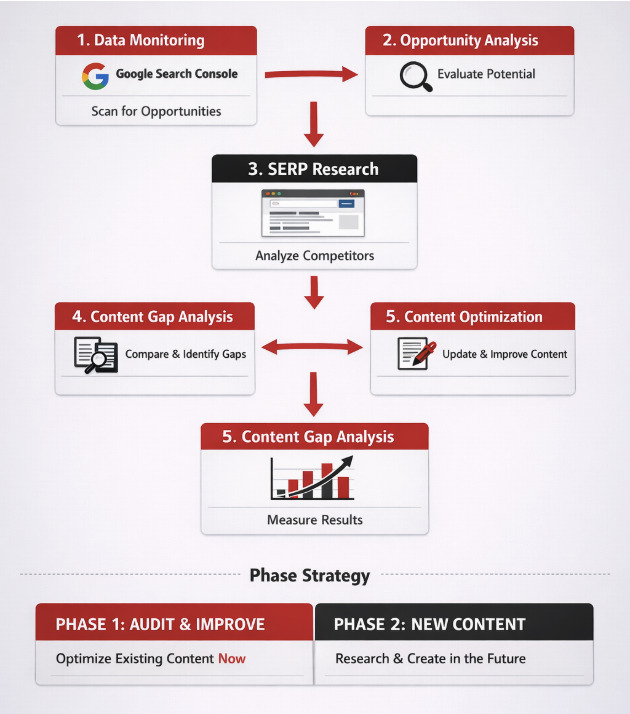
Here’s what we’re building: an AI SEO agent on n8n that alerts us whenever there’s a real opportunity hidden inside our Google Search Console data.
Google Search Console is a free tool from Google that shows how your website performs in search, including the keywords you rank for, clicks, impressions, and average positions. Most teams check it manually, spot-checking a few metrics when someone remembers to look.
Our agent’s job is to continuously scan that data and highlight where we could realistically perform better. Not theoretical improvements. Actual ranking opportunities based on what’s already working.
Once an opportunity is identified, a second agent kicks in to:
- Analyze the top-ranking articles for that keyword using a SERP API;
- Review the Google AI summary shown in search results;
- Scrape and study the competing content;
- Compare everything against our own article to uncover concrete improvement areas.
From there, we make targeted optimizations.
Only after proving this works will we expand into phase two: creating an agent for deeper keyword research and building entirely new content around fresh opportunities.
We want to make sure we’re building something anyone can use, regardless of budget. That’s why we’re intentionally avoiding expensive SEO tools or APIs like SEMrush or Ahrefs for this test.
What we’ve built so far (and where it broke)
So far, we’ve connected our Google Search Console data, which turned out to be surprisingly simple.
Here’s how the SEO workflow currently works:
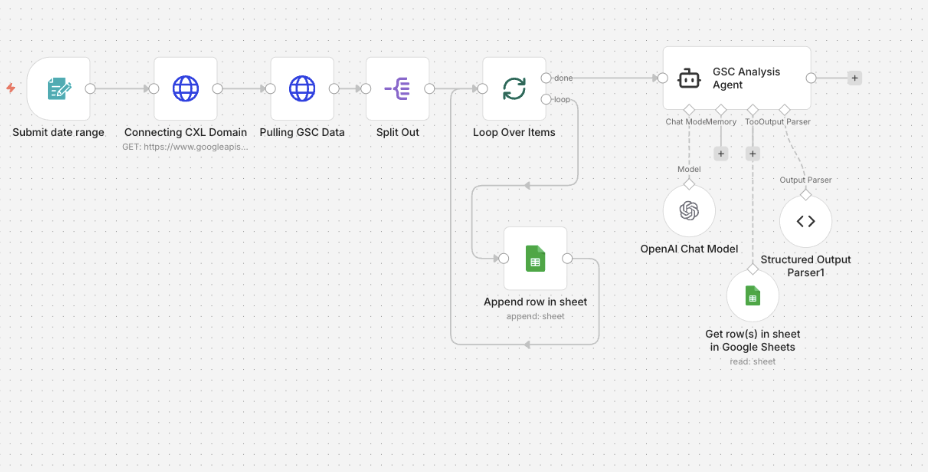
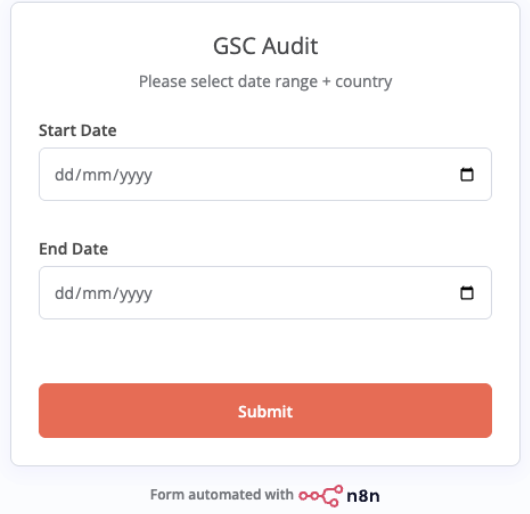
First, a form is triggered where we define the date range we want to analyze.
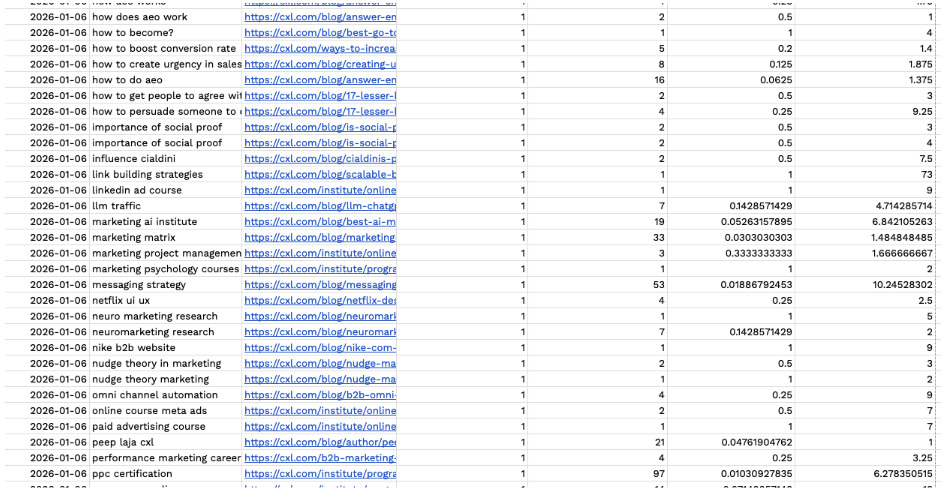
Next, the workflow connects directly to our Google Search Console account, pulls all relevant performance data, and stores each row into a structured spreadsheet table.
From there, an AI agent gets access to the spreadsheet and analyzes the full dataset to uncover SEO opportunities, highlighting what’s working, what’s underperforming, and where we can realistically improve.
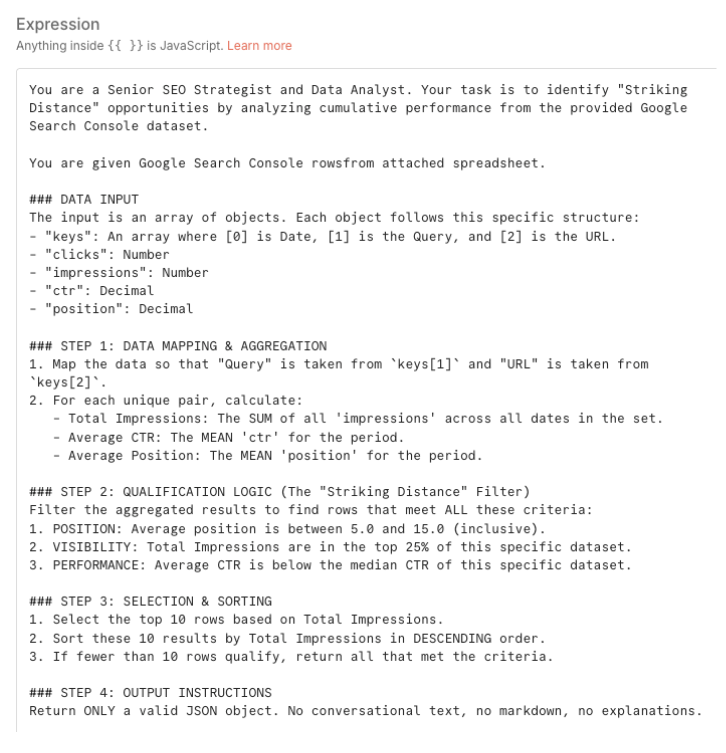
This is where we ran into our first real problem.
Up until this point, everything had worked perfectly. The connection with Google Search Console was successful. We generated a spreadsheet containing more than 2,000 rows of data, including URLs, clicks, impressions, and average positions.
But when it came time for the agent to analyze the spreadsheet, things slowed down dramatically. We waited 15 to 20 minutes, and it was still loading without producing any results.
So we tried a different approach.
We stepped outside of n8n, opened ChatGPT, uploaded the same spreadsheet, ran the exact same prompt, and received clear insights and recommendations in under a minute.
This confirmed something important: the prompt itself was strong. It successfully identified 10 key pages with real opportunities to improve rankings.
But this analysis wasn’t happening inside the n8n workflow because the processing time was simply too slow. In practice, it was much faster to export the spreadsheet and analyze it separately using ChatGPT or Gemini.
Why n8n choked (and how we fixed it)
We suspect the issue was architectural.
n8n’s AI Agent was likely struggling with the token limit or the overhead of fetching 2,000+ individual rows through the spreadsheet tool interface. ChatGPT’s Code Interpreter, by contrast, processes the file as a single batch in a sandbox, which is why it handled the same dataset in under a minute.
To keep the SEO workflow fully automated and fast enough to be practical, we reduced the analysis window from one month to one week.
This change:
- Lowered the dataset from roughly 2,000 rows to around 500 rows;
- Kept the insights recent and actionable;
- Allowed the agent to complete the analysis without choking on data volume.
And it actually worked.
The agent now processes the data, identifies opportunities, and returns results in a reasonable timeframe.
→ Read our guide on AI-powered lead research
Next up: Building the comparison agent
Now that we have an agent capable of identifying the top 10 pages with the highest potential for improvement, the next step is building a second agent.
This new agent will search Google for the top-ranking articles for each target keyword, compare them with our own content, and highlight what’s missing along with concrete improvement suggestions.
We’re building this step as you read this, and in episode two, we’ll share how it went—the good, the bad, and everything in between.
Why we’re doing this in public
Most SEO automation content follows the same pattern: here’s the finished system, here’s how great it is, here’s why you should buy the course.
We’re doing the opposite.
We decided to build an AI SEO agent in public because the messy middle—where things break, where assumptions fail, where you have to pivot—is where the real learning happens.
If you think we’re over-focusing on one step, missing something obvious, or should expand the workflow in a different direction, tell us. This is a collaborative build: it’s as much yours as it is ours.
Next week: we’ll show you whether the comparison agent works, what we learned from building it, and what breaks next.
Subscribe to our newsletter and get this series delivered to your inbox.
Want to continue exploring SEO and workflow automation?
→ Join our Vibecoding session and learn how to build your own marketing toolstack
→ Catch our 5-day n8n webinar series and learn how to automate manual marketing tasks
→ Learn how to Build an All-bound Marketing Engine
Discover more live and on-demand B2B AI courses here.
