
AI won’t take your job. But someone who knows AI might.
That’s been the dominant narrative for the past two years. So instead of adding to the speculation, we pulled real data. We analyzed 1,000 US-based marketing job listings on LinkedIn to see what companies are actually hiring for, what they’re paying, and where AI fits in.
Turns out, the job market looks nothing like the LinkedIn influencer narratives suggest.
Some roles are drowning in applicants while paying entry-level wages. Meanwhile, others pay 60% more with half the competition.
AI shows up in 43% of listings, but not where you’d expect. And the gap between what’s labeled “Digital Marketing” versus “Growth Marketing” is worth $27,000, even when the work is nearly identical.
Here’s what the data actually shows, and what it means for your career decisions.
Table of contents
- The market share myth: Popular roles aren’t necessarily lucrative roles
- Specialization is the only defensible position
- AI adoption isn’t uniform: It’s clustered by function and level
- How to build AI skills that differentiate
- Your resume is being screened by AI: Use AI to beat it
- What to do Monday morning
The market share myth: Popular roles aren’t necessarily lucrative roles
Social Media Marketing represents 24.8% of all job listings. It’s the single largest category in our dataset. It’s also one of the worst bets for your career.
Average salary: $81,790
Average applicants per posting: 110
Compare that to Growth and Performance roles, which make up just 10.5% of listings but pay $132,469 on average with only 104 applicants competing. Or CRO roles at 20.7% market share, $128,390 average salary, and 98 applicants per job.
The math is brutal: high-volume roles attract high competition and pay less.
The scarcity isn’t in the number of openings. It’s in the skills that command premium compensation.
Here’s the breakdown across major marketing sub-domains:
| Marketing Sub-Domain | Market Share (%) | Avg. Yearly Salary* | Avg. Applicants |
| Social Media Marketing | 24.8% | $81,790 | 110 |
| CRO (Conversion Optimization) | 20.7% | $128,390 | 98 |
| General Digital Marketing | 11.9% | $83,652 | 125 |
| Growth & Performance | 10.5% | $132,469 | 104 |
| SEO & Content Marketing | 6.7% | $90,583 | 89 |
*Market share represents the % of total job listings in each marketing sub-domain. Salaries reflect averages from listings with disclosed pay, and competition is measured by average applicant counts.
General Digital Marketing has the worst combination: middle-of-the-road pay at $83,652 with the highest competition at 125 applicants per opening. These are the roles that sound accessible but create the most brutal selection pressure.
When we cross-referenced this with the 2025 Exit Five B2B Marketing Salary Report, a few patterns emerged.
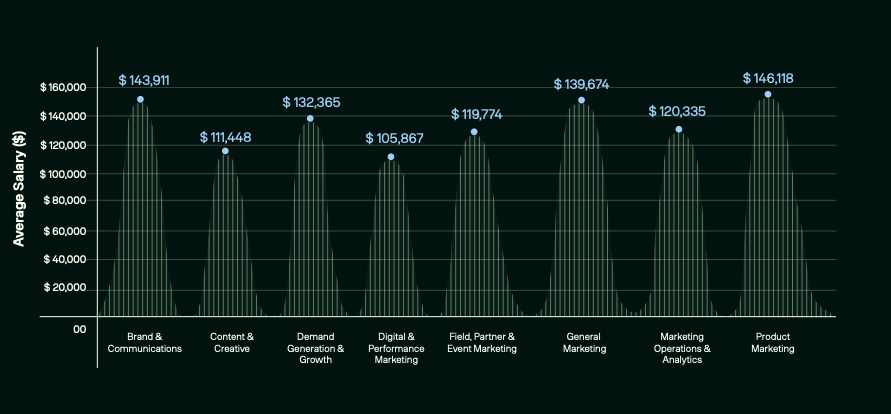
Exit Five found Product Marketing pays the highest at $146,000. Our data confirms this, but also reveals these jobs are significantly rarer than Social Media or General Marketing openings. It’s a strong career path with fewer doors.
Exit Five shows “Digital & Performance” roles averaging $105K while “Growth” roles average $132K. In our dataset, companies are hiring far more Growth titles.
The skills overlap significantly. The responsibilities overlap even more.
The difference, however, is Growth is framed as revenue ownership while Digital is positioned as channel execution. Compensation follows that perception.
The title you chase matters as much as the work you do.
What this means for you
The hiring market isn’t just showing us which roles are in demand; it’s showing us how competitive marketing has become. Yes, some roles attract more applicants than others. Yes, some roles pay more than others.
But the outcome is always the same: no matter which sub-domain you’re in, you have to stand out.
Specialization is the only defensible position
The hiring market isn’t just competitive—it’s split. High-volume roles like Social Media and General Marketing attract floods of applicants because the barrier to entry appears low. Everyone thinks they can do social media. Most can’t do it well, but that doesn’t stop 110 people from applying to each opening.
More specialized roles like CRO, Growth, and Performance attract fewer applicants because fewer people have built demonstrable skills in experimentation, analytics, and data-driven decision-making.
Standing out in high-volume roles means building a portfolio that proves velocity and quality.
You need to show you can move fast, adapt to platform changes, and use AI tools to amplify output without sacrificing standards.
You need to show real results—pipeline contribution, conversion lift, and revenue impact tied to specific experiments you ran.
The market is competitive everywhere. But some positions reward depth while others reward volume, and the compensation gap between those two approaches is $50,000 per year.
So while this data gives us useful direction, the best way to stay ahead is to keep learning, keep testing, and keep upskilling.
AI adoption isn’t uniform: It’s clustered by function and level
42.9% of all job listings mention AI, machine learning, or generative AI tools. But the distribution is wildly uneven.
| Marketing Sub-Domain | AI Mentioned in Job Role |
| Marketing Analytics & Ops | 83.9% |
| Growth & Performance | 62.5% |
| Product Marketing | 60.0% |
| SEO & Content Marketing | 59.1% |
| General Digital Marketing | 36.4% |
| CRO (Conversion Optimization) | 34.1% |
| Social Media Marketing | 16.7% |
*This table shows how often AI-related keywords (like ChatGPT, Automation, or Machine Learning) appear in all job descriptions.
Marketing Analytics & Ops roles mention AI in 83.9% of listings. Social Media Marketing mentions it in 16.7%. That’s a 5x difference.
More interesting: AI is mentioned in 60% of executive-level roles but only 29% of entry-level positions.
Companies aren’t looking for juniors who can prompt ChatGPT. They’re looking for leaders who can build AI strategies, integrate tools into workflows, and make decisions about where automation creates leverage versus where it introduces risk.
The most-mentioned AI capability isn’t ChatGPT, despite all the hype. It’s automation—referenced in 11.3% of all jobs, nearly 4x more frequently than any specific tool. SEO and Content roles show the highest “Generative AI” focus at 28.8%, which makes sense given the direct application to content production.
Here’s what the data doesn’t show: whether companies actually know what they want when they ask for “AI skills.”
Many listings include AI as a buzzword without defining the use case. That creates opportunity for practitioners who can demonstrate specific, repeatable applications rather than just tool familiarity.
How to build AI skills that differentiate
Nearly half of marketing jobs now mention AI. That means AI literacy is becoming a baseline expectation, rather than a differentiator.
The advantage goes to marketers who can map AI to real use cases inside their domain and turn those use cases into repeatable workflows.
Connect AI to the work you already do
- If you’re in content or SEO: Experiment with generative AI for drafts, outlines, content optimization, and keyword gap analysis. The value isn’t in having AI write your content; it’s in using AI to accelerate research, structure arguments, and identify optimization opportunities you’d miss manually.
- If you’re in growth or performance: Test AI for ad variation generation, audience research, and automated reporting. The bottleneck in performance marketing is testing velocity. AI can help you run more experiments faster without proportionally increasing headcount.
- If you’re in CRM or lifecycle: Explore AI for segmentation, personalization at scale, and message testing. The challenge isn’t sending emails; it’s sending the right email to the right segment at the right time. AI can help you build dynamic segmentation logic that adapts to behavior rather than relying on static lists.
Connect these tools into workflows
The data shows automation is mentioned far more often than specific AI tools. Companies value marketers who can make systems run, rather than just use standalone apps.
Turn one working use case into a repeatable process and document it
That documentation becomes your proof of competency. When a hiring manager asks, “How do you use AI in your work?” you don’t say, “I use ChatGPT.” You say, “I built a workflow that reduced content production time by 40% while maintaining quality standards. Here’s the process.”
That’s the difference between using AI and building AI into your operational advantage.
Your resume is being screened by AI: Use AI to beat it
44 job listings in our dataset explicitly disclose that AI may screen and process applications. These systems review resumes for relevant keywords, rank candidate skills, and analyze answers to screening questions.
The real number is almost certainly higher. Companies aren’t required to disclose AI screening, and many don’t.
If companies use AI to screen candidates, why not use AI to prepare for that screening.
Upload your resume and the target job description to ChatGPT, Claude, or Gemini.
Ask it to:
- Check whether your resume contains the key skills and keywords from the job post.
- Suggest missing terms or phrasing.
- Highlight where your experience could be made more specific or measurable.
This ensures your resume is “AI-friendly” before it enters an automated filter. Not by gaming the system with keyword stuffing, but by making sure your actual experience is framed in language that matches what the role requires.
Next, prepare for screening interviews the same way.
Ask AI:
- What questions are likely for this role.
- How strong your answers are.
- How to improve clarity, structure, or impact.
Here are two prompts you can use immediately:
Prompt #1: Resume optimization
| Here is a job description:[paste job description] Here is my resume [attached]. Act as an AI resume screening system.Tell me:– Which important keywords or skills from the job description are missing in my resume– Which parts of my resume should be clearer or more specific– How likely my resume is to pass an automated screening Give practical suggestions only. |
Prompt #2: Interview preparation
| You are an AI screening recruiter for this role.Based on this job description, list:– The 8 most likely screening questions– What a strong answer should include for each question Job description: [paste] |
Use AI as your rehearsal partner. The irony is genius: the same technology that’s screening you can help you get through the filter.
What to do Monday morning
- Audit your title against market positioning. If you’re in a “Digital Marketing” role but doing growth work, i.e. running experiments, optimizing funnels, driving pipeline, push for a title change. It’s not vanity. It’s worth $27,000 in average salary and positions you for roles with less competition. Titles signal value to hiring algorithms and compensation bands.
- Build one documented AI workflow in your domain. Pick the most repetitive, high-volume task in your role. Map out how AI can accelerate it without sacrificing quality. Document the before/after metrics. Time saved, output increased, quality maintained. This becomes your portfolio proof when AI skills come up in interviews.
- Reframe your experience in terms of specialization, not breadth. If you’re competing for high-volume roles, your resume needs to show you can move fast and deliver quality at scale. If you’re targeting specialized roles, your resume needs to show systems thinking and measurable impact on revenue. Generic “marketing experience” statements get filtered out in both cases.
- Use AI to optimize your resume for every application. Don’t send the same resume to every job. Use the prompts above to tailor your resume to each role’s specific requirements. The key is to emphasize the parts of your experience that match what they’re screening for.
- Start testing for roles one level above where you are now. If you’re in Social Media, test for Growth roles. If you’re in General Digital Marketing, test for CRO or Performance roles. The worst outcome is you learn what skills you need to build. The best outcome is that you leapfrog the competition stuck in saturated categories.
The effort: a few hours per week documenting your work and refining your positioning.
The payoff: access to roles with better pay, less competition, and clearer paths to advancement.
The market rewards systems, not tools
AI is rewriting how marketing roles are defined, compensated, and screened. But the underlying pattern is the same as it’s always been: specialists earn more than generalists, and practitioners who build systems earn more than those who execute tactics.
The trap is thinking AI skills are about knowing which tools to use. They’re not. They’re about knowing how to integrate those tools into workflows that create leverage—more output, better quality, faster velocity, measurable impact.
The data shows where the market is heading. Growth and specialized performance roles are pulling away in compensation. AI literacy is becoming baseline. Automation matters more than individual tool proficiency. And the gap between tactical execution and systems thinking is widening.
You can chase the high-volume roles and fight through 110 applicants for $82,000. Or you can build the skills that put you in the 10.5% of listings with half the competition and 60% more pay.
The market isn’t going to wait for you to decide. This is the time to do it.
Want to deepen your skills in AI for B2B marketing?
→ Explore our B2B Marketing and AI and Growth Marketing Minidegree programs for practical frameworks
→ Read our guide on building AI workflows for smarter ICP targeting
→ Book your seat at one of our live AI-focused courses or watch them on-demand and upskill at your own pace
