AI marketing courses age quickly. A program built around prompt templates and AI-assisted copy can still look current on its landing page while teaching a way of working that marketing teams have already moved beyond.
In 2026, useful AI training goes further. Marketers need to know how to redesign workflows, build and manage agents, work with data, automate execution, measure performance, and decide where human judgment still matters.
Your funnel can stall while the team stays busy. Marketers still lose hours to manual research, campaign production, reporting, audience analysis, content adaptation, and moving information between tools. Giving everyone access to ChatGPT does not fix those processes. It often just makes individual tasks faster.
The investment is already there. Gartner’s CMO Spend Survey found that CMOs now allocate an average of 15.3% of marketing budgets to AI. Yet only 30% report mature or fully developed AI readiness, while 70% admit their internal marketing processes are not mature enough to implement and scale AI effectively.
CXL’s own 2026 AI maturity benchmark found a similar gap at the practitioner level: 57% of marketers are still AI-assisted, 34% are AI-integrated, and only 9% have reached AI-native capability.
That is the gap a good AI marketing course should close.
We reviewed the current programs from CXL, Harvard, HubSpot, IBM, DMI, Section, Semrush, AI Academy, and other established training providers.
TL;DR
- Best overall for B2B marketers: CXL Marketing Engineer
- Best for senior marketing leaders: Harvard AI Marketing Course
- Best free course for beginners: HubSpot Academy AI for Marketing
- Best short workshop: Section AI for Marketers
- Best for continuous AI education: AI Academy by SmarterX
- Best for AI search and GEO/AEO: CXL Optimize Pages for AI Search with GEO/AEO
- Best professional AI marketing certification: Digital Marketing Institute AI for Marketing
- Best structured beginner specialization: IBM Generative AI for Digital Marketing
- Best free practical cross-channel course: Semrush Become an AI-Powered Marketer
- Best one-day live training: DMA AI for Marketing
Table of contents
- Top AI marketing courses
- 1. CXL Marketing Engineer
- 2. Harvard AI Marketing Course: Transforming Strategies with Generative AI
- 3. HubSpot Academy: AI for Marketing Course
- 4. Section: AI for Marketers
- 5. AI Academy by SmarterX: AI Mastery Membership
- 6. CXL: Optimize Pages for AI Search with GEO/AEO
- 7. Digital Marketing Institute: AI for Marketing – Agentic AI and Orchestration
- 8. IBM: Generative AI for Digital Marketing Specialization on Coursera
- 9. Semrush Academy: Become an AI-Powered Marketer
- 10. DMA: AI for Marketing Course
- How we chose these AI marketing courses
- FAQs about AI marketing courses
- Our AI marketing course recommendation
- What to do after an AI marketing course
Top AI marketing courses
There is no single course that makes sense for every marketer. An experienced marketer looking to build AI-powered workflows needs something different from someone learning how to use AI in marketing for the first time. (If you are choosing software rather than training, see the best AI marketing tools.)
The courses below are ranked on curriculum quality, how current the material is in 2026, instructor and provider credibility, practical application, and whether the skills transfer beyond one AI tool.
AI marketing courses compared
| Course | Best for | Format | Price |
| CXL Marketing Engineer | B2B marketers building AI systems that run their marketing | 8-week live cohort | Included in the annual plan ($1,599 a year) |
| Harvard AI Marketing Course | Senior marketing leaders | 2-day instructor-led program | $3,200 |
| HubSpot Academy AI for Marketing | Beginners | Self-paced | Free |
| Section AI for Marketers | Fast practical introduction | 2-hour workshop/on-demand | $195 list price |
| AI Academy by SmarterX | Continuous AI education | 12-month live + on-demand membership | $999/year |
| CXL Optimize Pages for AI Search with GEO/AEO | SEO, content, and growth marketers | On-demand | $299 |
| DMI AI for Marketing – Agentic AI and Orchestration | Practicing marketers seeking certification | 13.5-hour self-paced program | $3,090 list price |
| IBM Generative AI for Digital Marketing | Beginners wanting structured depth | 4-course specialization | Enroll free; paid access varies |
| Semrush Become an AI-Powered Marketer | Free practical AI training | Self-paced | Free |
| DMA AI for Marketing | Marketers wanting live professional training | 1-day live virtual | £349 member / £549 non-member |
Prices checked August 2026 and may change. Promotional pricing and membership options can reduce some course prices.
1. CXL Marketing Engineer
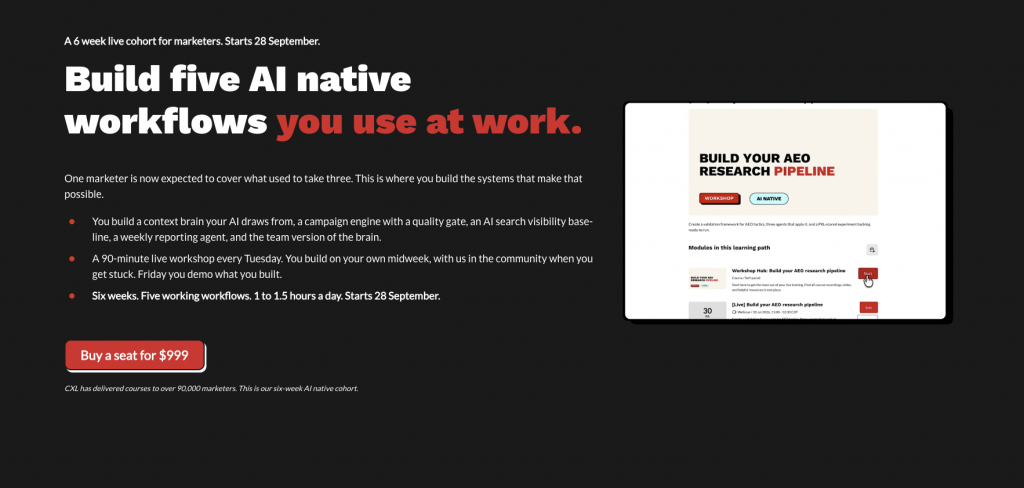
Best for: B2B marketers who already use AI and want to build production-ready workflows that run on their own data.
Course details
- Provider: CXL
- Instructors: Diane Wiredu, Ann Smarty, Tyler Durman, Nick Christensen and the CXL team
- Price: included in the CXL annual plan ($1,599 a year)
- Format: 8-week live cohort. Setup on 11 January, then live sessions on Tuesdays at 3 PM UTC, 19 January to 9 March
- Includes: live sessions, recordings, a year in the community, and certification on what you build
- Before you join: you run campaigns and read your own performance data, and have a paid LLM account. No coding needed; every build starts from a template.
What you’ll learn
- Build a context repo that gives AI your ICP, positioning, voice and proof, and score your manual work to pick the system worth building
- Connect your CRM and tools with n8n and APIs, without waiting on engineering
- Score AI output with schema checks, rubrics and evals before it ships
- Put your system to work in one track: campaigns, content or AI visibility, with an approval step and cost caps
- Ship a small app with Claude Code, a measurement dashboard and a weekly report agent
- Personalize pages, ad variants and outreach for 50+ target accounts from one template
- Get certified on a working system: your repo, a 14-day run log, evals, dashboard and app, defended in the community
Why we picked it
Most AI marketing courses teach techniques and leave the build for later. Marketing Engineer is built around finishing it: eight live weeks that take one system from a context repo to a certified build, running on your own CRM and GA4. Each week adds a layer the next one reads from, and certification is assessed on the working system, not a quiz.
Pros and cons
| Pros | Cons |
| You leave with a working system on your own data, not notes | Fixed cohort dates, not self-paced |
| Live sessions with named practitioners, plus recordings | Weekly live session and build time for eight weeks |
| Certification is assessed on what you built | Assumes you already run campaigns and read your own data |
2. Harvard AI Marketing Course: Transforming Strategies with Generative AI
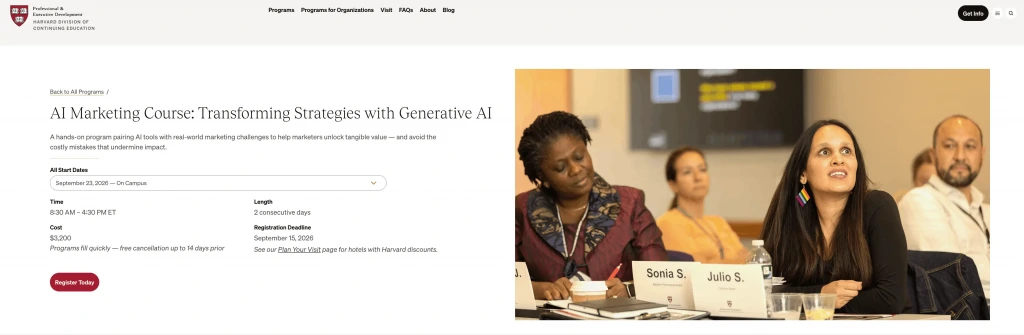
Best for: Marketing directors, VPs, agency leaders, and other senior marketers responsible for deciding where and how AI should be deployed across an organization.
Course details
- Provider: Harvard Division of Continuing Education, Professional & Executive Development
- Instructors: Christina Inge and Jake Cook
- Price: $3,200 for 2026 sessions
- Format: Instructor-led intensive
- Duration: 2 consecutive days
- Level: Intermediate to advanced
- Best for: Marketing leaders and senior cross-functional decision-makers
What you’ll learn
- Identify where generative, predictive, and agentic AI can create the most marketing value.
- Apply AI to segmentation, targeting, personalization, and campaign optimization.
- Use predictive analytics to improve marketing decisions.
- Adapt content and search strategies for GEO and AI-mediated discovery.
- Decide how AI changes team structures, workflows, measurement, and cross-functional collaboration.
Why we picked it
Harvard’s program is one of the stronger options for marketers who are responsible for AI strategy rather than day-to-day tool usage.
The 2026 curriculum explicitly addresses agentic AI, predictive analytics, AI-driven segmentation, campaign optimization, content automation, and AI-mediated search. It also deals with the harder organizational problems around deploying AI across marketing, analytics, product, IT, finance, and legal.
It is considerably more expensive than most courses in this list, but it is aimed at a different audience. This is leadership training for people deciding how AI changes the marketing function, not a ChatGPT workshop.
Pros and cons
| Pros | Cons |
| Current 2026 curriculum covering agentic AI and AI-mediated discovery | $3,200 price excludes many individual marketers |
| Strong focus on deployment and organizational decision-making | Two days limits the amount of implementation possible |
| Credible instructors and Harvard executive education environment | Overkill if you mainly want hands-on tool training |
3. HubSpot Academy: AI for Marketing Course
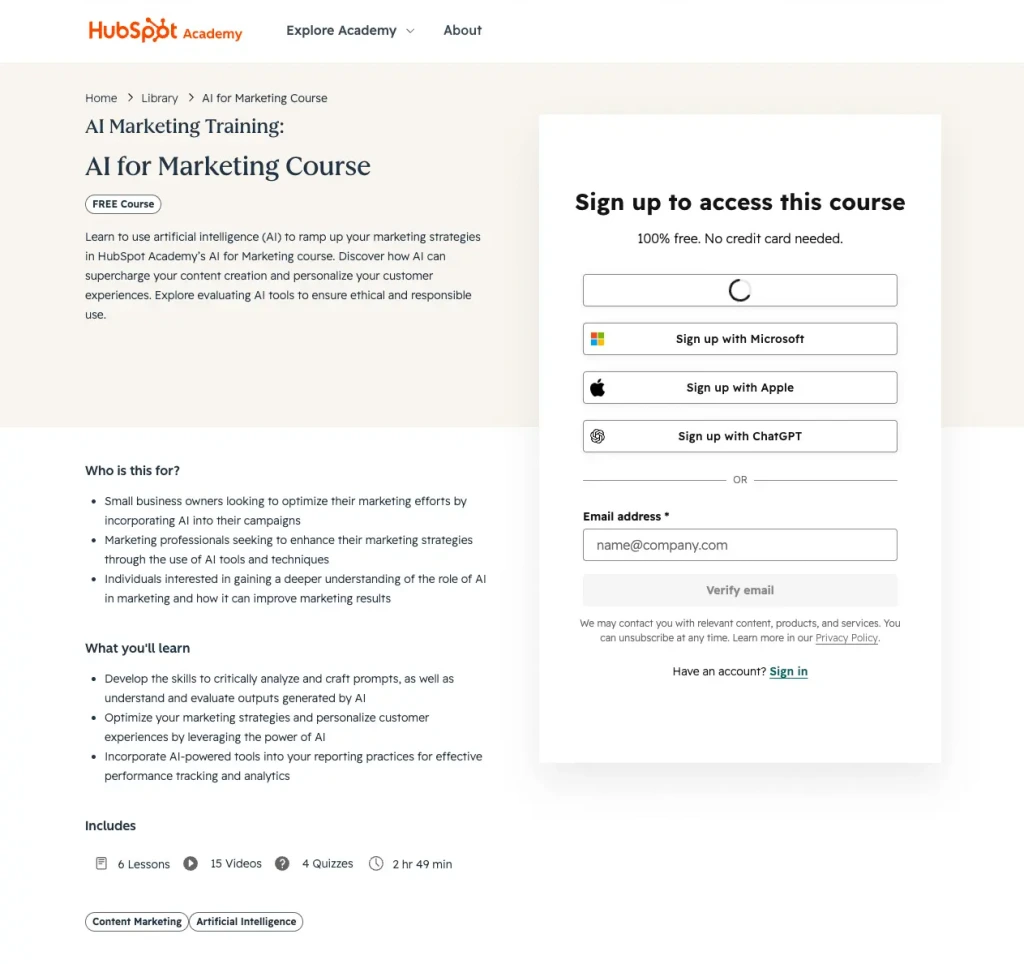
Best for: Marketers who want a credible, free introduction before investing in more advanced AI training.
Course details
- Provider: HubSpot Academy
- Instructors: Crystal King, Meghan Keaney Anderson, Kipp Bodnar, and other contributors
- Price: Free
- Format: Self-paced
- Duration: 2 hours 49 minutes across 6 lessons, 15 videos, and 4 quizzes
- Level: Beginner
- Best for: Individual marketers, small business owners, and teams starting with AI
What you’ll learn
- Write and evaluate prompts rather than accepting AI output at face value.
- Use AI for content creation and marketing campaigns.
- Personalize customer experiences with AI.
- Apply AI to reporting, analytics, and performance tracking.
- Evaluate responsible use, privacy, bias, and other ethical considerations.
Why we picked it
For a free course under three hours, HubSpot covers a useful amount of ground.
The curriculum moves beyond copy generation into campaign strategy, analytics, customer insights, personalization, predictive use cases, and responsible AI. The current course contains six lessons, 15 videos, and four quizzes and is open without a paid HubSpot subscription.
It will not teach you how to redesign an entire marketing operation, but that is not what a free introductory course should be expected to do.
Pros and cons
| Pros | Cons |
| Completely free | Limited depth for experienced AI users |
| Covers prompting, campaigns, analytics, personalization, and ethics | Some examples naturally lean toward the HubSpot ecosystem |
| Under three hours and easy to complete | No live implementation or direct instructor feedback |
4. Section: AI for Marketers
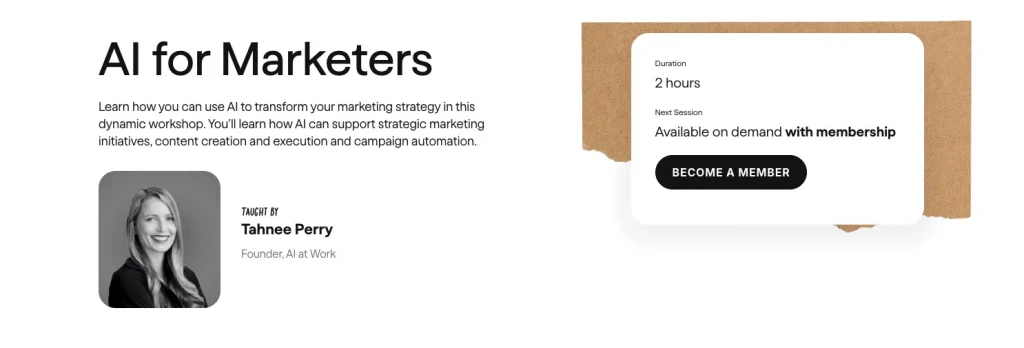
Best for: Busy marketers who want a focused workshop covering how AI fits into strategy, execution, and campaign automation without committing to a multi-week program.
Course details
- Provider: Section
- Instructor: Tahnee Perry, Founder of AI at Work
- Price: $195 list price; also included with Premium Membership
- Format: Workshop with on-demand access available through membership
- Duration: 2 hours
- Level: Beginner to intermediate
- Best for: Individual contributors through marketing leaders who need a concise overview
What you’ll learn
- Use AI to support strategic marketing decisions.
- Improve content creation and execution with AI.
- Apply AI across campaign workflows.
- Identify opportunities for campaign automation.
- Understand where AI can improve marketing productivity without removing human oversight.
Why we picked it
Section earns its place because it stays narrow.
Instead of stretching an introductory curriculum across several weeks, the course packages the major marketing use cases into a two-hour workshop. The current version is taught by Tahnee Perry, not Tim Sharp as stated in the previous version of this article. Section currently lists the standard price at $195, with on-demand access also available through membership.
Choose it when time matters more than depth.
Pros and cons
| Pros | Cons |
| Only two hours | Too short for deep implementation |
| Connects AI strategy with execution and automation | $195 is relatively expensive per hour |
| Useful for marketers who need a fast structured overview | Experienced AI practitioners may already know much of the material |
5. AI Academy by SmarterX: AI Mastery Membership
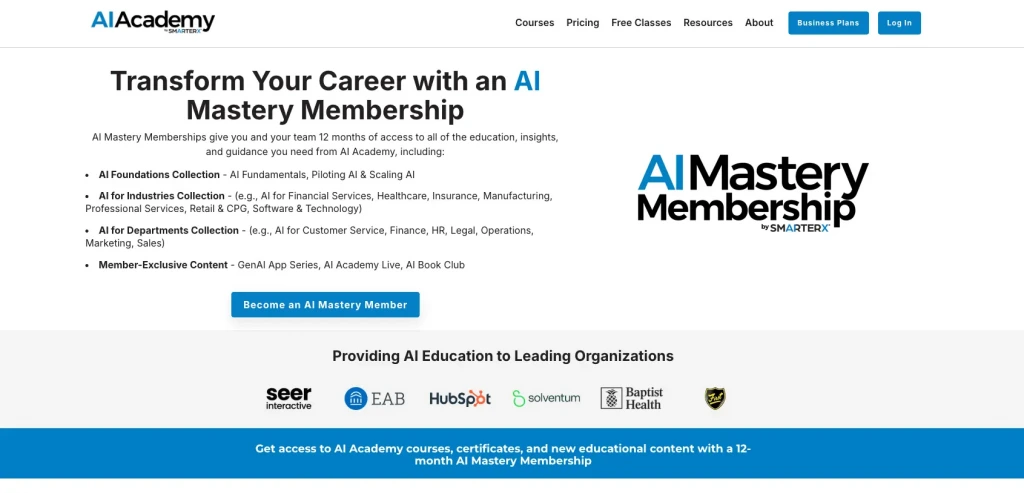
Best for: Marketing managers and leaders who want ongoing AI education instead of buying a course that could be outdated six months later.
Course details
- Provider: AI Academy by SmarterX
- Experts: Paul Roetzer, Mike Kaput, and other AI Academy contributors
- Price: $999 per year
- Format: Live and on-demand membership
- Duration: 12 months
- Level: Beginner through leadership
- Best for: Marketers who want continuous education across AI rather than one specialist skill
What you’ll learn
- AI fundamentals and the terminology marketers need to understand.
- How to identify, pilot, and prioritize useful AI initiatives.
- How to move successful AI pilots toward broader adoption.
- Current generative AI applications and changes in major AI platforms.
- How AI applies specifically to marketing and other business functions.
Why we picked it
Strictly speaking, this is now closer to a learning membership than a single AI marketing course. That is also why it is more useful than the old description in this article suggested.
AI Academy’s current $999 annual AI Mastery Membership includes AI Fundamentals, Piloting AI, Scaling AI, AI-for-department content including marketing, generative AI application training, live sessions, quarterly briefings, and AMAs. Individual course series are also offered separately for $499.
The old “AI Academy for Marketers” positioning has evolved as the education business expanded into the dedicated AI Academy by SmarterX. This entry should reflect the current product rather than preserving the previous branding.
Pros and cons
| Pros | Cons |
| Ongoing updates reduce the risk of training becoming stale | Membership model is excessive if you need one specific skill |
| Strong track record in marketing-focused AI education | Broader than marketing alone |
| Mix of foundational courses, briefings, live sessions, and applied series | Less implementation pressure than a build-focused cohort |
6. CXL: Optimize Pages for AI Search with GEO/AEO
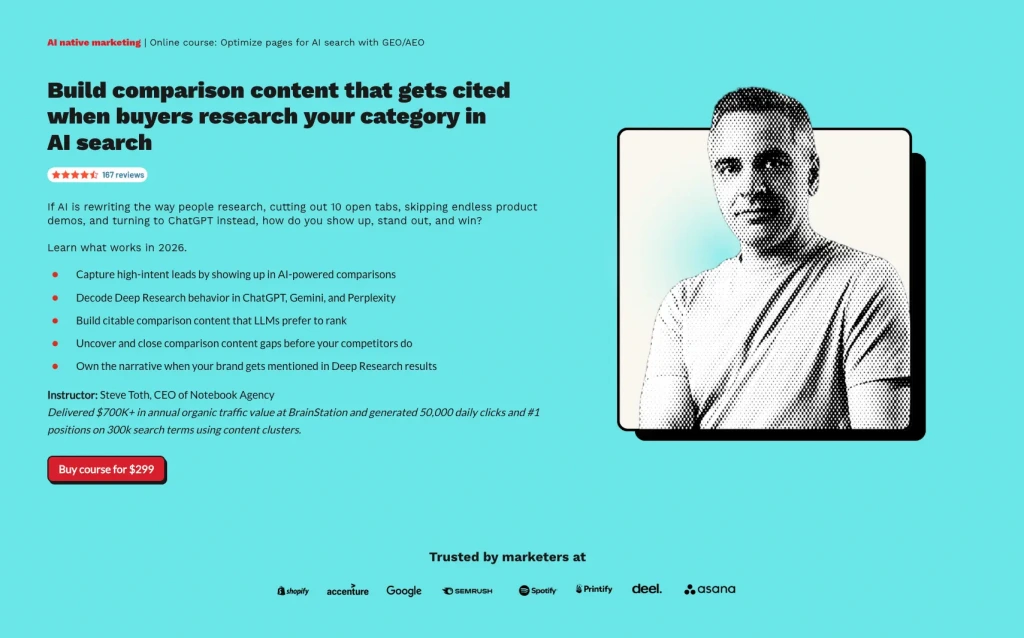
Best for: SEO, content, and growth marketers who already understand traditional search and now need to improve how their brands appear in ChatGPT, Gemini, Perplexity, AI Overviews, and other AI-driven research journeys.
Course details
- Provider: CXL
- Instructor: Steve Toth, CEO of Notebook Agency
- Price: $299 on-demand, or available through CXL’s broader AI training
- Format: On-demand, self-paced
- Duration: Approximately 2 hours
- Level: Intermediate to advanced
- Best for: SEOs, content strategists, and growth marketers
What you’ll learn
- Assess how your brand currently appears across AI search systems.
- Understand Deep Research behavior in ChatGPT, Gemini, and Perplexity.
- Find comparison-content gaps where competitors already dominate.
- Structure comparison and alternative pages for AI synthesis and citation.
- Measure AI influence and improve the information AI systems have available about your brand.
Why we picked it
This is the specialist course in the list.
It does not try to teach every AI marketing use case. Instead, Steve Toth focuses on how buyers research products through AI and how marketers can create content that survives that change in discovery behavior.
The current curriculum covers AI-search measurement, brand presence, comparison content, AI refinements, content structure, and methods for giving AI systems clearer information about a company.
That has become more relevant in 2026 as AI search moves out of the experimental category and into normal marketing work.
Pros and cons
| Pros | Cons |
| Dedicated GEO/AEO curriculum rather than generic AI SEO coverage | Too specialized if search is not part of your role |
| Practical frameworks, prompts, and comparison-content workflows | Assumes you already understand SEO and content strategy |
| Strong fit for B2B buying journeys and AI-assisted research | Self-paced format provides less direct feedback than live training |
7. Digital Marketing Institute: AI for Marketing – Agentic AI and Orchestration
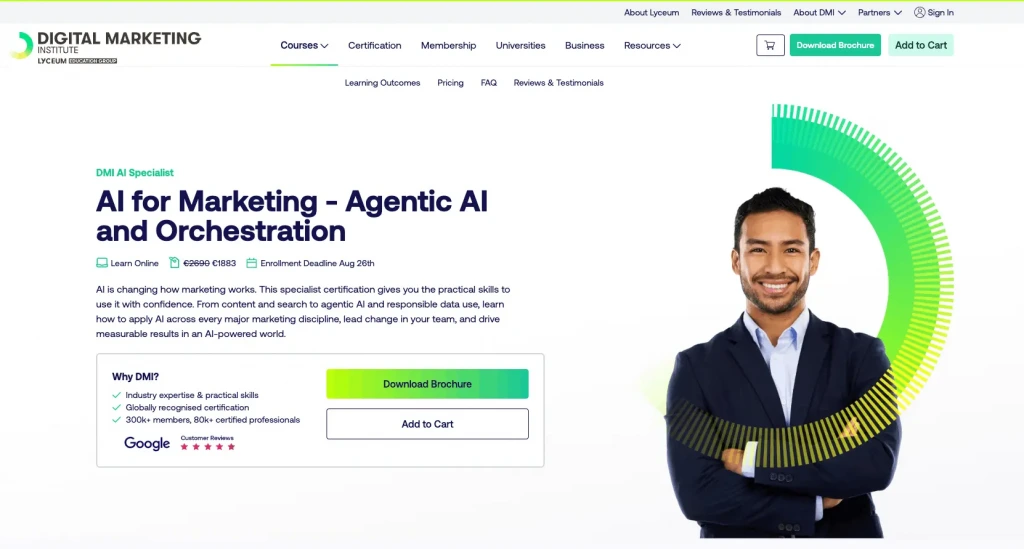
Best for: Practicing marketers who want a substantial, recognized AI marketing qualification covering both current execution and organizational AI adoption.
Course details
- Provider: Digital Marketing Institute
- Price: $3,090 list price; currently advertised at $2,163
- Format: Self-paced online
- Duration: 13.5 hours
- Level: Intermediate
- Best for: Marketing executives, specialists, managers, and directors
- Certification: DMI AI Specialist professional certification
What you’ll learn
- Apply AI across content, search, social media, paid marketing, CRM, and analytics.
- Understand agent architecture including context, memory, grounding, tools, and data.
- Brief, deploy, evaluate, and manage marketing agents.
- Apply GEO and AEO alongside more established SEO practices.
- Build AI governance, change-management, and human-AI collaboration processes.
- Work with predictive analytics, marketing data, privacy, and responsible AI.
Why we picked it
The previous version of this article recommended DMI’s five-hour AI for Business & Marketing course. That course still exists, but DMI now has a materially stronger option.
Its new AI for Marketing – Agentic AI and Orchestration program runs for 13.5 hours and explicitly covers AI agents, GEO/AEO, data, governance, change management, content, search, paid media, and social.
If you’re choosing DMI in 2026, this is the course that belongs in a best-of list.
Pros and cons
| Pros | Cons |
| Broad and unusually current curriculum | One of the most expensive self-paced options |
| Covers agentic AI, GEO/AEO, governance, data, and marketing execution | Certification structure may matter less if your goal is purely practical |
| Established professional certification | No live build sessions |
8. IBM: Generative AI for Digital Marketing Specialization on Coursera
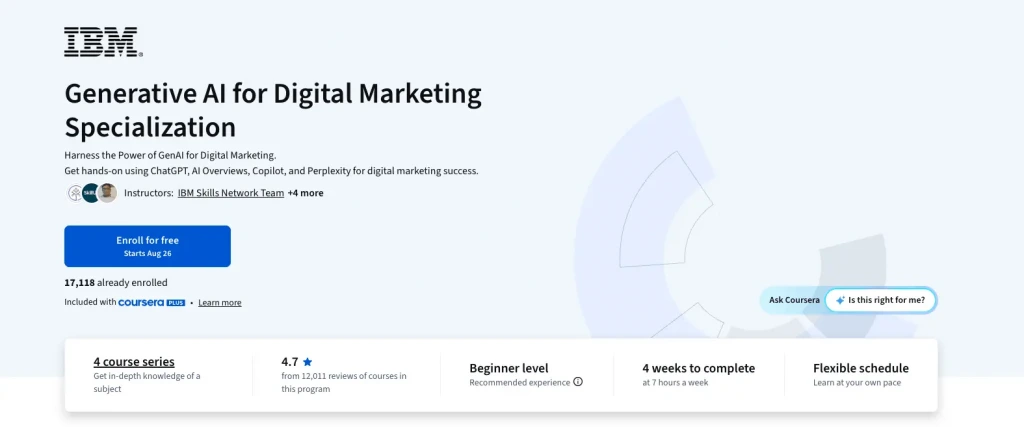
Best for: Marketers who want a structured introduction to generative AI with more depth than a short academy course.
Course details
- Provider: IBM via Coursera
- Instructors: IBM Skills Network Team and additional instructors
- Price: Enrollment is available free; paid access and certificate pricing depend on Coursera’s current plan
- Format: Self-paced
- Duration: 4-course specialization; approximately 4 weeks at 7 hours per week
- Level: Beginner
- Best for: Digital marketers, content professionals, consultants, founders, and career switchers
What you’ll learn
- Understand generative AI and prompt-engineering fundamentals.
- Use generative AI for segmentation and audience-focused campaigns.
- Apply AI to digital advertising and marketing content.
- Use AI for ecommerce personalization and email marketing.
- Optimize for newer search environments including AI Overviews, ChatGPT, Copilot, and Perplexity.
- Measure content and AI-search performance.
Why we picked it
IBM remains one of the stronger structured options for beginners, but the old article is out of date.
The current specialization is a four-course series, not three. It now includes hands-on work involving ChatGPT, Google AI Overviews, Copilot, Perplexity, GEO, AI-powered SEO, audience segmentation, advertising, personalization, and email automation.
That makes it more relevant to the 2026 marketing environment than the previous description suggested.
Pros and cons
| Pros | Cons |
| Broad four-course curriculum | Significant time commitment compared with shorter options |
| Current coverage of AI search alongside other marketing channels | Designed primarily for beginners |
| IBM career certificate and structured progression | Limited direct instructor interaction |
9. Semrush Academy: Become an AI-Powered Marketer
Best for: Marketers who want free, practical training covering several everyday AI use cases rather than another high-level introduction to what generative AI is.
Course details
- Provider: Semrush Academy
- Instructor: Michael Olaye
- Price: Free
- Format: Self-paced
- Duration: 14 short course sections
- Level: Beginner
- Best for: Marketers who want practical cross-channel AI examples
What you’ll learn
- Improve prompts for common marketing tasks.
- Use AI to support marketing strategy.
- Create and develop campaign concepts.
- Apply AI to content creation and SEO work.
- Incorporate AI tools into existing marketing processes.
- Understand practical examples of AI-driven personalization.
Why we picked it
Semrush’s course is another free option, but it occupies a different position from HubSpot.
Instructor Michael Olaye, currently EVP and Managing Director at Hero and formerly EVP of Strategy and Innovation at R/GA, brings more than 25 years of marketing, product, advertising, and technology experience. The curriculum combines prompting with strategy, campaign development, content, SEO, and workflow use cases.
It is a good option when you want to test practical AI marketing applications before committing to a longer program.
Pros and cons
| Pros | Cons |
| Free | Primarily introductory |
| Practical examples across several marketing disciplines | Some examples naturally connect to Semrush and specific tools |
| Experienced marketing instructor | Tool-specific lessons can date faster than workflow-based training |
10. DMA: AI for Marketing Course
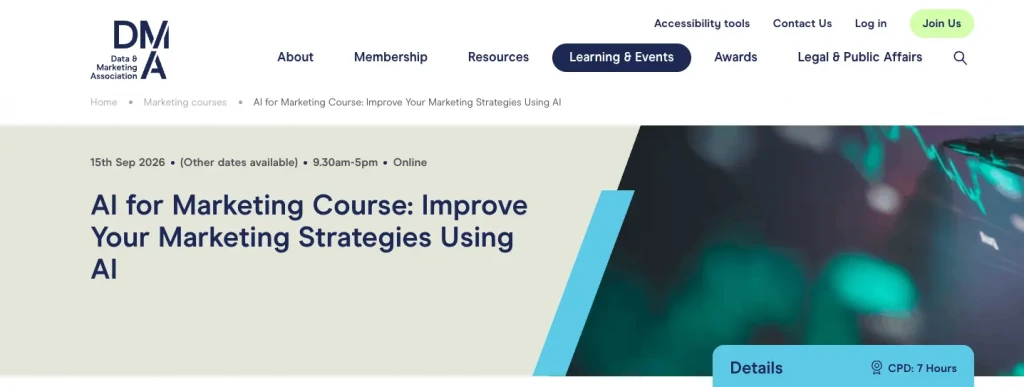
Best for: Marketers who prefer live instructor-led training and want to cover the main AI marketing applications in a single working day.
Course details
- Provider: Data & Marketing Association
- Instructors: Kerry Harrison and Nick Crawford
- Price: £349 for DMA members / £549 for non-members, excluding VAT
- Format: Live virtual
- Duration: One day, 9:30am–5pm; 7 CPD hours
- Level: Beginner to intermediate
- Best for: Working marketers who want live professional training
- Accreditation: IDM-accredited
What you’ll learn
- Understand current AI models including ChatGPT, Gemini, and Microsoft Copilot.
- Apply AI to marketing strategy, insights, A/B testing, campaign optimization, and budget decisions.
- Use AI for content research, ideation, and editing.
- Apply AI to SEO and prompting.
- Work with AI image and video tools.
- Understand responsible AI, ethics, and relevant regulation.
Why we picked it
DMA fills the live, shorter professional-training gap in this list.
The course runs as a one-day virtual masterclass and combines marketing strategy with practical exercises across content, search, campaign optimization, creative production, and responsible AI. Current 2026 sessions are taught by Kerry Harrison and Nick Crawford and carry seven CPD hours through IDM-accredited DMA Learning.
It is not deep enough to turn someone into an AI operations specialist in a day. But for marketers who learn better with an instructor and want a structured working session rather than a video library, it is a credible option.
Pros and cons
| Pros | Cons |
| Live instructor interaction | Fixed session dates |
| Broad curriculum completed in one day | Limited time for deeper workflow building |
| IDM-accredited and built for working marketers | Non-member price is high for a one-day course |
Free AI marketing courses
Three courses on this list are free, or free to start:
- HubSpot Academy: AI for Marketing. A self-paced introduction for beginners.
- Semrush Academy: Become an AI-Powered Marketer. Practical, tool-focused lessons.
- IBM: Generative AI for Digital Marketing on Coursera. Free to enroll, with paid access for graded work and the certificate.
Free courses are a good way to learn the vocabulary and the main use cases. They rarely make you build something that runs on your own work, which is where most of the skill comes from.
AI marketing certifications
If you want a credential, these programs on the list award one:
- CXL Marketing Engineer. Certification is based on the AI system you build and how you defend it, not on attendance or a quiz.
- Digital Marketing Institute: AI for Marketing. A professional diploma for practicing marketers.
- IBM: Generative AI for Digital Marketing. A Coursera specialization certificate on completion of the paid track.
A certificate helps most when it proves you can do the work. Hiring managers increasingly ask to see what you built. Check each provider’s page for current pricing and requirements.
How we chose these AI marketing courses
AI course pages are easy to make look current. Adding “agents” or a new model name to a landing page does not mean the underlying curriculum has kept pace.
We evaluated courses against five criteria.
1. Is the curriculum current in 2026?
Courses had to reflect how marketers are actually using AI now. Prompting and content generation can be part of the curriculum, but not the whole curriculum.
Current marketers also need exposure to areas such as workflow redesign, agents, automation, data, AI search, measurement, governance, and quality control.
2. Can you apply the skills at work?
We prioritized programs with exercises, workflows, projects, frameworks, or concrete implementation methods over courses built mainly around lectures and terminology.
3. Does the instructor or provider have relevant credibility?
A recognizable logo is not enough. We looked for established education providers and instructors with meaningful marketing, AI, business, search, or operational experience.
4. Does the course have a clear job to do?
Broad is not automatically better.
CXL’s GEO/AEO course makes the list because it is deliberately narrow. Harvard makes it because it addresses senior-level AI deployment. HubSpot makes it because it provides a credible free starting point.
A course should either cover AI marketing well or solve one important part of it particularly well.
5. Does the course move marketers beyond personal AI productivity?
This is becoming the dividing line.
CXL’s research found that 42% of marketers most want to learn how to build agents, while 65% still rate themselves as beginners or below in AI systems. The same research found that 43% say lack of time is stopping them from properly learning and experimenting with AI.
That makes course design important. Marketers do not need another 40-hour collection of disconnected AI tool tutorials. They need training that helps them apply AI to real marketing processes.
FAQs about AI marketing courses
What should an AI marketing course teach in 2026?
A good AI marketing course should cover research, content, campaign execution, analytics, automation, AI agents, workflow design, measurement, and human oversight. Advanced courses should go beyond prompting and teach marketers how to build repeatable AI-powered systems.
What is the best AI marketing course for beginners?
HubSpot Academy’s AI for Marketing course is one of the best free options for beginners, covering prompting, content, campaigns, personalization, analytics, and responsible AI. Semrush Academy is another strong free option with practical marketing examples.
What is the best AI marketing course for experienced B2B marketers?
CXL’s Marketing Engineer cohort is the strongest option for experienced B2B marketers who want to build AI systems that run on their own data rather than learn techniques.
Are free AI marketing courses worth taking?
Yes. Free courses from providers such as HubSpot and Semrush are useful for learning AI marketing fundamentals, but paid programs generally offer more advanced implementation, feedback, and workflow development.
Is an AI marketing certificate worth it?
An AI marketing certificate can be valuable when employers or career progression require formal credentials. For experienced marketers, demonstrable skills in building AI workflows, agents, analytics systems, or AI-search strategies are usually more valuable than the certificate alone.
Do marketers need to learn coding to use AI effectively?
Marketers do not need to become software engineers, but basic knowledge of APIs, automation, structured data, GitHub, and code can significantly expand what they can build with AI. CXL’s analysis of roughly 1,750 marketing job descriptions in 2026 found employers increasingly asking for specific AI tools and automation capabilities.
How quickly do AI marketing courses become outdated?
Tool-specific AI marketing lessons can become outdated within months as models and platforms change. Courses focused on transferable skills such as workflow design, experimentation, data, measurement, governance, and evaluation tend to remain useful for longer.
What are the best AI courses for marketers?
For beginners, HubSpot Academy’s AI for Marketing and Semrush’s Become an AI-Powered Marketer are free and cover the basics. For experienced B2B marketers who want to build working AI systems, CXL’s Marketing Engineer cohort is our top pick. Senior leaders who want strategy rather than hands-on building may prefer Harvard’s AI Marketing Course.
Can I learn AI marketing in 3 months?
You can learn enough to be useful. Most marketers can learn the tools and core use cases in a few weeks and build their first working workflows within two to three months, especially in a course that has you build on your own work. Staying current takes longer, because the tools change every few months.
Our AI marketing course recommendation
If you’re an experienced B2B marketer choosing one program from this list, CXL Marketing Engineer is our top overall recommendation.
The reason is not that it covers the most AI tools. It doesn’t need to.
It focuses on the harder transition most marketing teams have not completed yet: moving from AI-assisted tasks to integrated workflows and then to systems that other people can run.
CXL’s own benchmark puts only 9% of marketers at the AI-native stage, while 90% remain AI-assisted in marketing operations.
Your choice should still match the problem you need to solve.
Choose Harvard if your responsibility is senior-level AI strategy and organizational deployment. Choose HubSpot or Semrush if you’re starting from the fundamentals. Choose CXL’s GEO/AEO course if AI search is the immediate priority. Choose DMI if you want a substantial professional certification. Choose DMA or Section when you want shorter instructor-led training.
What to do after an AI marketing course
Finishing the course is not the outcome.
Pick one marketing process that is expensive, slow, inconsistent, or dependent on too many manual handoffs. Establish how it performs today. Then rebuild it using what you learned.
Measure something concrete: production time, research time, campaign launch speed, error rate, output capacity, conversion performance, analyst hours required, or the number of manual steps removed.
Then do it again.
The marketers pulling ahead are not the ones with the longest list of AI certificates. They are the ones turning what they learn into systems, workflows, and better marketing performance.
Click the icons to ask AI to match the best course to your career goals
Describe your career goals and let AI personalize the courses shown here.


Related Posts
-

Most "best marketing courses" lists are written for beginners. They rank the same free certificates,…
-
Content marketing education is often saturated with surface-level advice and theoretical frameworks that rarely produce…
-
Testing tools are getting more sophisticated. Blogs are brimming with "inspiring" case studies. Experimentation is…
-

Thinking about emailing influencers to ask them for backlinks or tweets? Most people are terrible…