Social media marketing is about more than posting consistently or running ads. Content, community, creators, paid distribution, and measurement all need to work together.
That’s becoming harder as channels change and teams are expected to deliver more with less. CXL’s research into B2B marketing challenges shows how those pressures are affecting marketing teams.
These 12 courses cover the social media skills that marketers need in 2026, from strategy and content creation to paid advertising, analytics, and AI-assisted workflows.
TL;DR
- Best free social media marketing certification: HubSpot Social Media Marketing Certification
- Best for beginners learning organic and paid social: Meta Social Media Marketing Professional Certificate
- Best for social content creation: Adobe Social Media Content & Strategy
- Best for Meta advertising: CXL Meta Ads
- Best for B2B LinkedIn advertising: CXL Validate and Scale LinkedIn Ads
- Best free organic social course: Semrush Social Media Marketing Crash Course
- Best for LinkedIn Thought Leader Ads: CXL LinkedIn Thought Leader Ads
- Best short course for AI social strategy: DMI Social Media Strategy with AI
Table of contents
- Best social media marketing courses
- 1. HubSpot Social Media Marketing Certification — HubSpot
- 2. Meta Social Media Marketing Professional Certificate — Meta
- 3. Adobe Social Media Content & Strategy — Adobe (Coursera)
- 4. Social Media Marketing Certificate — Noble Desktop
- 5. Meta Ads — CXL
- 6. Validate & Scale LinkedIn Ads — CXL
- 7. Social Media Marketing Crash Course — Semrush Academy
- 8. Specialist Diploma in Social Media Marketing — DMI
- 9. AI-Powered Content Creation for Social Media Success — UC Davis (Coursera)
- 10. LinkedIn Thought Leader Ads — CXL
- 11. Social Media Strategy with AI — Digital Marketing Institute
- 12. Social Media Marketing Specialization — Northwestern University
- How do you choose the right social media marketing course?
- Our recommendation for B2B Marketers
Social media marketing courses compared
| Course | Best for | Level | Format | Price |
|---|---|---|---|---|
| HubSpot Social Media Marketing Certification | Beginners building broad social marketing skills | Beginner–intermediate | Self-paced certification | Free |
| Meta Social Media Marketing Professional Certificate | Beginners learning organic and paid social | Beginner | Six-course specialization | Coursera subscription; access options vary |
| Adobe Social Media Content & Strategy | Marketers creating platform-ready social content | Beginner | Self-paced course | Coursera subscription; access options vary |
| Noble Desktop Social Media Marketing Certificate | Marketers wanting live, project-based training | Beginner–intermediate | Live online or NYC | $2,495 |
| CXL Meta Ads | Marketers improving Facebook and Instagram advertising | Intermediate | On-demand | Standalone or CXL All-Access |
| CXL Validate and Scale LinkedIn Ads | B2B marketers improving LinkedIn campaign performance | Intermediate | On-demand | Standalone or CXL All-Access |
| Semrush Social Media Marketing Crash Course | Marketers learning organic strategy and analytics | Beginner | Self-paced certification | Free |
| DMI Specialist Diploma in Social Media Marketing | Marketers wanting a comprehensive professional qualification | Beginner–intermediate | Self-paced diploma | $1,500+ |
| UC Davis AI-Powered Content Creation for Social Media Success | Marketers using AI for social content and campaigns | Intermediate | Five-course specialization | Coursera subscription; access options vary |
| CXL LinkedIn Thought Leader Ads | B2B marketers amplifying executive and expert content | Intermediate | On-demand | $299 |
| DMI Social Media Strategy with AI | Marketers adding AI to social strategy and execution | Intermediate | Self-paced short course | $560+ |
| Northwestern Social Media Marketing Specialization | Marketers wanting university-backed strategic training | Beginner | Six-course specialization | Coursera subscription; access options vary |
Prices checked September 2026 and may change.
Best social media marketing courses
1. HubSpot Social Media Marketing Certification — HubSpot

Best for: Marketers who want a free, structured foundation in social media strategy, content, community, advertising, and measurement.
Course details
- Provider: HubSpot Academy
- Price: Free
- Format: Self-paced certification
- Duration: 5 hours 18 minutes
- Content: 10 lessons, 38 videos, and 29 quizzes
- Level: Beginner to intermediate
- Certification: Yes
What you’ll learn
- Build a social media strategy around business goals.
- Use social listening and monitoring to understand your audience.
- Create content that supports reach and engagement.
- Build relationships and manage social communities.
- Understand social advertising and measure ROI.
- Apply governance, crisis-management, and employee-advocacy principles.
Why we picked it
HubSpot is one of the strongest free starting points because it covers social media as a complete marketing function rather than a collection of platform tutorials.
The curriculum connects strategy, content, community, paid promotion, and measurement. It is particularly useful for marketers who need to understand how these pieces fit together before specializing in one platform or discipline.
Pros and cons
| Pros | Cons |
|---|---|
| Free with certification | Experienced social marketers may find parts foundational |
| Covers organic, paid, community, and measurement | Strong inbound-marketing perspective |
| Structured lessons and assessments | Less depth on advanced platform-specific tactics |
2. Meta Social Media Marketing Professional Certificate — Meta

Best for: Beginners who want to learn social media marketing from strategy and content creation through to paid campaigns and analytics.
Course details
- Provider: Meta via Coursera
- Instructors: Anke Audenaert and Daniel Kob
- Price: Coursera subscription; free-trial and eligible access options vary
- Format: Six-course professional certificate
- Duration: Approximately five months at 10 hours per week
- Level: Beginner
- Certification: Meta Professional Certificate
What you’ll learn
- Establish a social media presence and develop a strategy.
- Create content for different audiences and platforms.
- Build and manage advertising campaigns.
- Use analytics to evaluate campaign performance.
- Apply AI tools to social media marketing tasks.
- Complete practical projects across the social marketing process.
Why we picked it
Meta’s certificate is a broader option than its individual advertising courses. It begins with social media fundamentals and organic presence before moving into advertising and analytics.
That makes it useful for someone entering the field who needs both sides of social media marketing, rather than only learning how to use Ads Manager.
Pros and cons
| Pros | Cons |
|---|---|
| Covers organic and paid social | Significant time commitment |
| Meta-backed curriculum with practical projects | Strong emphasis on Meta’s ecosystem |
| Suitable for complete beginners | Full certificate access is not automatically free |
3. Adobe Social Media Content & Strategy — Adobe (Coursera)

Best for: Marketers who want to improve social content creation, campaign planning, and the use of AI creative tools.
Course details
- Provider: Adobe via Coursera
- Price: Coursera subscription; access options vary
- Format: Self-paced course
- Duration: Approximately two weeks at 10 hours per week
- Content: Four modules
- Level: Beginner
- Certification: Shareable Coursera certificate
What you’ll learn
- Plan social content around audience and campaign goals.
- Create platform-ready visuals and messaging.
- Use Adobe Express and Firefly in content workflows.
- Build content calendars and scheduling processes.
- Measure results and refine content.
- Consider brand consistency, copyright, and responsible AI use.
Why we picked it
Adobe is the strongest creative-production option in this list. It focuses on turning a social strategy into actual content, rather than spending most of the course on channel theory.
It is particularly useful for marketers who create their own assets and need a more repeatable process for producing, adapting, and evaluating social content across platforms.
Pros and cons
| Pros | Cons |
|---|---|
| Practical content-creation focus | Not a complete social media marketing qualification |
| Includes AI creative tools | Naturally centered on Adobe’s tools |
| Covers planning through measurement | Limited depth on paid advertising |
4. Social Media Marketing Certificate — Noble Desktop

Best for: Marketers who want live instruction, hands-on projects, and a substantial social media marketing qualification.
Course details
- Provider: Noble Desktop
- Price: $2,495
- Format: Live online or in-person in New York City
- Duration: 72 hours
- Level: Beginner to intermediate
- Certification: Certificate of completion
- Includes: Project work, mentoring, and a capstone
What you’ll learn
- Develop social strategies for different platforms.
- Create and manage organic content.
- Plan and optimize paid social campaigns.
- Use analytics to evaluate performance.
- Build a portfolio of practical social media work.
- Apply campaign and content skills across a wider marketing mix.
Why we picked it
Noble Desktop offers a different learning experience from the self-paced courses on this list. The live format, projects, and mentoring make it more suitable for someone who wants structured instruction and feedback.
It also covers both organic and paid social, making it a broader professional training option rather than a certification tied to one advertising platform.
Pros and cons
| Pros | Cons |
|---|---|
| Live, project-based training | Expensive compared with self-paced alternatives |
| Broad organic and paid curriculum | Requires a substantial time commitment |
| Mentoring and portfolio work | Less flexible than fully on-demand courses |
5. Meta Ads — CXL

Best for: Marketers already running Facebook and Instagram ads who want to improve creative, targeting, profitability, and scale.
Course details
- Provider: CXL
- Instructor: Jack Paxton
- Price: Standalone or CXL All-Access
- Format: On-demand
- Duration: 5 hours 33 minutes
- Content: 26 lessons
- Level: Intermediate
- Certification: Yes
What you’ll learn
- Audit Meta campaign structure, creative, and tracking.
- Match targeting and messaging to buying intent.
- Improve hooks and ad creative.
- Calculate CAC, ROAS, and breakeven points.
- Use Meta CAPI and server-side tracking.
- Scale campaigns using a repeatable process.
- Apply AI-powered competitor research to creative strategy.
Why we picked it
Paid social is only one part of social media marketing, but it deserves a place in a broader curriculum. CXL’s Meta course goes beyond campaign setup into the economics and decision-making behind profitable advertising.
Jack Paxton connects customer research, creative, tracking, optimization, and scaling, making it a stronger option for marketers who already understand the basics and need to improve performance.
Pros and cons
| Pros | Cons |
|---|---|
| Strong commercial and performance focus | Not designed for complete beginners |
| Covers tracking, creative, and scaling | Meta-specific |
| Includes AI competitor research | Paid |
6. Validate & Scale LinkedIn Ads — CXL

Best for: B2B marketers who want to turn LinkedIn advertising into measurable pipeline rather than expensive clicks.
Course details
- Provider: CXL
- Instructor: AJ Wilcox
- Price: Standalone or CXL All-Access
- Format: On-demand
- Duration: 4 hours 10 minutes
- Content: 29 lessons
- Level: Intermediate
- Certification: Yes
What you’ll learn
- Decide whether LinkedIn is commercially viable.
- Build segmented campaign structures and audiences.
- Create multi-stage retargeting funnels.
- Manage bidding and budgets.
- Use UTMs, CAPI, and the Insight Tag.
- Optimize and scale campaigns while controlling costs.
Why we picked it
LinkedIn has different audiences, costs, and funnel economics from Meta. This course is built around those differences rather than applying a generic paid-social playbook.
AJ Wilcox covers channel validation, targeting, campaign architecture, tracking, optimization, and scale. It is especially relevant for B2B teams where social advertising needs to contribute to pipeline.
Pros and cons
| Pros | Cons |
|---|---|
| Deep LinkedIn-specific training | Paid |
| Strong B2B and pipeline focus | Too specialized if LinkedIn is not a core channel |
| Covers targeting through scale | Assumes some paid-media knowledge |
7. Social Media Marketing Crash Course — Semrush Academy
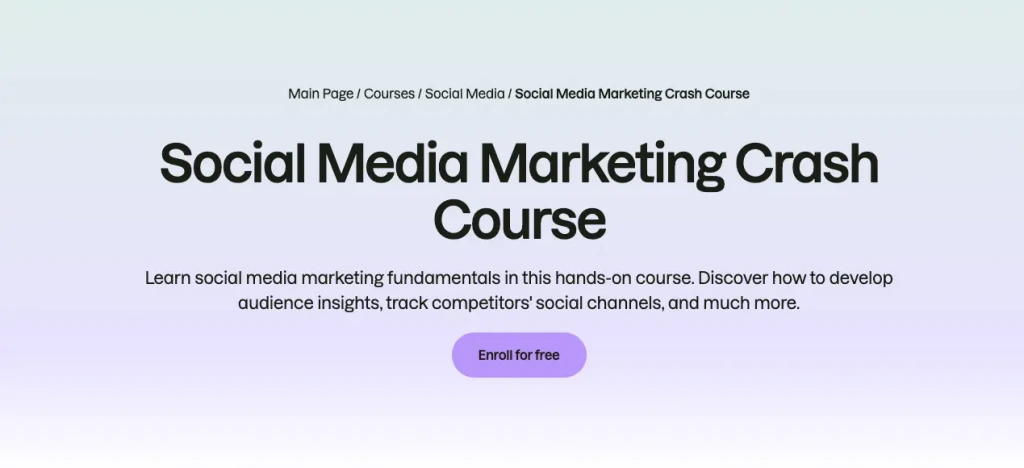
Best for: Marketers who want a free introduction to organic social media strategy, audience research, influencers, and analytics.
Course details
- Provider: Semrush Academy
- Instructor: Janet Machuka
- Price: Free
- Format: Self-paced
- Duration: Approximately one hour
- Content: Seven lessons
- Level: Beginner
- Certification: Yes
What you’ll learn
- Understand how social media algorithms affect content.
- Research audiences and benchmark competitors.
- Build an organic social media strategy.
- Use social publishing tools to organize content.
- Understand influencer selection and campaign basics.
- Measure social performance using relevant metrics.
Why we picked it
This is a useful counterbalance to the paid-social courses. It focuses on the organic work that determines whether a brand has something worth saying and an audience worth reaching.
Janet Machuka covers strategy, algorithms, audience insight, competitor research, influencers, and analytics in a short course. It is a practical starting point for marketers who want to strengthen their social fundamentals without paying for a larger program.
Pros and cons
| Pros | Cons |
|---|---|
| Free with certification | Short and introductory |
| Strong organic-social focus | Limited depth on paid campaigns |
| Covers research, strategy, and measurement | Some examples use Semrush tools |
8. Specialist Diploma in Social Media Marketing — DMI

Best for: Marketers who want a comprehensive professional qualification covering social strategy, content, platforms, paid promotion, and measurement.
Course details
- Provider: Digital Marketing Institute
- Price: $1500+
- Format: Self-paced professional diploma
- Duration: 27 hours of content; typically 8–10 weeks
- Access: Up to 24 weeks
- Level: Beginner to intermediate
- Certification: Professional diploma
What you’ll learn
- Build a social media strategy around business objectives.
- Research audiences and select appropriate platforms.
- Create and manage social content.
- Use paid social advertising and campaign optimization.
- Apply AI tools to research and content workflows.
- Measure and report social media performance.
Why we picked it
DMI is one of the more comprehensive options for marketers who want formal training across the whole social media function.
The curriculum combines strategy, content, platforms, paid promotion, analytics, and AI rather than treating social media as either an organic publishing channel or an advertising channel alone. It is a stronger fit for marketers looking for a broad professional qualification.
Pros and cons
| Pros | Cons |
|---|---|
| Comprehensive social media curriculum | More expensive than free certifications |
| Covers organic, paid, and AI | Longer commitment |
| Professional diploma | Less specialized than platform-specific courses |
9. AI-Powered Content Creation for Social Media Success — UC Davis (Coursera)

Best for: Marketers who want to use AI to plan, create, and improve social content without losing brand control.
Course details
- Provider: University of California, Davis via Coursera
- Instructor: Andrew Brooks
- Price: Coursera subscription; access options vary
- Format: Five-course specialization
- Duration: Approximately four weeks at 10 hours per week
- Level: Intermediate
- Last updated: June 2026
- Certification: Shareable certificate
What you’ll learn
- Build AI-assisted campaign briefs, personas, and KPIs.
- Create and refine posts, visuals, and short videos.
- Maintain brand voice, accuracy, and disclosure standards.
- Plan micro-influencer campaigns.
- Analyze LinkedIn performance and sentiment.
- Turn performance insights into optimization decisions.
Why we picked it
This is one of the more relevant newer options because it applies AI to actual social media workflows rather than teaching generic prompting.
The specialization follows campaign planning, content creation, influencer activity, and analytics. It also includes quality and ethical checks, which matter when teams are using AI to produce more content across multiple channels.
Pros and cons
| Pros | Cons |
|---|---|
| Updated in 2026 | Requires some existing social marketing knowledge |
| Practical AI-assisted social workflows | Not a full social media marketing qualification |
| Covers content, influencers, and analytics | Certificate access may require payment |
10. LinkedIn Thought Leader Ads — CXL
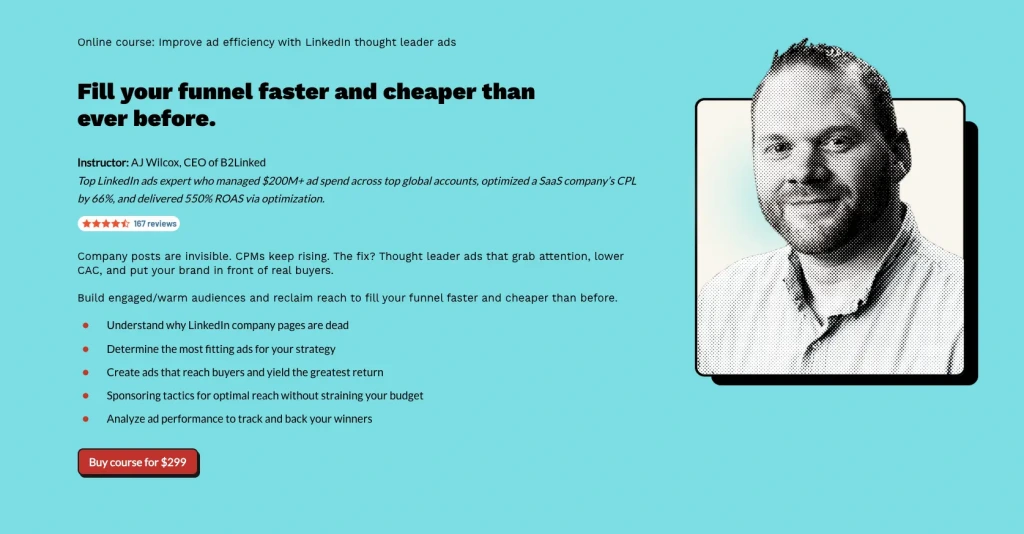
Best for: B2B marketers using executives, founders, and subject-matter experts to build reach and create warmer audiences on LinkedIn.
Course details
- Provider: CXL
- Instructor: AJ Wilcox
- Price: $299
- Format: On-demand
- Level: Intermediate
- Focus: LinkedIn Thought Leader Ads and expert-led paid distribution
What you’ll learn
- Identify employee and executive content worth sponsoring.
- Set up Thought Leader Ads with appropriate targeting and budgets.
- Build retargeting audiences from sponsored content.
- Connect expert content to wider LinkedIn funnels.
- Measure engagement and campaign performance.
- Get internal experts involved consistently.
Why we picked it
Thought Leader Ads sit at the intersection of organic social and paid distribution. They allow B2B teams to amplify content from real people rather than relying only on company-page advertising.
AJ Wilcox’s course focuses on how to select, sponsor, and measure that content. It is a useful specialist option for teams already investing in executive visibility or employee advocacy and wanting to connect those efforts to paid campaigns.
Pros and cons
| Pros | Cons |
|---|---|
| Relevant to both expert content and paid distribution | Very LinkedIn-specific |
| Strong B2B use case | Not a complete social media course |
| Current on-demand training | Requires people and content worth sponsoring |
11. Social Media Strategy with AI — Digital Marketing Institute

Best for: Marketers who already understand social media fundamentals and want to use AI more effectively in strategy, content, and analysis.
Course details
- Provider: Digital Marketing Institute
- Price: $560+
- Format: Self-paced short course
- Duration: 9 hours
- Content: 4 modules
- Access: 12 weeks
- Level: Intermediate
- Certification: Associate Certificate
What you’ll learn
- Use AI for audience and competitor research.
- Develop social media strategies with AI assistance.
- Improve content creation and repurposing.
- Build video strategies for YouTube and TikTok.
- Analyze social performance and identify improvements.
- Apply responsible AI principles to marketing work.
Why we picked it
DMI’s short course is a better fit for marketers who already know the fundamentals and want to add AI to their existing social media process.
It focuses on research, strategy, content, video, and analytics rather than presenting AI as a replacement for marketing judgment. That makes it useful as a specialist follow-on course rather than another broad beginner qualification.
Pros and cons
| Pros | Cons |
|---|---|
| Focused AI application to social media | Not a complete social media curriculum |
| Covers strategy, content, and analytics | Requires existing marketing knowledge |
| Shorter than the full DMI diploma | Current tuition needs checking |
12. Social Media Marketing Specialization — Northwestern University

Best for: Marketers who want university-backed training in social strategy, listening, engagement, content, and business measurement.
Course details
- Provider: Northwestern University via Coursera
- Instructor: Randy Hlavac
- Price: Coursera subscription; individual course auditing may be available
- Format: Six-course specialization
- Duration: Approximately four weeks at 10 hours per week, depending on pace
- Level: Beginner
- Certification: Shareable specialization certificate
What you’ll learn
- Develop a social media marketing strategy.
- Use social listening and analytics to understand audiences.
- Build engagement and nurture strategies.
- Connect content, advertising, and earned media.
- Measure social activity against business objectives.
- Apply the learning through a capstone project.
Why we picked it
Northwestern offers a more academic and strategic alternative to platform-led training. The specialization covers the wider social marketing process, from audience insight and engagement to content, advertising, and business measurement.
The curriculum is updated regularly and now includes AI-related material, but its main strength remains the broader framework for understanding how social media supports business and marketing objectives.
Pros and cons
| Pros | Cons |
|---|---|
| University-backed structured curriculum | Less platform-specific than specialist courses |
| Covers strategy, listening, content, and measurement | Some examples in older modules may feel dated |
| Includes a capstone project | Full certificate requires paid access |
Why are social media marketing skills important in 2026?
Social media teams are being asked to build awareness and prove business impact at the same time.
HubSpot’s 2026 Social Media Marketing Report, based on more than 1,100 social media professionals, found that 59% of teams cite increasing brand awareness as their top goal. But measurement remains difficult: 41% of B2B marketers say it’s hard to tie social activity directly to business outcomes.
The content challenge is just as real. Sprout Social’s 2026 research found that only 56% of social users think brands do a good job of producing truly original content.
That makes the skill set broader than publishing or advertising alone. Marketers need to understand what audiences want, create content worth engaging with, distribute it effectively, and measure what it contributes to the business.
What should a social media marketing course teach in 2026?
A good social media marketing course should teach you how to build an audience, create content that earns attention, and connect that activity to business goals.
Look for training that covers:
- Social media strategy and audience research
- Platform selection and channel-specific content
- Content creation, storytelling, and brand voice
- Community management and social listening
- Creator partnerships and employee advocacy
- Paid social advertising
- Analytics, testing, and measurement
- AI-assisted research, production, and workflows
You don’t need every skill at the same depth. But you should understand how they fit together. A strong organic strategy can make paid distribution more effective, while better research and measurement help you decide what to create next.
How did we choose the best social media marketing courses?
We prioritized courses that teach skills directly applicable to social media marketing, rather than broad digital marketing programs with only a small social media component.
Our selections were based on:
- Instructor credibility: Training from established providers, universities, platform experts, or experienced practitioners.
- Curriculum quality: Meaningful coverage of strategy, content, community, paid social, analytics, or a clearly defined specialization.
- Current relevance: Training that reflects how social media works in 2026, including platform changes and relevant AI workflows.
- Practical application: Exercises, projects, frameworks, or examples marketers can use in their own work.
- Distinct value: A mix of broad qualifications and specialist courses, rather than several versions of the same advertising curriculum.
- Value: Free and paid options judged against the depth of training, support, and certification included.
How do you choose the right social media marketing course?
Start with the skill you actually need to improve.
- Judge the value against what you need next. The most expensive course isn’t automatically the best one. Choose the training that closes a real gap in your work.
- Match the course to your goal. If you need a broad foundation, choose HubSpot, Meta, DMI, or Northwestern. If your priority is content creation, Adobe or UC Davis may be a better fit.
- Choose the right level. Beginners need strategy, audience research, content, and measurement. Experienced marketers will get more from specialist training in advertising, AI, or advanced execution.
- Look beyond platform tutorials. Interfaces change. Audience understanding, creative judgment, testing, and measurement transfer between platforms.
- Check the practical work. Look for projects, exercises, campaign examples, or frameworks you can apply to your own social channels.
- Decide whether you need a credential or a specific skill. A professional diploma may be useful for a career move, while a shorter specialist course may solve an immediate problem.
Our recommendation for B2B Marketers
If you’re serious about mastering social, don’t stop at one course, build a stack that scales with your skills.
Start with HubSpot’s Social Media Marketing Certification to ground yourself in strategy, then layer on Meta’s Professional Certificate to understand how Facebook and Instagram actually drive awareness and engagement.
Next, move into storytelling and creative execution with Adobe’s Social Media Content & Strategy and Noble Desktop’s Social Media Marketing Certificate. Both will sharpen your ability to create scroll-stopping content with purpose.
From there, graduate to performance and paid growth. The CXL Validate & Scale Meta Ads course will show you how to architect Meta campaigns that scale predictably, while Validate & Scale LinkedIn Ads gives you the complete B2B playbook for building LinkedIn campaigns that fill pipelines.
Finally, crown your stack with CXL’s LinkedIn Experimentation, an advanced course that turns data into your creative co-pilot. You’ll learn how to test, iterate, and compound wins across campaigns, building a feedback loop that fuses creativity with performance.
FAQs about social media marketing courses
What is the best social media marketing course for beginners?
HubSpot Social Media Marketing Certification is our top free starting point because it covers strategy, content, community, advertising, and measurement. Meta’s Professional Certificate is another strong option if you want a longer program covering both organic and paid social.
What is the best free social media marketing certification?
HubSpot is the strongest broad free option. Semrush’s Social Media Marketing Crash Course is a good alternative if you want a shorter course focused on organic strategy, audience research, and analytics.
Which social media marketing course is best for B2B marketers?
CXL Validate and Scale LinkedIn Ads is the strongest specialist option for B2B marketers focused on paid LinkedIn performance. For a broader social media foundation, HubSpot, DMI, or Northwestern are better starting points.
What is the best course for social media content creation?
Adobe Social Media Content & Strategy is a strong option for practical content creation and planning. UC Davis is better suited to marketers who want to use AI across content, campaigns, and analytics.
What is the best social media marketing course for AI?
UC Davis AI-Powered Content Creation for Social Media Success is the strongest specialist option for AI-assisted social content. DMI Social Media Strategy with AI is another choice for marketers who want to apply AI to research, strategy, and performance analysis.
Are social media marketing certifications worth it?
They can be, particularly when you’re entering the field or moving into a new specialization. A certification can demonstrate structured training, but employers and clients will also want evidence that you can create, manage, and improve real social media programs.
Go further: build the systems behind your marketing
Social media is one part of a wider marketing operation. The next step is connecting the research, content, campaigns, measurement, and workflows around it.
That’s where CXL’s AI Native Marketer program comes in. It combines live workshops with on-demand training, helping marketers build working AI workflows across research, production, experimentation, analytics, and operations.
If you want to go deeper into a specific area, CXL’s live workshops offer hands-on training on current marketing workflows. If you’re still building your social media fundamentals, start with one of the courses above. If you’re ready to connect those skills to the rest of your marketing operation, that’s the next step.
Click the icons to ask AI to match the best course to your career goals
Describe your career goals and let AI personalize the courses shown here.