AI native marketing | One-week sprint, day 2: Campaign engine with a quality gate
Build the campaign workflow that checks its own output before you do.
Seven channels built on CXL instructors’ rules, and a review that scores every draft against your brief before you see it.
- Write a brief with one goal, a number and a date, checked before anything is drafted
- Turn each channel into a workflow you adjust step by step
- Score every draft against your quality gate: ship, review or fix
- Stay in charge: you approve the brief and every fix, and Claude never sends
- Replaces: The generic first draft, and the reviewer who catches what AI made up.
Sprint day 2: Wednesday, 11 November 2026 | 4 PM CET / 9 AM CST / 3 PM UTC | 90 minutes
Included in a CXL annual subscription, with 3 months community access.
Trusted by marketers at


Your live instructor and campaign expert
4x’d efficiency & leads CXL’s growth, experimentation & product. Trained 25k+ marketers with 80+ courses, 4000+ blogs & playbooks.

Volume was never the bottleneck. Trust is. A campaign system you cannot trust at scale is just faster manual work.
Here is what the review caught when the last cohort ran the engine on their own campaigns:
- A $500 ask aimed at cold traffic, flagged at Gate 1 before any ad ran
- A $200 ad budget too small to ever hit the campaign’s own kill rule
- Ads promising a free trial that the landing page never mentioned
- Landing page lines the AI made up, with nothing in the source files behind them
- A target sales had never agreed to, until they signed it off in writing
Every flag comes with a fix you can use, rewrite or leave. You leave with a brief that passed Gate 1, a workflow for every channel, and drafts scored against your own quality gate.
Included in a CXL annual subscription, with 3 months community access.
📅 Day 2 of 3, 90 minutes
Wednesday 11 November 2026
4 PM CET / 9 AM CST / 3 PM UTC
Includes 3 months community access so you can keep building and get support after the session.
Came to previous workshops? This is a teardown of the updated system, not a rerun.
Before the session: install it and draft one campaign
Install the Campaign Engine plugin, then write a brief and draft one channel for a campaign of yours, or for the sample company.
- A few minutes to install, and 30 minutes at most to run on the sample data
- On your own briefs and results the output is richer, but it can take longer. More time and more connected MCPs, richer results
- Outcome: An approved brief and a first scored draft, ready to take apart live
Part 01: Write a brief the engine can act on
You wrote a brief in prep. Live, we open Gate 1. The small-c and big-C structure comes from Tyler Durman’s briefs and plans for real campaigns, and the rules come from CXL courses.
- One goal, a number, a date and a buying action, or the brief does not pass Gate 1
- Small-c or big-C, proposed from the goal
- How we built it: why nothing is drafted until the brief passes, and why missing proof stays blank
- Outcome: A brief template and 16 Gate 1 rules you can change
Part 02: Channels as workflows you adjust
We stripped CXL courses for each channel’s workflow, then stitched them together. Live, we show how a course became a step, and how to turn your own playbook into a workflow.
- Seven starter workflows: email campaign, email sequence, blog post, social, sales enablement, landing page and ad tests
- Every step names the rule it follows and the instructor it comes from
- Outcome: Your own workflow for every channel this campaign needs
Part 03: Draft every channel, and the review runs itself
Live, we take apart the review: why 26 of the 101 starter steps stay with you, and how each criterion is weighted per channel.
- Ship, review or fix for every draft, on 16 criteria from CXL instructors, weighted per channel
- Gate 2: use the fix, write your own, or leave it. You load the drafts and launch; Claude never sends
- Outcome: A full campaign draft, scored and ready to load into your tools
Part 04 (optional): Make the gate yours
Live, we show how the gate’s criteria and weights were chosen. Then you answer six questions about your channels and your last miss, and the gate changes to match.
- Weights per channel, and a row for the thing your last campaign failed on
- Add Jev or Clef as an automatic second check at both gates (paid tools, also optional)
- Outcome: A quality gate tuned to reject what you would reject
After the session: post your demo
Post a finished or attempted customization or rebuild of the system for your needs in the community.
- A piece or the full system: the more you show, the more we can review
- Demos close Friday 20 November, end of day
- Outcome: Feedback on your build and your certificate
What you need before you start
- You should be comfortable with: running campaigns and reading your own performance data. No coding needed.
- You do not need: prior Claude Code or n8n experience. Every build starts from a template.
- A paid Claude account, Claude Code preferred, plus a free Miro account. The reporting agent and AI visibility builds also use n8n.
- About 2 hours of prep in the app on the Monday before, matched to your level by the quiz. If you get stuck, we help you through it.
- Any other tool is explained live, with alternatives. You are not locked into one stack.
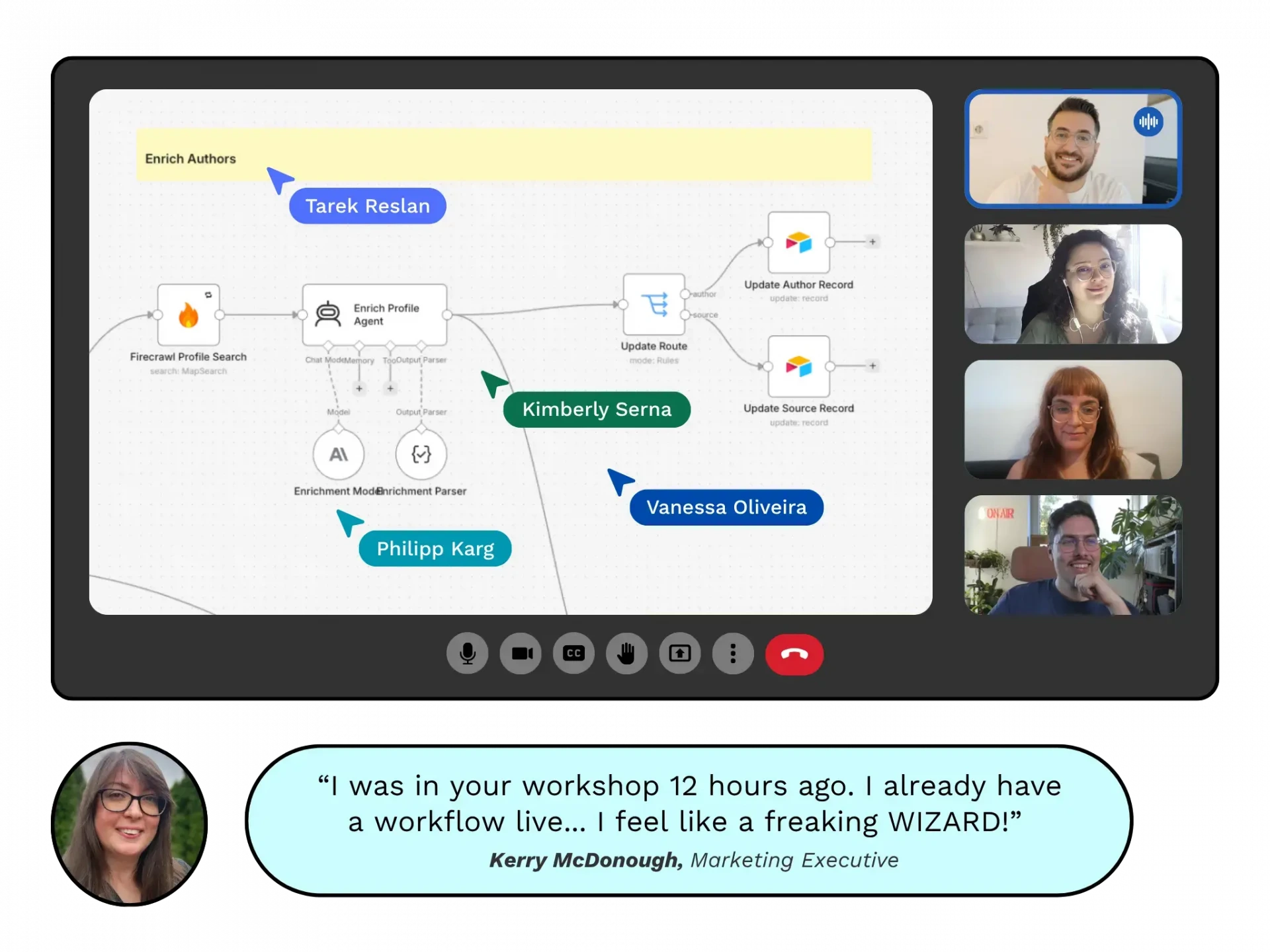
What marketers said after the Campaign engine workshop

Fractional CMO & GTM Strategist
“The best part was watching the engine catch things I tell clients all the time. My first brief put the $500 ask in front of cold traffic, and Gate 1 flagged it: don’t lead with the heavy ask.”

Founder, Mesh Creative Studios
“Biggest learning: the review forced me to stop claiming things I hadn’t proven yet.”

Co-Founder, Feral MKT
“We now have a clear path to follow, based on strong foundations set by the workflows, created at amazing speed. Without AI, this could’ve taken me a week, maybe two, to nail down.”

AI Native GTM Strategist & Product Marketer
“What I really liked about this whole exercise is the clear separation between Claude AND the user (me) to avoid AI slop by taking great measures to allow the user to do the thinking instead of AI.”

Marketing Communications Manager, TXI
“It caught two lines on the landing page that it had made up, things like ‘Slots run Monday to Friday.’ Nothing in the source files backed them up, so it flagged them to fix.”
Who has built one
A B2B eCommerce platform. Clinic management software. A creative agency. A fractional CTO service. A bookkeeping software startup. A consultancy for B2B tech leadership teams. A pension fund. An elective healthcare provider. A social club that hasn’t launched yet.
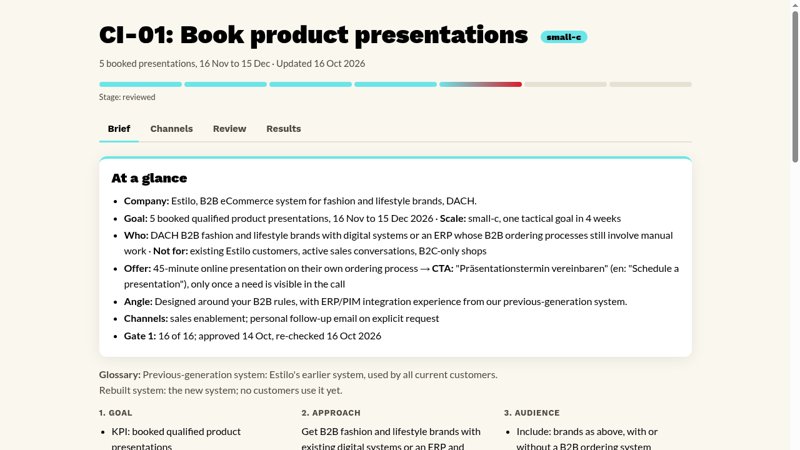
B2B eCommerce platform
Sales signed off the target in writing before the brief passed Gate 1. Five review rounds took the drafts to 87% and 96%.
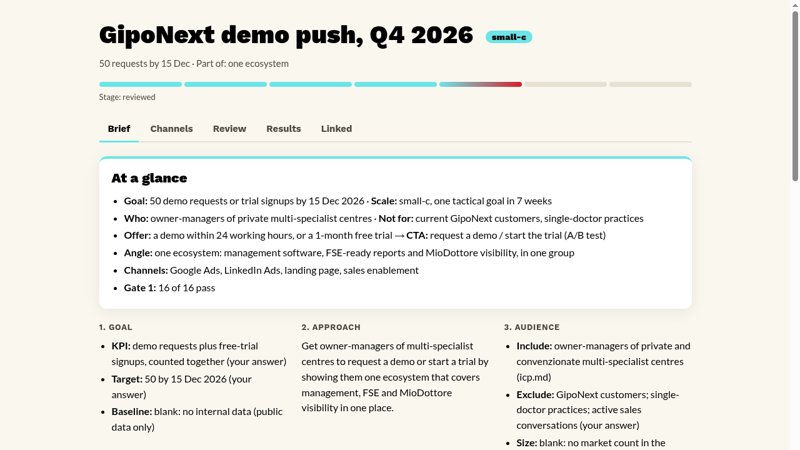
Clinic management software
A campaign to win 50 demo or trial requests in 7 weeks: five channels, all drafted and through Gate 2.
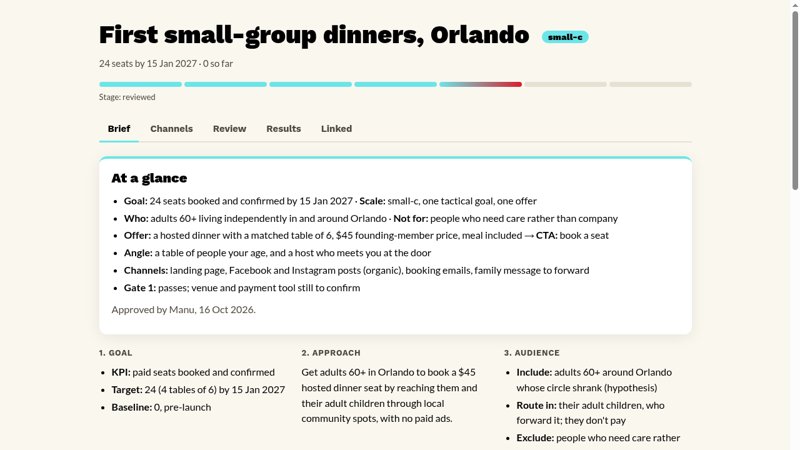
Social club for people 60+, pre-launch
A paid first dinner, to test whether older adults will pay for it themselves. All four channels reached ship after 9 fixes.
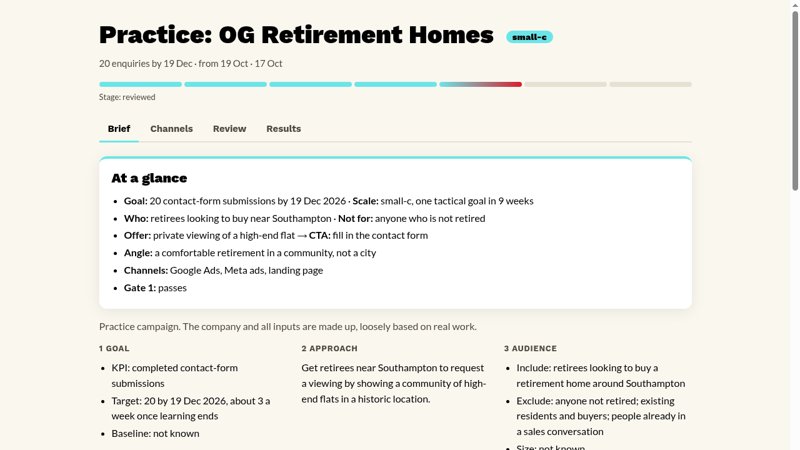
Practice campaign, retirement homes
The copy was fine. Nothing reached ship because nothing could be proven yet, and the review said so.
Build it on day 2 of the one-week sprint. The best demos are selected for expert feedback from Tyler Durman.
The next AI native cohort
One week. Three working workflows. Starts 10 November 2026.
Marketing Brain
One document every AI tool reads, so drafts start on brand.

Campaign engine
One brief in, a full campaign draft out, with sources you can check.

Reporting agent
A weekly summary of what changed and what to do next.

Build three AI native workflows you use at work, in a one-week sprint.
You build a marketing brain your AI draws from, a campaign engine that checks its own claims, and a weekly reporting agent.
Keep up with AI native marketing tactics and workflows.
Subscribe to our weekly newsletter.
We find and report on AI native marketing case studies, success stories, and playbooks that are working out there right now.
Subscribe to our weekly educational newsletter