The best go-to-market courses teach you more than how to launch a product. You need to know how to validate demand, define your audience, sharpen positioning, choose the right channels, align revenue teams, and measure what happens after launch.
That matters even more in 2026. ICONIQ’s State of GTM research, based on more than 150 B2B software GTM leaders, found that 48% now use hybrid pricing models, while high-growth companies expect self-serve to contribute about 20% of revenue versus roughly 10% for peers. Deeper AI adoption was also associated with higher conversion at parts of the funnel.
We reviewed current GTM courses and certifications to find eight options covering everything from a fast introduction to B2B GTM, account-based strategy, revenue architecture, product marketing, and AI-supported execution.
TL;DR
- Best for AI-supported GTM execution: CXL’s AI Native Marketer
- Best structured GTM certificate: Microsoft Go-To-Market Strategy Professional Certificate
- Best for testing and validating GTM: CXL’s Go-to-Market Strategy
- Best for account-based GTM: Demandbase’s Account-Based GTM Certification
- Best for GTM and revenue leaders: Winning by Design’s Revenue Architecture
- Best for B2B SaaS GTM: CXL’s B2B GTM Strategy – Get to $10m ARR
Table of contents
- Go-to-market courses compared
- Best GTM courses in 2026
- 1. AI Native Marketer (CXL)
- 2. Create a Go-to-Market Plan (LinkedIn Learning)
- 3. Microsoft Go-To-Market Strategy Professional Certificate (Microsoft – Coursera)
- 4. Go-to-Market Strategy — CXL
- 5. Account-Based GTM Certification (Demandbase)
- 6. Revenue Architecture (Winning by Design)
- 7. Go-to-Market Certified: Masters (Product Marketing Alliance)
- 8. B2B GTM Strategy – Get to $10m ARR (Madhav Bhandari – CXL)
- What should a go-to-market course teach?
- How we chose these courses
- How to choose the right go-to-market course
- Which GTM course should you choose?
- FAQs about go-to-market courses
Go-to-market courses compared
| Course | Best for | Level | Format | Price |
|---|---|---|---|---|
| AI Native Marketer — CXL | Using AI across GTM execution, reporting, and marketing systems | Mixed; preparation adapts to your AI level | Six-week live cohort | $999 |
| Create a Go-to-Market Plan — LinkedIn Learning | Learning GTM fundamentals quickly | Intermediate | On-demand | LinkedIn Learning access |
| Microsoft Go-To-Market Strategy Professional Certificate | End-to-end GTM strategy and campaign execution | Intermediate | Five-course, self-paced certificate | Coursera access; price varies |
| Go-to-Market Strategy — CXL | Testing demand and validating GTM before scaling | Intermediate | On-demand | Individual price not publicly shown |
| Account-Based GTM Certification — Demandbase | Account-based B2B GTM | Intermediate | Self-paced certification | Free for Demandbase customers; $349 otherwise |
| Revenue Architecture — Winning by Design | Connecting GTM with the wider revenue system | Advanced | Six live online sessions plus on-demand material | $1,500 |
| Go-to-Market Certified: Masters — Product Marketing Alliance | Product and feature launches | Intermediate to advanced | On-demand, live virtual, or in-person | $1,299 |
| B2B GTM Strategy – Get to $10m ARR — CXL | B2B SaaS channel and campaign execution | Intermediate to advanced | On-demand | $299 |
Prices checked in 2026 and may change. Where a provider does not publish a formal skill level, the level above reflects its stated audience and prerequisites.
Best GTM courses in 2026
1. AI Native Marketer (CXL)
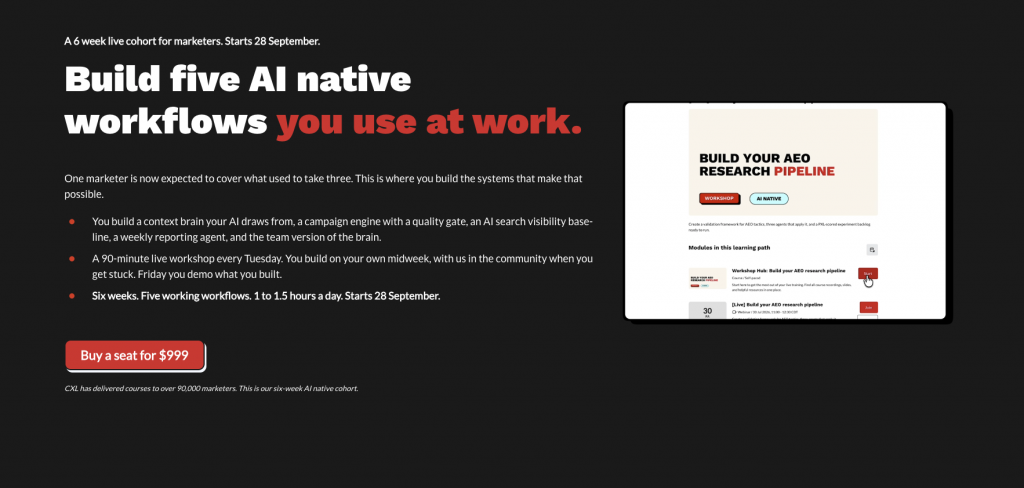
Best for: Marketers who want to use AI across GTM work, from positioning and campaign execution to AI search visibility, reporting, and team workflows.
Course details
- Provider: CXL
- Instructors: Hesh Fekry, Tarek Reslan, Diane Wiredu, Nick Christensen, Ann Smarty, and other CXL experts
- Price: $999
- Format: Six-week live cohort
- Duration: Around 1 to 1.5 hours per day, Monday to Friday, including a 90-minute live workshop
- Level: AI-assisted to AI-native; preparation is matched to your current level
- Certification: Six certificates, including CXL Certified: AI Native Marketer
What you’ll learn
- Build a marketing context system around your ICP, positioning, voice, and proof.
- Create an AI campaign engine that produces emails, social content, enablement assets, and sequences from a single brief.
- Add quality checks so AI-generated campaign work is reviewed against sources and brand standards.
- Measure AI search visibility across ChatGPT, Gemini, and Perplexity.
- Build an AI reporting agent that connects marketing data and identifies what changed and what needs attention.
- Create a shared company marketing brain that gives teams and AI tools access to the same marketing context.
Why we picked it
AI Native Marketer is broader than a traditional GTM course, but much of the program supports the work that goes into running a modern GTM strategy. You build systems for positioning, campaign production, AI visibility, performance reporting, and team execution, then run them on your own marketing data. That makes it useful for marketers who already understand the basics of GTM and want to improve how they execute it with AI.
Pros and cons
| Pros | Cons |
|---|---|
| Covers AI across positioning, campaigns, measurement, and reporting | Not a dedicated GTM course |
| You build five working workflows using your own marketing data | Requires around 5 to 7.5 hours per week for six weeks |
| Includes live workshops, community support, and six certificates | Fixed cohort dates rather than fully self-paced |
2. Create a Go-to-Market Plan (LinkedIn Learning)

Best for: Marketers who want a short introduction to building a complete GTM plan. It covers market validation, positioning, pricing, channels, launch activity, and measurement.
Course details
- Provider: LinkedIn Learning
- Instructor: Deirdre Breakenridge
- Price: Included with LinkedIn Learning; a one-month free trial is currently available
- Format: On-demand, self-paced
- Duration: 1 hour 35 minutes
- Level: Intermediate
- Certification: LinkedIn Learning Certificate of Completion
What you’ll learn
- Decide when you need a formal GTM strategy.
- Research the market and validate a product before launch.
- Build positioning and messaging for different customer segments.
- Choose pricing, promotion, and distribution models.
- Select the right channels and support channel partners.
- Set GTM KPIs and adjust your measurement after launch.
Why we picked it
LinkedIn Learning gives you a useful overview of the main parts of a GTM strategy without requiring a large time commitment. It covers more than promotion, including product strategy, pricing, distribution, sales support, customer experience, and post-launch measurement.
Pros and cons
| Pros | Cons |
|---|---|
| Covers the main GTM components in under two hours | Limited depth compared with longer programs |
| Includes product, channel, marketing, and measurement strategy | Fewer hands-on projects |
| Includes a completion certificate | Requires LinkedIn Learning access |
3. Microsoft Go-To-Market Strategy Professional Certificate (Microsoft – Coursera)
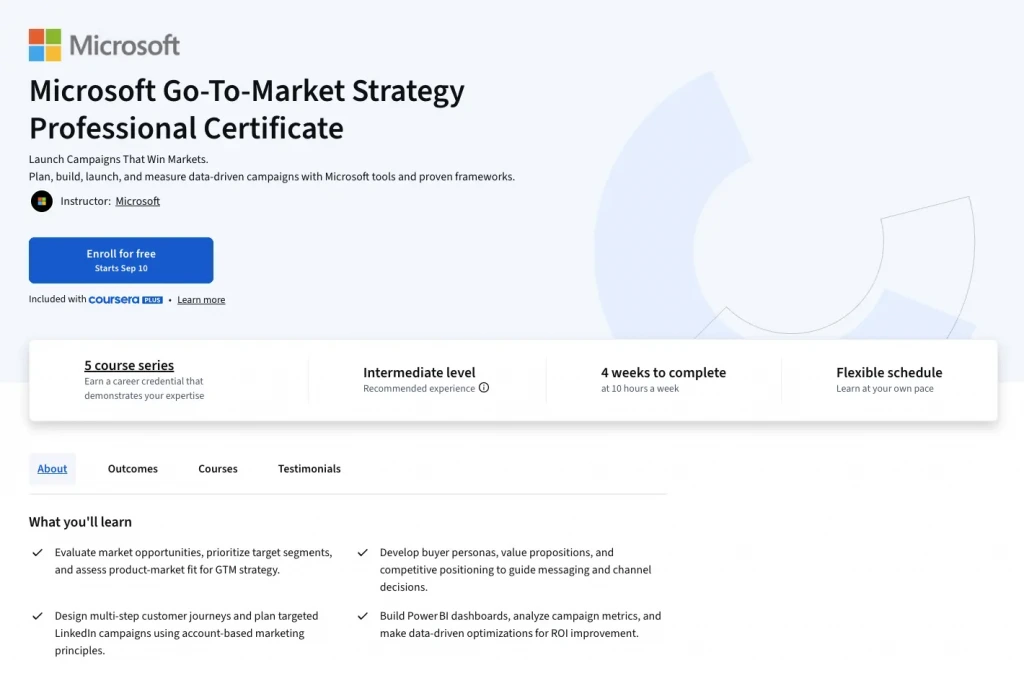
Best for: Marketers who want a broader GTM program covering research, positioning, campaign execution, AI, analytics, and post-launch optimization.
Course details
- Provider: Microsoft via Coursera
- Instructor: Microsoft
- Price: Available through Coursera; no fixed standalone price is listed on the current program page
- Format: On-demand, self-paced
- Duration: Five courses; around four weeks at 10 hours per week
- Level: Intermediate
- Certification: Microsoft Professional Certificate
What you’ll learn
- Evaluate market opportunities and product-market fit.
- Prioritize segments and build buyer personas.
- Develop value propositions and competitive positioning.
- Build multi-step customer journeys and LinkedIn ABM campaigns.
- Use AI assistants in content and campaign execution.
- Build dashboards in Power BI or Excel and use performance data to improve campaigns.
Why we picked it
Microsoft covers the GTM process from early market analysis through launch and measurement. It also brings AI, account-based marketing, campaign execution, and analytics into the same program, with projects that turn the material into work you can actually use.
Pros and cons
| Pros | Cons |
|---|---|
| Covers strategy, execution, and measurement | Longer commitment than most courses here |
| Includes AI, ABM, and marketing analytics | Some exercises use Microsoft and LinkedIn tools |
| Includes three applied GTM projects | More structured than marketers wanting a quick course may need |
4. Go-to-Market Strategy — CXL

Best for: Growth, demand generation, and product marketers who want to test a GTM strategy before putting more budget behind it. The course focuses on demand validation, CAC, conversion gaps, landing pages, and lead generation.
Course details
- Provider: CXL
- Instructor: Trevor Longino, Founder and CEO of CrowdTamers
- Price: Available individually or through a CXL subscription; the current individual price is not publicly shown
- Format: On-demand, self-paced
- Duration: 2 hours 24 minutes, 16 lessons
- Level: Intermediate
- Certification: CXL Experimentation-Led GTM Strategy Course Certificate
What you’ll learn
- Use Minimum Viable Sprints to test a GTM strategy before scaling.
- Find gaps between interest, attention, consideration, and decision.
- Build the data and tracking needed to measure early GTM experiments.
- Create and test lead generation campaigns.
- Build and improve landing pages around real demand.
- Connect inbound, outbound, and content once you are ready to scale.
Why we picked it
This course is built around testing whether your GTM strategy works before spending heavily on it. Trevor Longino shows you how to validate demand, find weak points in the funnel, and build a repeatable acquisition system around what the data tells you.
Pros and cons
| Pros | Cons |
|---|---|
| Strong focus on testing and demand validation | Assumes you already understand basic acquisition |
| Covers ads, landing pages, lead management, and scaling | Less focused on product launch management |
| Includes practical workshops and certification | Individual price is not publicly displayed |
5. Account-Based GTM Certification (Demandbase)
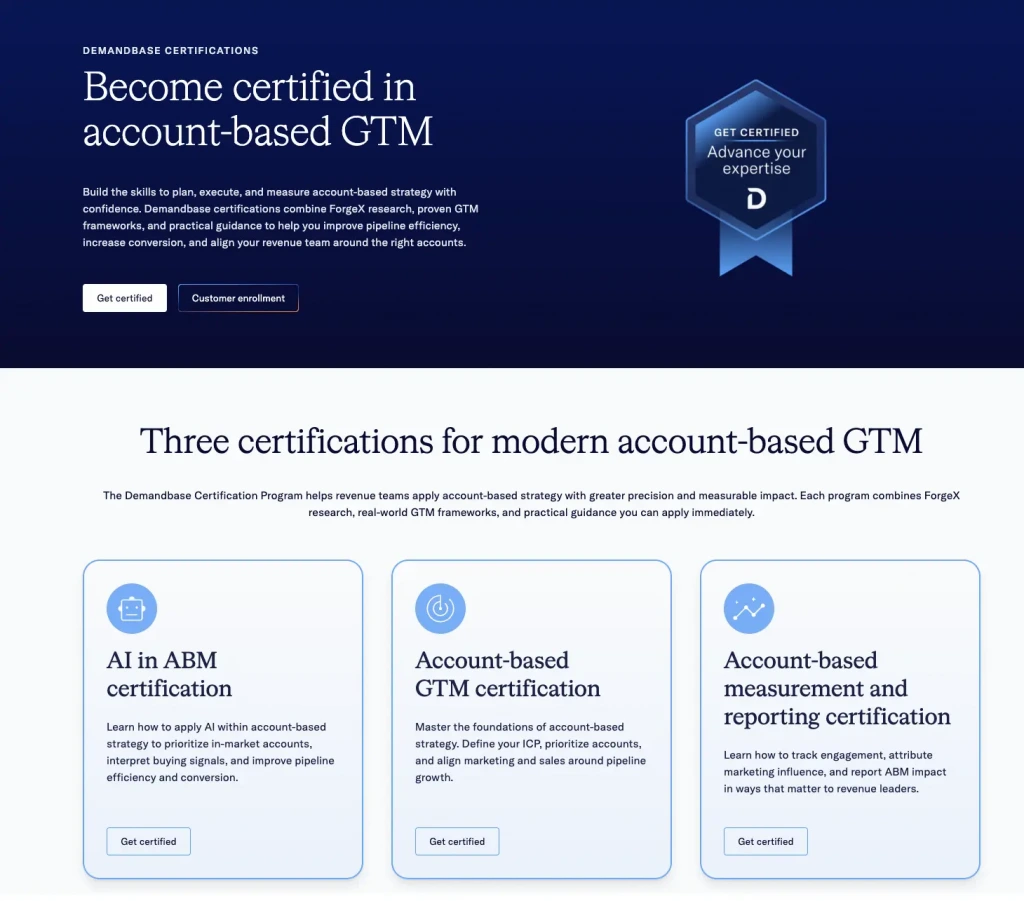
Best for: B2B marketers and revenue teams that want to build GTM around high-value accounts. The course focuses on ICPs, account prioritization, sales and marketing alignment, and pipeline.
Course details
- Provider: Demandbase
- Instructor: No single instructor is listed
- Price: Free for Demandbase customers; $349 for non-customers
- Format: Self-paced certification
- Duration: Typically 5–6 hours
- Level: Not formally stated
- Certification: Account-Based GTM certification with a shareable digital badge
What you’ll learn
- Define an ICP for an account-based GTM strategy.
- Identify and prioritize the accounts worth targeting.
- Align marketing and sales around the same accounts.
- Build account-based programs around pipeline rather than lead volume.
- Apply Demandbase and ForgeX GTM frameworks.
- Connect account selection, engagement, and measurement.
Why we picked it
Demandbase is the strongest specialist option here for account-based GTM. Instead of treating ABM as an advertising tactic, the certification starts with ICP and account selection, then connects marketing and sales around pipeline growth.
Pros and cons
| Pros | Cons |
|---|---|
| Focused specifically on account-based GTM | Not relevant to every GTM model |
| Covers ICP, prioritization, alignment, and pipeline | Costs $349 for non-customers |
| Self-paced with a shareable certification | More specialized than a general GTM course |
6. Revenue Architecture (Winning by Design)

Best for: B2B and recurring-revenue leaders who want to build a GTM system that connects marketing, sales, customer success, and RevOps around the same revenue model.
Course details
- Provider: Winning by Design
- Instructors: Certified Winning by Design trainers
- Price: $1,500 per person
- Format: Live online training with additional on-demand learning
- Duration: 12 hours across six two-hour sessions over two weeks
- Level: Advanced; designed primarily for GTM and revenue leaders
- Certification: Revenue Architecture certification after passing the final assessment
What you’ll learn
- Choose the right revenue model for ownership, subscription, or consumption businesses.
- Measure the full customer lifecycle from acquisition through retention and expansion.
- Understand the metrics and mathematical relationships that drive recurring revenue.
- Build an operating model that aligns GTM teams around the same data and processes.
- Identify growth stages and the changes needed as a company scales.
- Select GTM motions that connect marketing, sales, and customer success around how customers buy.
Why we picked it
Winning by Design treats GTM as a revenue system rather than a marketing launch. The course connects customer acquisition, sales, retention, expansion, operating processes, and growth into one framework. It is a strong option for B2B leaders who need to design or fix the GTM engine across multiple teams.
Pros and cons
| Pros | Cons |
|---|---|
| Built specifically around GTM and recurring revenue | Expensive compared with shorter courses |
| Connects marketing, sales, customer success, and RevOps | Primarily aimed at experienced leaders |
| Includes practical frameworks and certification | Live format requires attending scheduled sessions |
7. Go-to-Market Certified: Masters (Product Marketing Alliance)

Best for: Product marketers who manage product, feature, or market launches and need a deeper GTM process covering pre-launch, launch, and post-launch work.
Course details
- Provider: Product Marketing Alliance
- Instructor: PMA experts and product marketing practitioners
- Price: $1,299 one-off payment
- Format: On-demand, live virtual, or in-person
- Duration: 19+ hours listed on the current certification page
- Level: Experienced product marketers
- Certification: CPD and CIM accredited certification
What you’ll learn
- Adapt GTM strategy across SaaS, PLG, B2B, B2C, startups, and new markets.
- Prioritize product and feature launches.
- Build launch roadmaps and define target audiences.
- Use customer research to segment messaging.
- Prepare sales enablement and customer communications.
- Track launch metrics, win rates, adoption, and post-launch performance.
- Manage GTM ownership and cross-functional execution.
Why we picked it
PMA covers the full launch lifecycle in more depth than most courses on this list. It is particularly strong for product marketers who have to coordinate positioning, sales enablement, launch activity, measurement, and multiple internal teams.
Pros and cons
| Pros | Cons |
|---|---|
| Covers pre-launch through post-launch | One of the most expensive options |
| Strong focus on product launches and cross-functional GTM | Primarily built for product marketers |
| Includes templates, coursework, exams, and certification | More extensive than beginners may need |
8. B2B GTM Strategy – Get to $10m ARR (Madhav Bhandari – CXL)

Best for: B2B SaaS marketers who want to see how a high-growth company builds and runs its GTM engine. It covers channels, campaigns, AI, influencers, events, brand, community, and team structure.
Course details
- Provider: CXL
- Instructor: Madhav Bhandari, VP of Marketing at Storylane
- Price: $299
- Format: On-demand
- Duration: Two-part course; total runtime is not publicly stated
- Level: Intermediate to advanced
What you’ll learn
- Decide which GTM channels deserve more investment.
- Use AI across outbound, content, demos, and marketing execution.
- Structure a lean B2B marketing team around the channels that work.
- Build repeatable campaign briefs and templates.
- Run influencer and event programs around pipeline rather than reach alone.
- Use brand, community, and employee advocacy alongside demand generation.
Why we picked it
This course gives you a behind-the-scenes look at how Storylane built its GTM engine as the company grew. Madhav Bhandari covers the channels, campaigns, team structure, and AI workflows behind that growth rather than teaching GTM only as a strategic framework.
Pros and cons
| Pros | Cons |
|---|---|
| Built specifically around B2B SaaS GTM | Less relevant to B2C marketers |
| Covers AI alongside channels, campaigns, and brand | Total runtime is not publicly stated |
| Includes real campaign structures and channel examples | Focused heavily on the Storylane model |
What should a go-to-market course teach?
A good GTM course should cover the decisions that take a product from market opportunity to launch and growth.
Look for training that covers:
- Market and customer research: ICPs, segments, buying groups, and customer needs.
- Positioning and messaging: How to differentiate the offer and communicate why it matters.
- GTM channels: Sales-led, product-led, account-based, partner, inbound, outbound, and hybrid models.
- Launch and execution: Campaigns, sales enablement, cross-functional alignment, and channel activation.
- Measurement: Pipeline, CAC, conversion, revenue, retention, and post-launch performance.
- AI: How AI can support research, campaigns, reporting, and GTM execution.
How we chose these courses
We selected courses that teach practical go-to-market skills across strategy, launch, execution, and measurement.
Each course was evaluated on five factors:
- Relevance to GTM. The curriculum needed to cover go-to-market strategy directly rather than general marketing.
- Instructor credibility. We prioritized experienced GTM, growth, product marketing, and revenue practitioners.
- Practicality. Strong courses include frameworks, exercises, projects, or processes you can apply at work.
- Accessibility. The list includes short courses, deeper certifications, live training, and self-paced options.
- Course quality. We checked the current curriculum, format, pricing, instructors, and provider reputation.
How to choose the right go-to-market course
- Define what you need to learn. Start with a broader course if you need GTM fundamentals. Choose Demandbase for account-based GTM, PMA for product launches, or Winning by Design for revenue architecture.
- Match it to your GTM model. B2B SaaS, enterprise sales, PLG, and consumer launches require different channels and processes.
- Choose strategy or execution. Some courses focus on positioning and market decisions; others go deeper into campaigns, sales alignment, AI, and reporting.
- Look for practical application. Prioritize courses with projects, frameworks, workshops, or exercises you can use on a real GTM problem.
- Check the instructor and certification. Practitioner experience matters more than the certificate alone.
Which GTM course should you choose?
For the broadest introduction, start with Microsoft’s Go-To-Market Strategy Professional Certificate. It covers market analysis, positioning, campaigns, AI, and measurement in one structured program.
For experienced B2B marketers, CXL’s B2B GTM Strategy – Get to $10m ARR is stronger on execution, while Winning by Design’s Revenue Architecture is better for leaders connecting marketing, sales, customer success, and RevOps.
If you want to build AI into how you execute GTM, CXL’s AI Native Marketer is our top AI-focused option.
FAQs about go-to-market courses
What is a go-to-market course?
A go-to-market course teaches you how to take a product or service to market, from identifying customers and positioning the offer to choosing channels, launching campaigns, aligning teams, and measuring results.
What is the best go-to-market course for beginners?
LinkedIn Learning’s Create a Go-to-Market Plan is the shortest option for learning the fundamentals. Microsoft’s professional certificate is a better choice if you want a more complete program.
What is the best go-to-market course for B2B marketers?
CXL’s B2B GTM Strategy – Get to $10m ARR is built specifically around B2B SaaS channels and execution. Demandbase is a stronger choice if your GTM strategy is account-based.
Are go-to-market certifications worth it?
Yes, if the curriculum matches the GTM skills you need. Prioritize relevant frameworks, practitioner-led teaching, and practical application over the certificate itself.
How is AI changing go-to-market strategy?
AI is increasingly used across research, campaign production, reporting, sales workflows, and measurement. The strongest GTM training shows you where AI can improve execution without replacing the market and customer decisions behind the strategy.
Take it further with CXL’s AI Native Marketer program
GTM is one part of how AI is changing marketing.
CXL’s AI Native Marketer program helps marketers build working AI systems across campaign production, measurement, reporting, and marketing operations.
If you want to go beyond GTM strategy and build AI into how you execute marketing, explore the program and CXL’s related live AI workshops.
Click the icons to ask AI to match the best course to your career goals
Describe your career goals and let AI personalize the courses shown here.