AI adoption in B2B marketing is accelerating. Effective AI adoption, however, is not.
Our research suggests most marketers are still applying AI tactically rather than systematically, focusing on tools instead of building scalable operating systems.
To understand what’s really happening beneath the hype, we combined behavioral and survey data.
After analyzing Reddit discussions around AI overwhelm, we surveyed B2B marketers to examine how teams are using AI in B2B marketing, where organizations are seeing measurable gains, and where execution gaps are widening.
The patterns that emerged were unexpected.
Table of contents
- Content production is table stakes. Systems are the differentiator.
- Why AI agents for marketers are becoming the next priority
- The AI skill gap that’s become a competitiveness gap
- Time is the real blocker (and that’s actually a good thing)
- Next steps in AI workflow automation
- The AI marketing skills gap won’t close itself
Content production is table stakes. Systems are the differentiator.
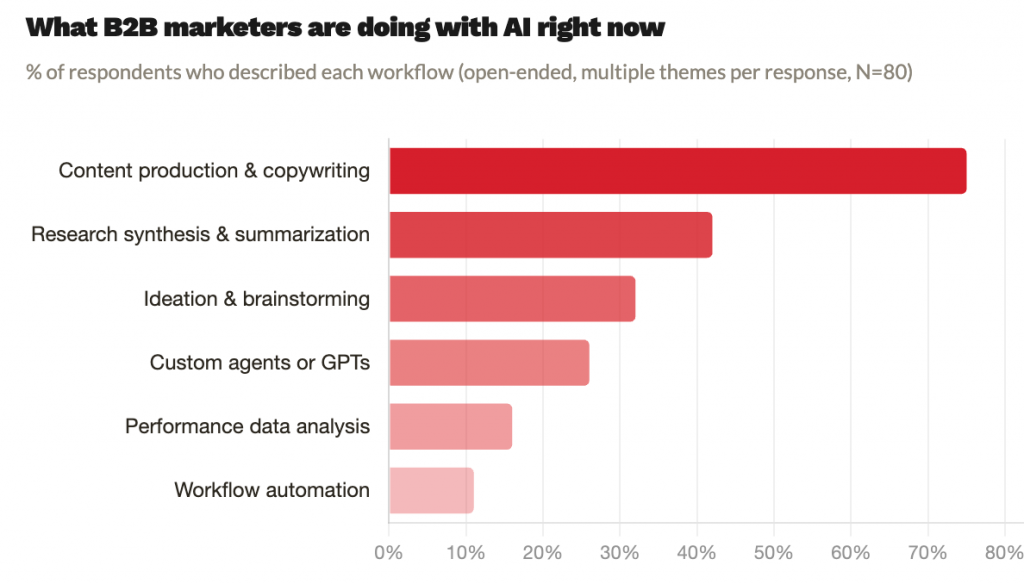
The number one use case, by a wide margin, is content production. 75% of respondents described content production as part of their current AI marketing workflow, citing:
- Emails
- Landing pages
- Social copy
- Ad creative
That wasn’t surprising. What was more revealing was how they’re doing it.
The marketers reporting the highest-quality output aren’t just prompting differently. They’ve built systems:
- Persistent brand context
- Custom GPTs or internal skills
- Layered review systems
- Iterative drafting processes
The “paste a brief, get a draft” crowd is still producing output that requires heavy editing and oversight.
One respondent described their workflow:
“I prompt Claude with the goal and audience, Claude asks me questions before it starts drafting. At this point, Claude runs our brand voice and terminology skill so the copy is about 90% there.”
The takeaway: Rather than prompting tactically, smart marketers are creating an operational infrastructure. The distinction matters because infrastructure compounds. A well-designed system improves consistency, reduces editing time, and scales output quality across the organization.
The second-largest workflow category, at 42%, was research synthesis:
- Summarizing customer interviews
- Mining sales calls
- Running competitive analysis
The takeaway: This is the high-leverage work most teams are still doing manually. The teams automating them are reclaiming hours of operational time every week—not incremental productivity gains, but meaningful shifts in capacity.
Why AI agents for marketers are becoming the next priority
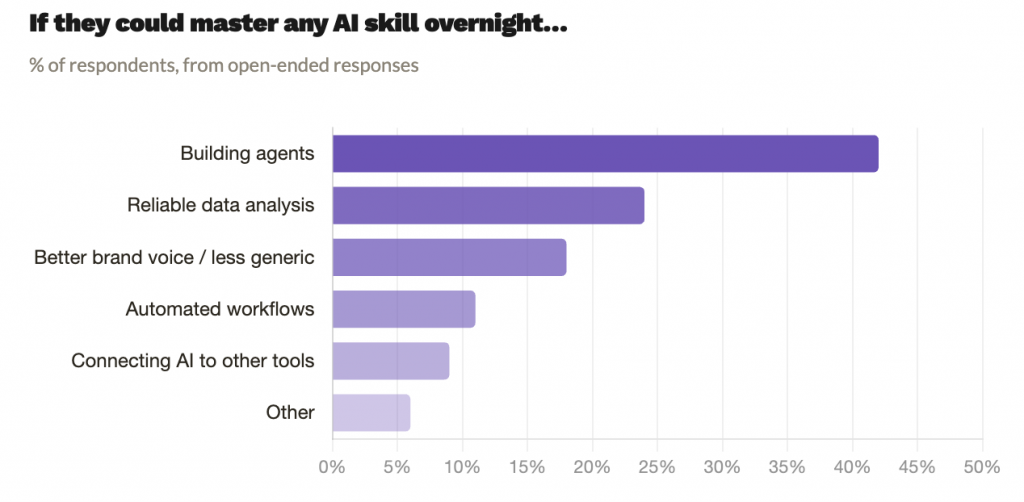
We asked what AI marketing skills respondents would most want to master overnight. The answer said more about the current moment in AI than any trend report.
Building agents was named by 42% of respondents. Not better prompting or more tools, but agents.
The takeaway: This matters because agents represent a fundamentally different relationship with AI: one where the system acts on your behalf across multiple steps, rather than just responding to a single input.
The second cluster (24%) was reliable data analysis: the ability to trust AI with actual numbers rather than hoping it doesn’t hallucinate a key metric.
The third (18%) was fixing the brand voice problem: making AI output sound less like AI.
The takeaway: Marketers aren’t asking for more AI tools. They’re asking for the skills to use the tools they already have in more powerful, trustworthy ways.
The AI skill gap that’s become a competitiveness gap
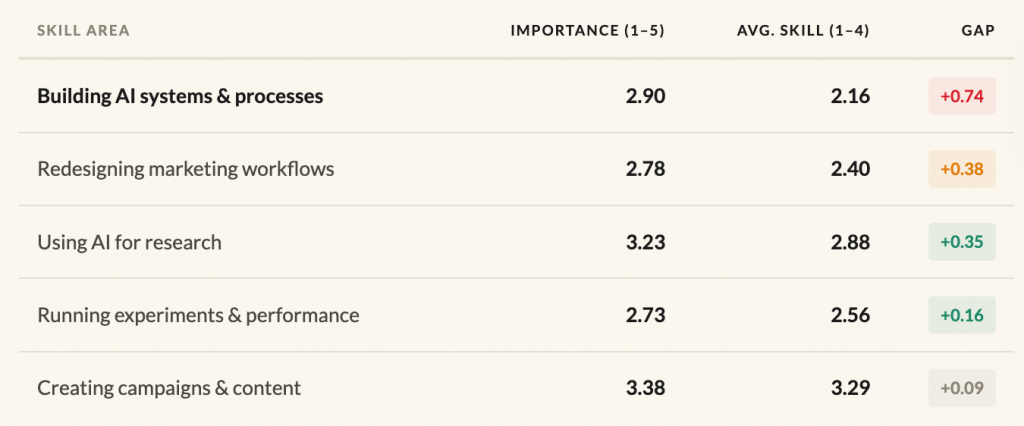
We asked respondents to rank five skill areas by importance, then rate their current proficiency.
Content production ranked most important, and it’s also where respondents are most skilled. 49% already rate themselves advanced at AI-assisted content production.
But AI Systems? That’s a different story entirely.
65% of respondents rated themselves beginner or below on AI systems, including building workflows, agents, and automation that compound over time.
The takeaway: The most-wanted skill, the highest-leverage category, and the area where current capability is the lowest.
This is how competence gaps become competitiveness gaps. Slowly, then suddenly.
Time is the real blocker (and that’s actually a good thing)
When we asked what’s actually holding marketers back from developing AI skills, the answers were illuminating.
Cost wasn’t the primary barrier, and neither was company resistance or AI tool access.
43% said they simply don’t have enough time to properly learn and experiment with AI. This explains why so many rely on self-teaching and learning on the go: not because it’s effective, but because it’s the only option that fits between the actual job.
Another 24% said they’re unsure which AI skills are worth learning in the first place. This is the more dangerous problem. Spending time learning the wrong thing isn’t just inefficient; it’s an opportunity cost that compounds over months.
15% said existing AI courses feel too theoretical or are too narrowly focused on specific tools that might not survive the next six months.
Here’s why this is actually good news: the barriers are solvable. They’re not structural or financial, but about prioritization and path-finding. Marketers aren’t unmotivated: 43% are already learning on their own, in whatever gaps they can find. They need a signal about what’s worth their limited hours, instead of another course about ChatGPT prompting basics.
Next steps in AI workflow automation
The survey data points to a clear sequence for any B2B marketer who wants to close the AI skills gap without burning out.
- Audit your content workflow first. Content is where most teams have the most AI exposure, which means it’s the fastest place to build systems thinking. Build a persistent brand context document, define your review steps, and create a repeatable workflow before you touch anything else.
- Stop learning tools. Start learning logic. The 24% who don’t know what’s worth learning are stuck because they’re evaluating specific AI tools instead of underlying capabilities. Agents, data analysis, and brand voice aren’t tied to a single platform. Learn the logic; the tool implementations will follow.
- Carve one hour per week for systems experimentation instead of learning. The time barrier is real, but “I don’t have time to learn AI” often means “I don’t have time to take a course.” Experimentation is different. Pick one workflow that’s currently manual, try to automate one step, and document what didn’t work. That’s how the AI marketing skills gap closes.
- Prioritize AI systems skills over content skills. The data is clear: 49% of your peers are already advanced at content production with AI. That’s not where the competitive delta is. The 65% who are beginner or below on AI systems; that’s the gap you want to close before your competitors do.
The AI marketing skills gap won’t close itself
The marketers who feel overwhelmed by AI and the ones who are adapting successfully aren’t separated by intelligence or resources. They’re separated by systems.
Most marketers are already past the “should I use AI?” question. They’re in the messy middle of figuring out how: which skills, which workflows, and which investments of their limited time are actually worth it. The industry is moving faster than traditional learning, most online courses, and most teams can keep up with organically.
The answer isn’t more tools nor better prompts. It’s building the infrastructure that makes the output reliable, repeatable, and compounding.
Knowing which AI marketing workflows to automate first is becoming a competitive skill. So is designing systems that remain reliable as complexity increases, and understanding when tools actually create leverage.
CXL’s AI Agents for B2B Marketing program focuses on the operational side of AI adoption: how to think in systems, build scalable workflows, and implement AI-driven processes without relying on a large engineering team.
You can also explore related live cohorts and on-demand programs:
- Content automation for B2B marketers with n8n
- SEO automation with n8n and Claude Code
- B2B buyer pain-led GTM strategy
- B2B ad campaigns with Claude Code and n8n
- Optimizing B2B content funnels with AI
- Build apps as content with AI
- AI-ready agencies: what clients see
- Measuring the modern AI-powered funnel
