
When it comes to AI adoption, the dominant narrative amongst marketers is that they’re falling behind. That every new tool, every new model, every new AI marketing workflow announced on LinkedIn is a gap you need to close—now. And the more you scroll, the more that feeling compounds.
The anxiety isn’t irrational, but the response to it usually is.
AI FOMO, the pervasive anxiety over adoption speed, skills obsolescence, and missed opportunity, usually splits into two responses—hasty adoption of tools and workflows they don’t need, or avoidance of the ones they do.
We dug into real Reddit discussions in digital marketing communities, and what surfaced wasn’t a skills gap. It was something more fundamental.
Table of contents
- The overwhelm is real. The diagnosis is wrong.
- Reddit is your most honest research source. Here’s how to mine it.
- Why “learn AI” is the worst goal you can set
- The task-first automation framework (How to get started)
- What systems thinking looks like in practice
- The failure modes you need to anticipate
- Next steps
- Stop trying to learn AI. Start trying to solve a problem.
The overwhelm is real. The diagnosis is wrong.
Scroll any digital marketing subreddit right now, and you’ll find a consistent pattern. Practitioners aren’t intimidated by AI itself. They’re intimidated by the implied obligation of AI: the sense that they need to understand marketing automation systems, integrations, workflows, and LLMs at scale (simultaneously) to stay relevant.
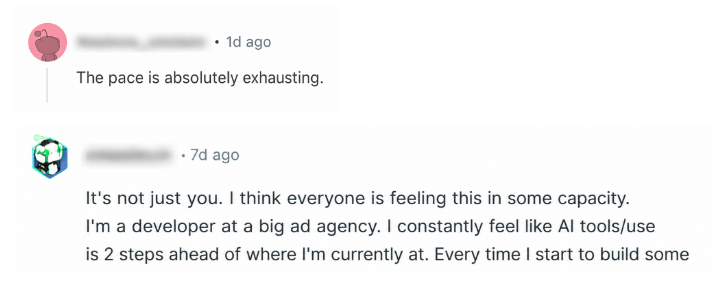
Multiple Reddit threads surface the same specific pain point: people use AI for small things (drafting captions, brainstorming angles, or cleaning up copy) but feel completely lost the moment anyone mentions “automations.”

That’s a very precise gap that points to more than generalized AI FOMO.
The gap isn’t between beginners and experts. It’s between tactical users and systems thinkers.
- Tactical users pick up individual tools.
- Systems thinkers connect those tools into AI marketing workflows that compound over time.
Most marketers are stuck in tactical mode, not because they’re unsophisticated, but because no one gave them a credible on-ramp to the systems layer.
Adding to the pressure: LinkedIn has become a firehose of AI hype.
Real practitioners in these Reddit threads are openly calling out the “AI guru” ecosystem—accounts selling unrealistic promises, workflows that don’t hold up in practice, and a general sense that the people shouting loudest have the least to show for it.

The distrust is warranted, and it makes it even harder to know whose advice to actually follow.
Reddit is your most honest research source. Here’s how to mine it.
Most market research tools give you polished, sanitized data. Reddit gives you what people actually think at 11 pm when nobody’s watching their personal brand.
The problem has always been scale. Reading threads one by one is slow. Copying and pasting comments into a doc is tedious. But Steve Toth shared a dead-simple technique on LinkedIn that turns any public thread into structured research data.
Add /.json to the end of any Reddit URL.
So reddit.com/r/DigitalMarketing/comments/[thread] becomes reddit.com/r/DigitalMarketing/comments/[thread]/.json. Instantly, the entire discussion — every comment, every upvote count, every nested reply — is available as structured data you can feed directly into an LLM.
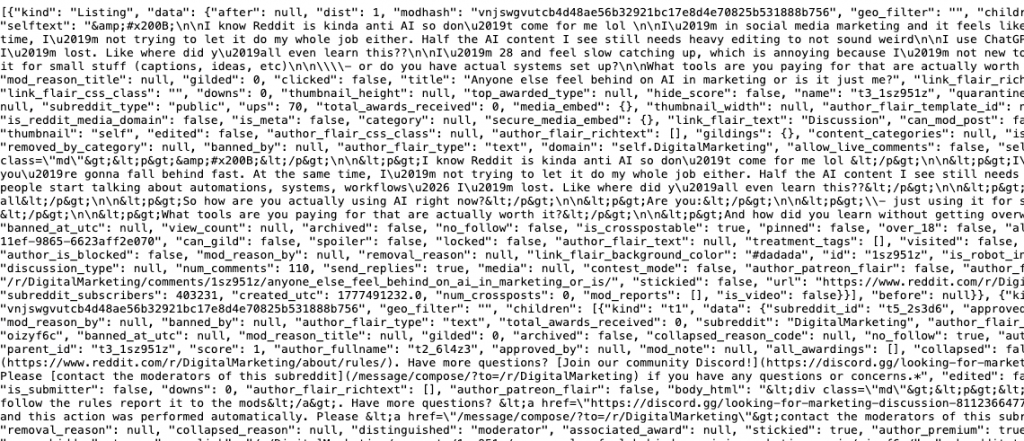
From there, prompt Claude or ChatGPT to extract recurring themes, dominant emotions, specific objections, and language patterns at scale.
What used to take hours of qualitative reading takes minutes. And the output isn’t a summary; it’s a map of how your audience actually talks about their problems. You can use this Reddit research method for any topic, any subreddit, at any time.
This is how we surfaced the insights in this article.
We focused on these two Reddit discussions:
- Is it just me, or is what’s happening now in Digital marketing with AI is insane!
- Anyone else feel behind on AI in marketing or is it just me?
Two threads, JSON-extracted from the most upvoted comments in active discussions, and analyzed for recurring themes without the filter of a researcher deciding what mattered.
And what it consistently reveals, across threads and communities, is the same thing: the overwhelm isn’t about capability. It’s about orientation.
Why “learn AI” is the worst goal you can set
When we asked marketers what’s stopped them from developing their AI skills, the data was telling:
- 43% said they don’t have enough time
- 24% said they don’t know which skills actually matter
- 18% said they don’t know where to start.
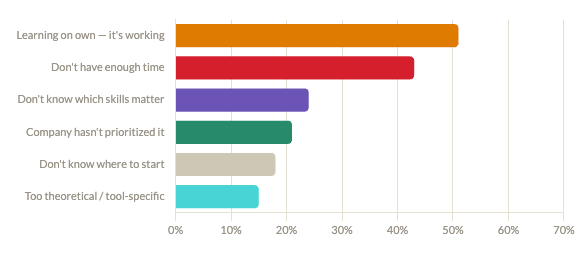
That’s 85% of respondents blocked by some version of the same problem—not capability, but orientation.
“Learn AI” is a category, not a goal. It’s as useful as saying “learn technology.”
You can’t learn AI any more than you can learn The Internet. What you can do is identify a specific, painful, time-consuming task in your workflow and make it faster.
That’s a goal, and it’s learnable.
The most repeated practical advice across multiple Reddit threads (appearing independently in different discussions, which is notable) was this: pick one tedious task, automate just that, and don’t try to learn “AI” as a category. It keeps surfacing because it’s the only advice that actually works.
This isn’t a dumbed-down version of a real strategy. It is the real strategy.
The compounding happens later, once you’ve got a few automations running. That’s when you naturally start thinking about how to connect them. That’s when “systems thinking” emerges organically—not from a course or a framework, but from lived experience of what the best marketing automation systems actually feel like.
The task-first automation framework (How to get started)
The trap is trying to go all-in from day one. Every tool, every workflow, every integration at once.
The task-first automation framework inverts this:
Step one: Audit your own workflow for the single most time-consuming recurring task.
Not the most interesting one. Not the one you should be doing differently. The one that eats the most time and produces the least joy. That’s your target.
Step two: Ask one question before reaching for a tool.
Can this specific task be automated or meaningfully simplified? Some tasks can. Some can’t. The answer doesn’t always require a complicated AI solution. Sometimes it’s just a smarter prompt, a simple Zapier trigger, or a Claude workflow for a specific content step. Don’t overbuild.
Step three: Find one tool that addresses that one task.
Not five tools. Not a stack. One. Get it working well enough that it’s actually saving you time before you consider the next thing. Shipping a half-built automation stack is worse than shipping nothing. It creates maintenance debt and erodes confidence.
Step four: Repeat.
Once the first automation is stable, look at the next task. Then the next. After a few iterations, something shifts: you start naturally seeing the connections between tasks. The progression matters. Trying to skip to “system” before you’ve built the component parts is why most AI initiatives stall.
What systems thinking looks like in practice
Systems thinking doesn’t mean complexity.
Once you’ve automated a few individual tasks, you start asking a different question: how do I connect A to Z without touching it in the middle?
That’s the shift from tactical AI user to operator. And it happens naturally once you’ve got working components to connect—not from reading about systems, but from having built enough pieces that the connections become obvious.
The practitioners who’ve made this transition describe it the same way: the first automation was the hardest to justify. The second was easier. By the third, the frame had changed entirely. They weren’t thinking about “should I use AI for this?” They were thinking about what the system should look like and reverse-engineering it.
The failure modes you need to anticipate
Not all of this goes smoothly. A few patterns consistently derail practitioners before they reach the systems layer.
Chasing tools instead of solving problems.
There’s always a new tool. If your criterion for adopting AI tools is “this looks interesting” rather than “this solves a specific problem I have,” you’ll accumulate subscriptions and build nothing. The cost isn’t just money; it’s the cognitive overhead of maintaining a half-connected stack.
Mistaking automation for strategy.
Automating a broken process just means you’re doing the wrong thing faster. Before you automate anything, be clear that the underlying task is worth doing at all. AI doesn’t fix bad strategy. It amplifies it.
Building for a future workflow instead of your current one.
A common failure mode is designing the sophisticated system you want to have before you’ve validated that the basic components work. Build for today’s workflow. Extend it when you’ve outgrown it.
Trusting LinkedIn gurus over Reddit practitioners.
The signal-to-noise ratio on LinkedIn AI content is genuinely poor. The people publishing daily AI marketing workflow content often have more incentive to generate engagement than to share what actually works. Skepticism isn’t cynicism; it’s a reasonable response to a monetized content environment.
Next steps
The overwhelm doesn’t go away by learning more about AI. It goes away by making one decision.
- Identify the task: Look at your actual calendar and task list from last week. What ate the most time that wasn’t strategic? Write it down.
- Ask the one question: Can this specific task be automated or meaningfully simplified with a tool or prompt? If yes, go to step three. If no, find the next most time-consuming task and try again.
- Pick one tool: Research specifically for that task. Don’t evaluate tools in the abstract—evaluate them against your specific task. Try it for two weeks before deciding whether it works.
- Ship the imperfect version: A working automation at 80% is worth more than a perfect system you haven’t built yet. Get something running, then improve it.
- Wait before expanding: Let the first automation stabilize before adding the next one. The compounding effect is real, but it requires each component to actually work before you connect it to something else.
Stop trying to learn AI. Start trying to solve a problem.
Comprehensive automation frameworks or the perception that you need to create a complete AI transformation overnight are what’s creating AI overwhelm in the first place. You don’t need to know how to build a full automation stack. You need to know how to make this week 20% less painful.
The systems emerge from the tasks. The confidence emerges from the shipped automations. The expertise emerges from the compounding. None of it emerges from trying to learn AI as a category.
Start small, stay specific, and ship the boring version first.
Knowing which task to automate first is a skill. So is building the workflow that actually holds up, and knowing when to bring in AI automation tools like n8n and Claude Code.
CXL’s AI Agents for B2B Marketing program covers the full stack, from how to think about AI systems to how to build and run them without an engineering team.
Or explore some of our live cohorts and on-demand courses:
- Content automation for B2B marketers with n8n
- SEO automation with n8n and Claude Code
- B2B buyer pain-led GTM strategy
- B2B ad campaigns with Claude Code and n8n
- Optimizing B2B content funnels with AI
- Build apps as content with AI
- AI-ready agencies: what clients see
- Measuring the modern AI-powered funnel
