The two most useful AI workflows in paid marketing right now aren’t about writing better ad copy. They’re about building your ICP from real customer data instead of a guess, and automating campaign reporting so insights reach you the same morning instead of the following Monday.
We hosted the second live workshop in our AI Native Marketer program with Nick Christensen, head of growth at AppSumo, on exactly this: building agents to improve ad performance and monitor campaigns.
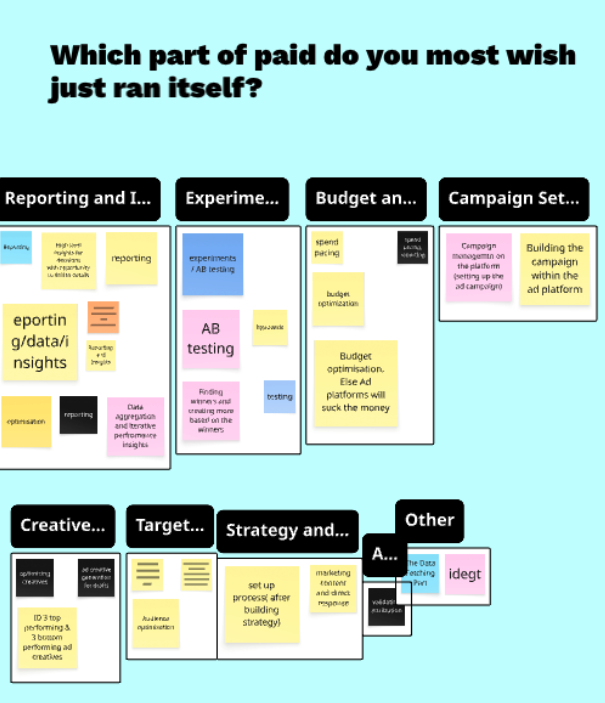
We opened by asking the room one question: which part of paid do you most wish just ran itself? Experimentation, budget optimization, campaign setup, creative, and targeting all came up. But the biggest bucket by far was reporting and insights: pulling the data, aggregating it, and turning it into something you can act on.
Nick shared two workflows he runs every day that address that directly. This post walks through both, with the exact inputs, tools, and steps.
Table of contents
Workflow 1: Build your ICP from real customer data
Most campaigns start with a channel and then go looking for customers to fill it. Nick argues for the opposite order: find your best customers first, and let the channels fall out of who they are.
The mechanism behind this is the Pareto principle. In almost every business, a small slice of buyers drives an outsized share of revenue, often around 10% of customers driving 50% of it. Your ideal customer persona (ICP) isn’t a brainstormed avatar built in a workshop. It’s those specific people, found in your actual data.
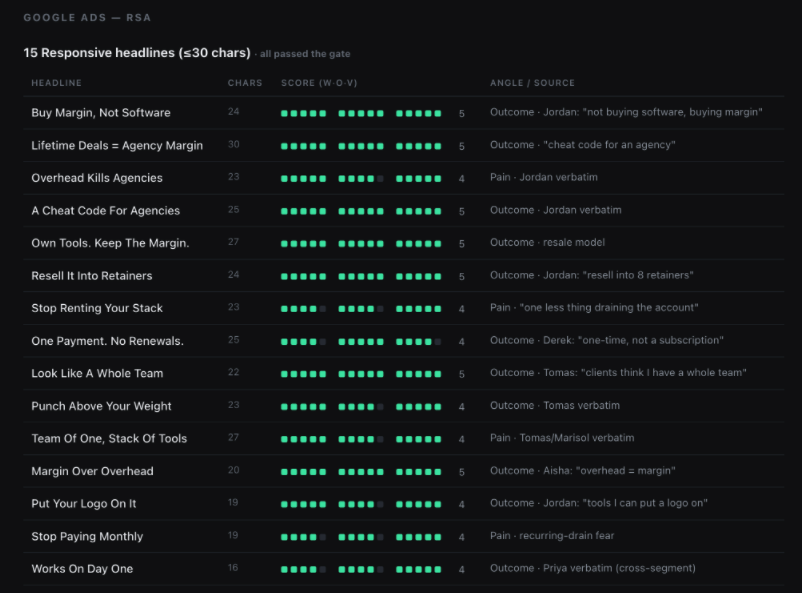
The solution is a Claude Code prompt that reads a folder of real customer data and outputs an “ICP dossier”: a one-page profile of your highest-value customer segment, written in their own words, plus campaign assets ready to paste into ad platforms. That includes Google Ads headlines and descriptions, image specs, and Meta audience and search themes.
What to feed it
The workflow is only as good as what goes into the folder:
- A customer export (from Stripe or your payment processor) with spend, order counts, and any available profile data
- Customer reviews
- Sales or customer call transcripts (Nick uses Granola, which connects to Claude Code via MCP)
- Support tickets
Even 10 to 20 customers is enough to surface real trends. If you don’t have this data yet, the fix is old-fashioned: talk to a few of your best customers, record the calls, and drop the notes in the folder.
Why grounding beats prompting
This workflow captures the finding that stood out most in our AI maturity benchmark: across every category we measured, how often marketers use AI far outpaced how well they used it. Everyone is prompting. Few are grounding.
That’s the difference here. Ask a chatbot for ad copy with no inputs and you get the same generic persona and headlines as everyone else, because the model is inventing a customer rather than describing a real one. Generic-sounding AI output is a well-documented failure mode in B2B content specifically.
This system synthesizes evidence instead of guessing: real spend data, real reviews, real call transcripts, so the campaign comes out in the words your buyers actually use. The skill isn’t the prompt. It’s choosing what to feed the system, and judging what comes out of it.
Titles are becoming obsolete. Shipping is what matters.
This exact output used to require a copywriter’s brief, a researcher’s survey project, and weeks of back-and-forth between teams. Now one marketer ships it in minutes, with the AI handling synthesis and the marketer handling judgment.
Workflow 2: Automate reporting so insights come to you
A workshop poll matched what we’d have guessed: most attendees spend 1 to 4 hours per week assembling ad reports across GA4, ad platforms, and BI tools. Nick used to spend every Monday morning doing the same thing.
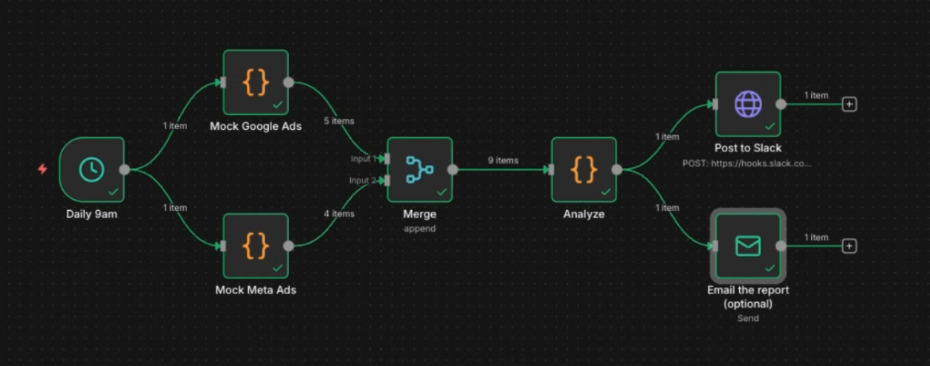
The replacement is an n8n workflow that runs automatically every day at 9am:
- Pulls campaign data from Google Ads (via API) and Meta (via Meta’s MCP)
- Merges the sources into one table
- Analyzes the merged data against your goals: which campaigns meet target, which need attention, each with a grade
- Posts the digest to Slack, email, or both
The analyze step is where your goals live. The automation only knows what “good” looks like if you’ve defined it.
Why this matters more than it used to
Marketers are expected to ship much faster than even a year ago. When we analyzed 1,750 marketing job listings earlier this year, mentions of “automation” in job descriptions jumped from 13% to 21% in just four months.
That pressure is exactly why becoming AI-native matters here. And the win isn’t only the hours saved assembling the report. It’s speed to action: when the insight lands in Slack at 9am already graded, you scale or pause a campaign the same morning, not the following Monday.
| Manual reporting | Automated daily digest | |
|---|---|---|
| Data pull | Manual export from each platform | API pull, scheduled daily |
| Merge | Manual, in a spreadsheet | Automatic, into one table |
| Judgment | Applied once a week, after the pull | Applied daily, against a pre-set goal |
| Time to action | Days (often the following Monday) | Same morning |
What this means for you
The pattern across both workflows is the same: AI does the synthesis and the assembly, you make the decisions. Scaling, pausing, and testing are still judgment, taste, and experience. They just no longer come bundled with hours of busywork.
A few tips if you want to move in this direction:
- Expect the friction in the wiring, not the concepts. API credentials, webhooks, and app passwords are where people get stuck. When you hit an error, paste it into Claude Code and let it troubleshoot.
- Start with your customer data, not your channels. Export your best customers from Stripe or your payment processor, add reviews and call notes, and let Claude Code or Codex synthesize the ICP. Even if you think you already know your ICP, run it against real data.
- Define success before you automate reporting. Pick one blended metric and set a target per channel. The automation is only as useful as the goal it grades against.
- Merge your data sources before judging a campaign. In-platform numbers alone will mislead you; combine them with GA4 or your own database.
Join CXL’s new AI Native Marketer program
Marketing titles are becoming obsolete. What matters now is what you can actually ship.
The marketers pulling ahead are the ones building AI-powered systems, redesigning workflows, automating execution, and integrating AI into the way they operate every day. At the same time, bandwidth has become one of the biggest pain points for marketers because learning AI initially costs time before it gives time back.
That’s why we built this program: to help marketers move from being AI-assisted or AI-integrated to becoming truly AI-native. The program combines live workshops, on-demand lessons, frameworks, templates, and real implementation examples.
You can join the program here.
Related Posts
-

Most marketers don’t have an ICP problem. They have a bad ICP problem. The kind…
-
That “whale” client you brag about? They might actually be killing your business. On paper,…
-
Marketers love acronyms. ICP. TCP. TAM. SAM. SOM. CCL. It sounds smart in meetings, but…
-
Your LinkedIn funnel is bleeding leads every day; let’s patch the holes before another prospect…