At the beginning of each quarter, we scrape hundreds of marketing job descriptions on LinkedIn.
The goal is to track how AI is changing marketing hiring and what companies expect from new hires.
We did it in Q1. Again in Q2. And now we have the Q3 numbers.
This time, we analyzed 878 US marketing job descriptions and compared them with our previous datasets.
The direction is becoming pretty hard to ignore.
In Q3 2026, 40% of US marketing job descriptions required AI as a skill or responsibility, up from 15% in Q1 and 28% in Q2. That’s roughly one in seven roles at the start of the year. Now it’s four in 10.
We’ll cover:
- What to do about it, depending on your role
- How often marketing job descriptions mention and require AI, quarter by quarter
- How the language around AI is changing (agents, “AI-native”, automation)
- Which seniority levels and marketing functions are changing fastest
- The AI tools employers name most often
Table of contents
Key findings
| Signal | Q1 2026 | Q2 2026 | Q3 2026 |
|---|---|---|---|
| Job descriptions that mention AI | 30% | 40% | 54% |
| Job descriptions that require AI | 15% | 28% | 40% |
| Mention AI five or more times | 8% | 11% | 22% |
| Use “AI-native”, “AI-first”, or “AI-forward” | 3% | 5% | 10% |
| Mention AI agents or “agentic” work | 3% | 3% | 8% |
| Ask for AI search, AEO, or GEO work | 6% | 7% | 15% |
| Mention automation | 18% | 23% | 35% |
| Jobs analyzed | 653 | 595 | 878 |
AI is moving from a nice-to-have to a requirement
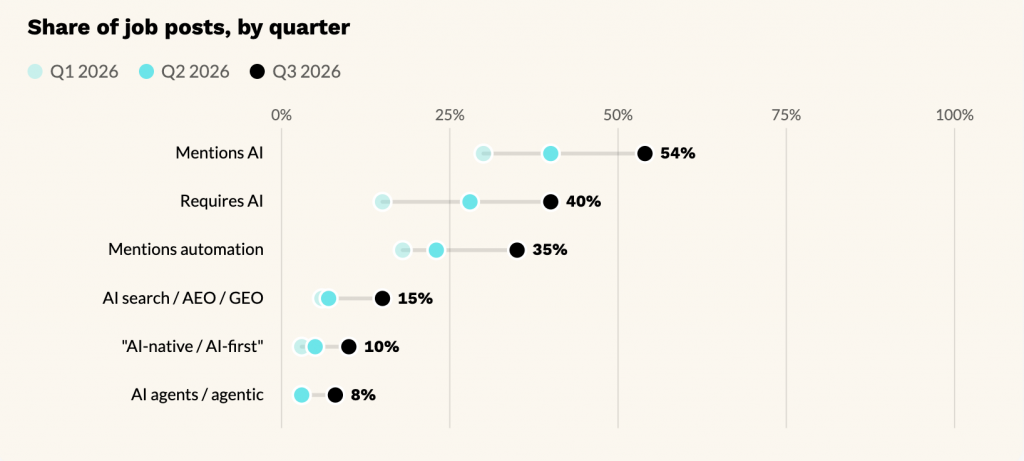
At the beginning of the year, 30% of the marketing jobs we analyzed mentioned AI.
In Q3, that number reached 54%.
More importantly, the percentage of jobs that actually require AI as a skill or responsibility jumped from 15% in Q1 to 28% in Q2 and 40% in Q3.
That’s roughly 1 in every 7 marketing roles at the beginning of the year.
Now it’s 4 in 10.
And it isn’t just companies adding “AI” somewhere in the job description.
The language itself is changing.
AI went from a line item to a theme
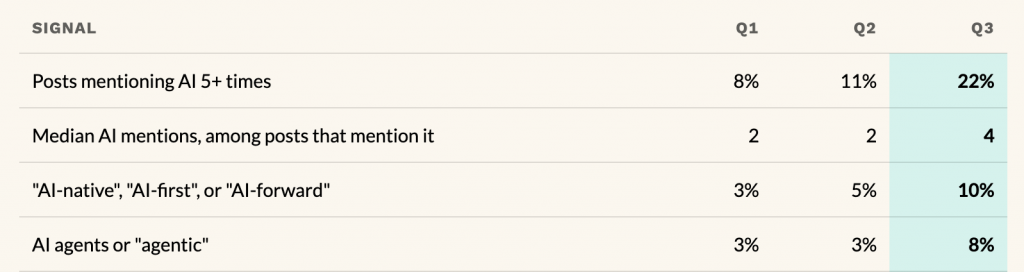
In Q1, only 8% of job descriptions mentioned AI five or more times.
In Q3, it’s 22%.
Among jobs that mention AI, the median number of mentions doubled from 2 to 4.
Terms like “AI-native,” “AI-first,” and “AI-forward” went from 3% of job descriptions in Q1 to 10% in Q3.
Mentions of AI agents and “agentic” work went from 3% to 8%.
In other words, companies aren’t simply asking, “Can you use ChatGPT?”
They’re increasingly looking for marketers who can make AI part of how they work.
What this means for you: Being able to say you “use AI” isn’t much of a differentiator anymore. The stronger signal is showing how you use it: the workflows you’ve built, the processes you’ve improved, and the work you can now do faster or better because of it.
The bar is shifting toward workflows and automation
Another signal we found interesting: automation appeared in 18% of jobs in Q1.
By Q3, that had almost doubled to 35%.
And the context around the word is changing too.
In Q3, “automation” appeared next to AI 214 times, compared with 168 mentions alongside traditional marketing automation platforms.
We’re also starting to see builder tools like Claude Code, Cursor, n8n, and Clay appear in marketing job descriptions.
The expectation is moving beyond generating a piece of copy with an LLM.
Increasingly, it’s about connecting tools, automating work, and building repeatable AI-powered workflows.
What this means for you: Don’t stop at prompting. Learn how to turn something you repeatedly do, research, reporting, campaign creation, lead enrichment, into a workflow. You don’t need to become a developer, but understanding how to connect AI to your actual marketing processes is becoming a valuable skill.
AI isn’t just an execution-level skill
One of the more interesting shifts is what happens when we break the data down by seniority.
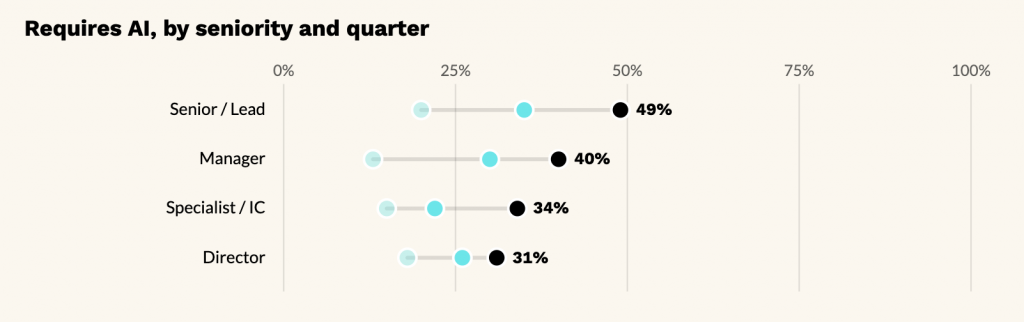
AI requirements increased at every level between Q1 and Q3.
But the biggest jump was among Senior / Lead roles, where the share requiring AI went from 20% in Q1 to 49% in Q3.
- Managers moved from 13% to 40%,
- Specialist and individual contributor roles went from 15% to 34%.
- Directors increased too, from 18% to 31%.
So AI isn’t simply becoming another execution skill for junior marketers. The expectation is moving up the org chart as well.
For more senior marketers, that likely means understanding more than how to use the tools yourself. As AI becomes embedded across marketing workflows, senior marketers will increasingly need to understand where it fits, what should be automated, how teams should use it, and where human judgment still matters.
What this means for you: The more senior you become, the less your AI advantage may come from simply being good at prompting. You need to understand how to apply AI across a team: identifying use cases, redesigning workflows, setting guardrails, and helping others adopt it. AI fluency is increasingly becoming part of marketing leadership, not just marketing execution.
Some marketing functions are moving much faster than others
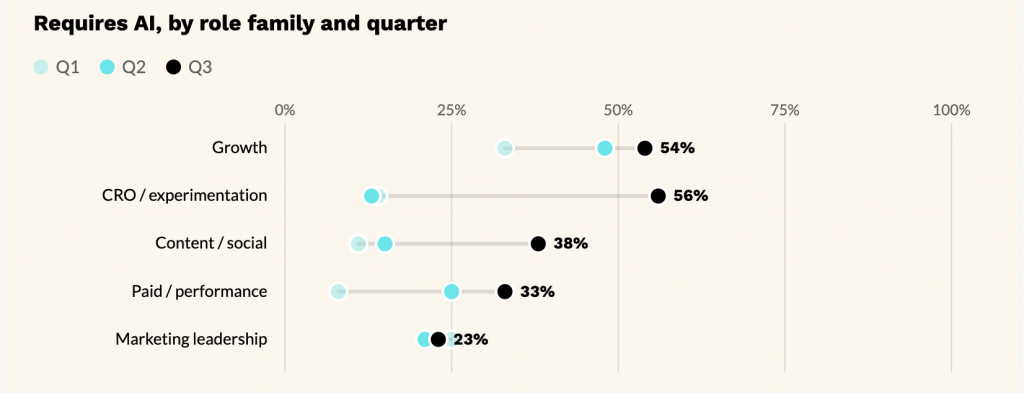
The change isn’t evenly distributed.
In Q3, 54% of growth roles required AI skills. For CRO and experimentation roles, it was 56%.
Growth roles also led on AI agents, with 14% mentioning them, and automation, at 53%.
But traditional marketing leadership roles were much slower to change.
Only 23% required AI in Q3.
Even more interesting: generalist marketing director roles stayed relatively flat throughout the year, while 60% of growth director roles required AI.
So this doesn’t appear to simply be a seniority story.
It’s a function story.
What this means for you: Look at what’s happening specifically within your discipline. The expectations for a growth marketer are already very different from those for a generalist marketing director. If you’re planning your next career move, the skills being requested in the roles you want are probably a better roadmap than any generic list of “AI skills marketers need.”
The bigger picture
The most interesting part of this research isn’t that more job descriptions contain the word “AI.”
We already expected that. It’s how the ask is changing.
At the beginning of the year, knowing how to use AI could differentiate you.
Increasingly, employers seem to expect marketers to know how to use it as part of the job.
And the bar is moving again. toward marketers who can build workflows, automate processes, work with agents, optimize for AI search, and integrate AI into the way marketing actually gets done.
For the full report, including more data and statistics, check it out here.
Become AI-native in one week
The data is clear: companies are increasingly looking for marketers who can do more than just use AI tools.
So how do you become one of them?
Join CXL’s one-week AI Native Marketer sprint, happening November 10–12.
Across three live, hands-on workshops, you’ll build:
- Your Marketing Brain: A central knowledge base that gives AI the context it needs to understand your brand, audience, positioning, and voice.
- Your Campaign Engine: Turn a single brief into campaign assets that follow your brand guidelines and messaging.
- Your Marketing Reporting Agent: Connect your marketing data and turn it into actionable insights and recommendations.
This isn’t another course where you just watch someone use AI.
You’ll actually build the systems, put them to work, and walk away with workflows you can use immediately.
