B2B marketing workflow automation works when you redesign the workflow before you touch a tool, not after.
The common failure mode is opening Claude, ChatGPT, or a workflow platform and handing over an entire task, hoping the output holds up. It rarely does.
The process for building genuine automation hasn’t changed since before AI existed: you still have to know each step of the existing workflow in detail before you can decide what an AI or automation should replace.
What gets inserted into each step has changed; the discipline of mapping the step itself hasn’t.
A live CXL workshop, “Redesigning B2B marketing workflows for AI and automation,” part of the AI Native Marketer program, covered exactly this.
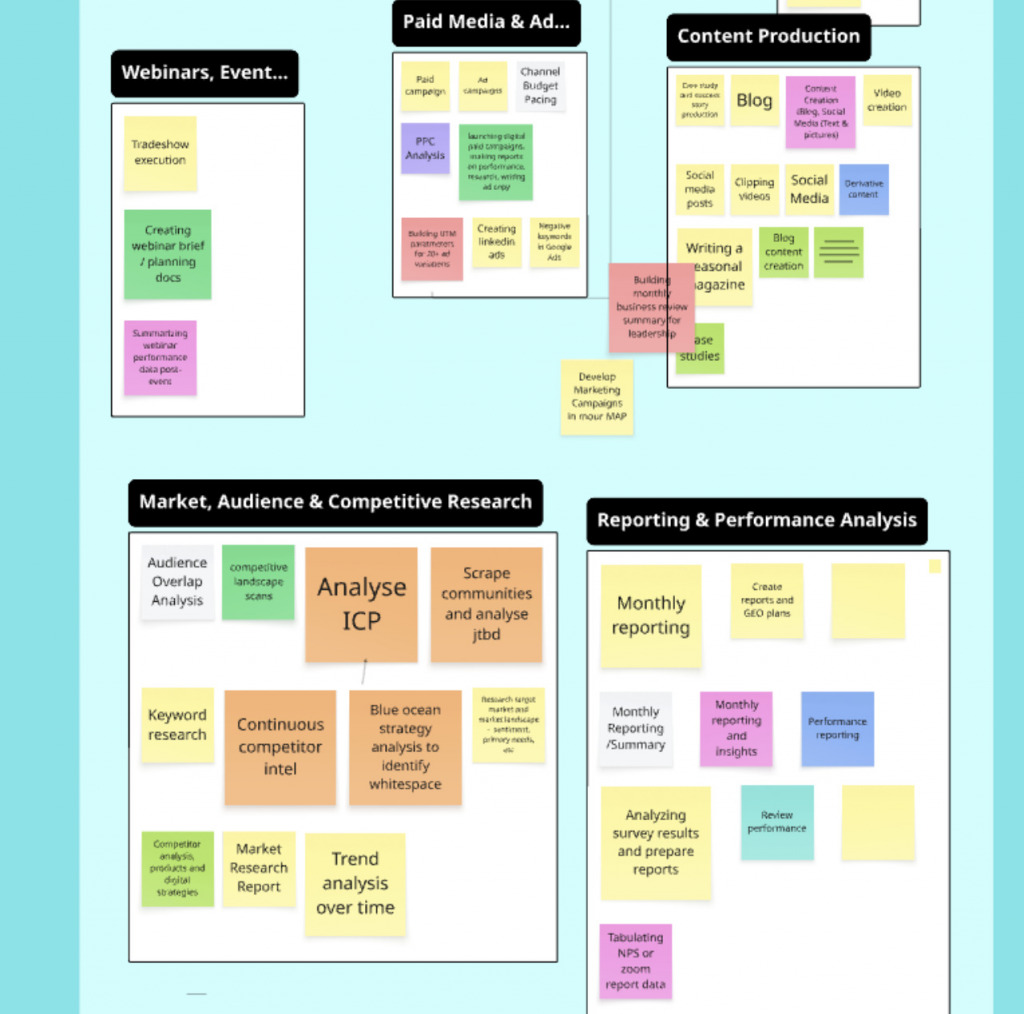
The session opened with a simple exercise: attendees added their most repetitive tasks to a shared board.
The patterns that came back again and again were reporting (monthly SEO and GEO reports, performance summaries), content production running at five to ten blog posts a week, email campaigns, lead follow-up, and landing page builds. None of these tasks had been properly mapped before someone tried to automate them.
Table of contents
- Why most workflow automation attempts fail before they start
- Why swimlanes beat flowcharts and written SOPs
- The format specifics that make it work
- Lane by role, not just by tool
- What the live mapping exercise revealed
- The takeaway: automate the clearest step first, not the whole workflow
- Where this fits in a bigger automation build
Why most workflow automation attempts fail before they start
They fail because the person automating never understood the workflow they were replacing.
Skipping straight to the tool and handing over a task wholesale produces unreliable output because nobody defined which parts of the task needed human judgement and which parts were mechanical.
This is the gap CXL’s research keeps surfacing: the majority of B2B marketers are stuck at what CXL calls “Assisted”, using AI to speed up an existing task rather than rebuilding how the work gets done, one of the core skills modern marketers need to become AI-native.
In CXL’s research, workflow redesign ranks as the number one stated skill gap, above prompting and above tool fluency. Marketers know the tools. They can’t redesign the workflow the tools sit inside.
Moving from Assisted to Integrated, where the workflow itself gets rebuilt around AI rather than AI getting bolted onto the old process, requires a method for seeing the workflow clearly first.
That’s what the rest of the workshop was built to teach.
Why swimlanes beat flowcharts and written SOPs
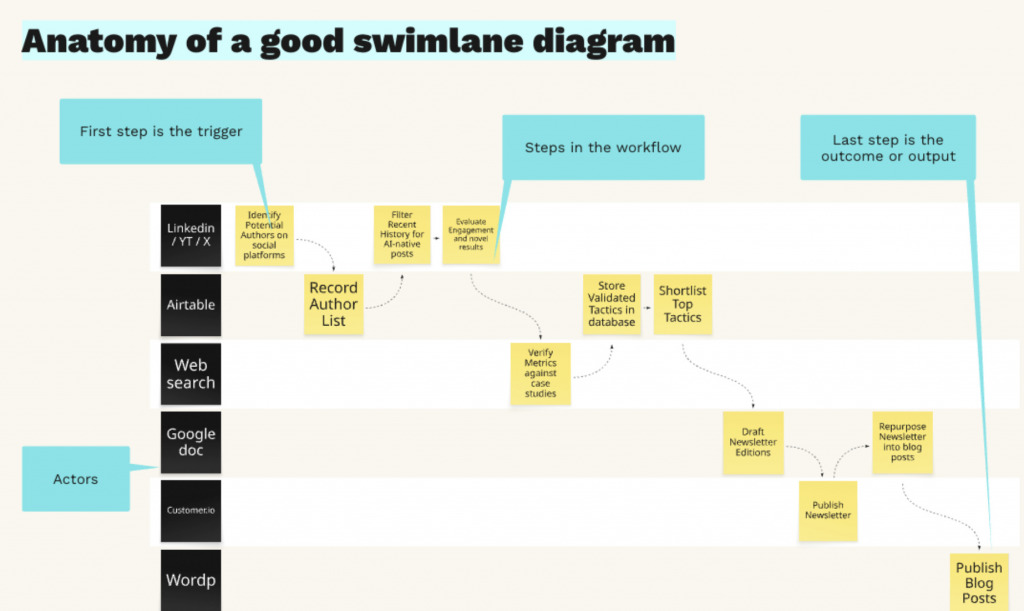
Swimlanes work because they solve the two problems that sink the obvious alternatives. Written standard operating procedures break down the moment a workflow has branching logic or a handover between people.
A document can describe step five, but it can’t easily show that step five sometimes routes to a different person depending on a condition met in step three. Flowcharts solve that branching problem, but they get heavy fast once you’re mapping more than one workflow at a time, and they don’t force you to name who or what is doing each step.
Swimlanes solve both problems at once. Each horizontal lane represents an actor, whether that’s a person, a role, or a tool. Laying the workflow out this way makes the actors and tools involved impossible to miss, which is exactly the point: you can’t redesign a workflow you can’t see the ownership of.
The format specifics that make it work
The workshop was precise about the mechanics, because the mechanics are what make the exercise useful rather than decorative. Each vertical step in the diagram gets exactly one sticky note. Never stack two things onto a single step; doing so confuses the automation planning that comes later, because you can no longer tell whether you’re automating one task or two.
Underneath each step sits a details row that captures time spent on that step, where an AI opportunity exists, what’s difficult about the step, and any feedback gathered from the person who owns it.
That details row is where the value sits. Once time-per-step and AI opportunity are logged against every sticky note, converting the workflow into an automation plan becomes a structured comparison rather than a guess: pull the human steps that can be replaced into a new lane, swap in the AI or automation step, and compare the before and after time directly.
It’s still deliberate work; the mapping just gives you something concrete to work from.
Lane by role, not just by tool
One structural choice separates a workflow map that surfaces genuine redesign opportunities from one that just documents what already exists: lane the workflow by role, or by a hybrid of role and tool, rather than by tool alone.
Laning by tool tells you what software touches the workflow. Laning by role tells you where judgement is being applied and where it isn’t.
That distinction is what surfaces where human review gates should sit. The goal is to keep humans on the strategic decisions, the brief, the judgement calls, the things that require context an AI system doesn’t have, and let automation absorb everything mechanical around those decisions.
Without a role-based lane structure, it’s easy to automate a step that needed a human check, or to leave a purely mechanical step sitting with a person because nobody separated the role from the tool clearly enough to see it.
What the live mapping exercise revealed
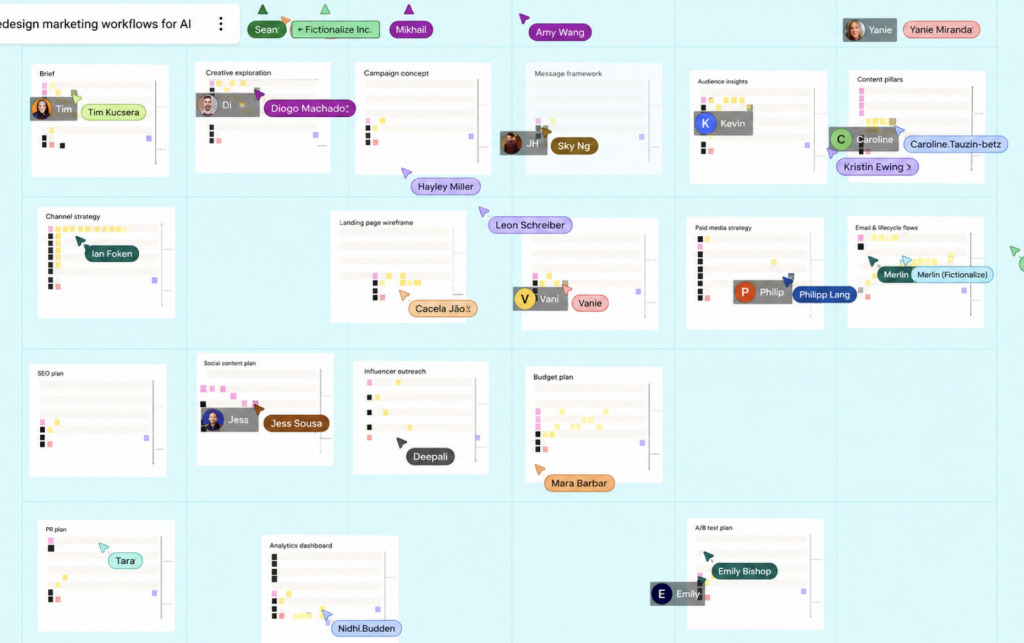
After the framework was introduced, attendees mapped their own workflows in swimlanes: one sticky note per step, roles and tools kept in separate lanes, time and AI opportunity logged under each, and a details row noting what was hardest about the step.
The exercise surfaced time-saving opportunities that weren’t visible before the workflow existed on paper, along with bottlenecks that recurred across different attendees’ processes and a clearer picture of which actors were involved at each stage. Each attendee left with a swimlane map of their own workflow, sticky notes attached, time and AI opportunity logged step by step, and a specific first automation target identified rather than a list of open questions.
As the workshop framed it, the goal wasn’t to produce a diagram for its own sake. The goal was to make the workflow specific enough that automating it became a decision about one step at a time, rather than an attempt to replace the whole process in one move.
The takeaway: automate the clearest step first, not the whole workflow
The actionable version of this framework is straightforward enough to run this week. Pick one repetitive, recurring task, whether that’s a monthly report, a content brief, or a lead follow-up sequence. Map it in swimlanes: one sticky per step, roles and tools in separate lanes, never two things on one step. Log the time spent and the AI opportunity under each step. Then automate the step with the clearest opportunity first. Automate one step at a time.
This sequencing matters because it’s the difference between Assisted and Integrated in practice, not just in theory. Assisted is inserting an AI tool into an existing task and hoping it holds up. Integrated is knowing exactly which step in a mapped, role-based workflow should change hands from a person to an automation, and why. AI-native marketers map the workflow and decide, step by step, what changes hands based on that map.
Teams evaluating a broader marketing automation strategy run into the same wall at scale: automating five separate workflows without first mapping each one by role tends to produce five fragile automations rather than one coherent system. The mapping step is the work, not a formality before it starts.
Where this fits in a bigger automation build
Once a single workflow is mapped and one step is automated, the same method scales to reporting pipelines, content production lines, and lead follow-up sequences. Teams building AI systems that hold up under production load tend to hit the same lesson from a different angle: the system only works if the underlying process was understood before it was rebuilt in code or in a workflow tool. A reporting or research automation built on n8n is only as reliable as the swimlane map that preceded it.
This is the hands-on skill the AI Native Marketer programme is built to close. Understanding swimlane mapping in theory is a start, but mapping your own reporting workflow, your own content pipeline, or your own lead follow-up sequence in a live session, with feedback on where the human review gates should sit, is what’s required to move from Assisted to Integrated. That’s the gap CXL’s research keeps flagging as the largest one B2B marketers report: the ability to redesign the workflow the tools sit inside, not just tool literacy.
Join CXL’s new AI Native Marketer program
Marketing titles are becoming obsolete. What matters now is what you can actually ship.
The marketers pulling ahead are the ones building AI-powered systems, redesigning workflows, automating execution, and integrating AI into the way they operate every day. At the same time, bandwidth has become one of the biggest pain points for marketers because learning AI initially costs time before it gives time back.
That’s why we built this program: to help marketers move from being AI-assisted or AI-integrated to becoming truly AI-native. The program combines live workshops, on-demand lessons, frameworks, templates, and real implementation examples.
You can join the program here.
