AI-assisted marketers are becoming more replaceable. Marketers who build AI systems around their work are becoming more valuable, more in demand, and harder to compete with.
That’s not speculation. Over the past few months at CXL, we surveyed hundreds of B2B marketers and analyzed how AI is reshaping marketing roles, workflows, and organizational expectations.
The clearest signal from our research: becoming an AI-native marketer is where the industry is heading, and increasingly what companies are hiring for.
But most marketers don’t fully understand what “AI-native” means, and even fewer know where they currently stand on the path to getting there.
This article breaks down what AI-native actually means, the five skill areas where B2B marketers are struggling most right now, and what progress in each area actually looks like.
Table of contents
The three levels of AI adoption in marketing
Most marketers have incorporated AI into their work in some form. They use ChatGPT for drafts. They run prompts through Perplexity to speed up research. They’ve set up a few automations in their email platform.
That’s AI-assisted. It’s useful. But it’s not AI-native.
An AI-native marketer doesn’t use AI to assist with individual tasks. They redesign entire workflows around AI from the ground up, build marketing systems and agents that run without constant human intervention, and structure their operations so AI is the default engine, not an optional add-on.
The distinction matters because the performance gap between these two approaches is widening. AI-native marketers are producing more, iterating faster, and building capabilities that individual tool users simply can’t replicate.
Before diving into specific skills, it helps to understand where most marketers currently sit:
| Level | Description |
|---|---|
| AI-Assisted | Uses AI tools in isolation to help with individual tasks. Relies on manual steps between tools. |
| AI-Integrated | Connects AI tools and automations together to streamline parts of their workflow. Reduces manual handoffs. |
| AI-Native | Builds fully AI-driven systems, agents, and workflows from the ground up. AI is the operating model, not a supplement. |
Most B2B marketers are somewhere between AI-assisted and AI-integrated. The gap to AI-native is where the biggest career and performance opportunities now exist.
The 5 skill areas where marketers are falling behind
Our research identified five specific domains where the skill gap is largest, and where the opportunity for differentiation is highest.
1. Production & Content
What the data says: 46% of B2B marketing leaders said they want the content engine fully off their plate. Meanwhile, 42% identified generic-sounding AI output as their top content failure.
These two numbers tell the whole story. The demand for scalable AI-driven content production is high. But most marketers haven’t solved the quality problem that makes that scale trustworthy.
What separates AI-native marketers: The challenge isn’t generating more content. Any marketer can spin up a ChatGPT prompt and fill a content calendar. The challenge is turning a single brief into a fully coordinated set of assets: ads, landing pages, email sequences, and social variants, while maintaining a consistent brand voice and ensuring the content is optimized for both human readers and AI-generated search results.
The gap: Most marketers are still producing content one piece at a time, manually adapting it for each channel.
AI-native marketers build production systems that treat one brief as the input and multiple platform-ready assets as the output.
2. Research
What the data says: 42% of B2B marketers already use AI for research, but most still manually copy between tabs and tools instead of automating the process.
What separates AI-native marketers: The next stage is building research pipelines. Instead of manually running queries and synthesizing results, AI-native marketers set up workflows that automatically surface competitive intelligence, audience insights, and trend signals, verify outputs against multiple sources, and deliver findings in a format ready for action.
The gap: The difference between using AI for research and building AI research systems is the difference between spending three hours per week on competitive research and having that intelligence arrive automatically every Monday morning.
3. Workflow Redesign
What the data says: 55% of B2B marketers rate themselves as beginners in workflow redesign. Only 10% recognize it as one of the most important skills to develop.
What separates AI-native marketers: The question isn’t “how do I use AI more?” It’s “which of my current workflows should I retire, which should I rebuild, and which should I redesign from scratch?”
Workflow redesign is a fundamentally different skill than tool adoption. It requires mapping current processes, identifying where human input is genuinely required versus where it’s just a habit, and restructuring operations so that AI handles the high-volume, low-judgment steps while human effort concentrates on strategy, taste, and approval.
The gap: Most AI skill development focuses on prompting and tool usage. Workflow redesign is the meta-skill that determines how much value all the other skills actually produce.
4. Experimentation & Analytics
What the data says: 42% of marketers say they are beginners at running experiments and analyzing performance. 37% say hallucinated data is their #1 AI failure.
What separates AI-native marketers: AI-native marketers are building analytics workflows that can automatically pull performance data from multiple platforms, identify anomalies, generate hypotheses about causation, and surface recommended experiments, complete with expected impact and confidence intervals, without needing a data analyst to run the process.
The gap: Most marketers are still interpreting data manually or relying entirely on data teams. The AI-native path is building lightweight analytics intelligence that runs continuously and flags what matters.
5. Operations & AI Systems
What the data says: 42% of B2B marketers say building AI systems is their most-wanted skill. 65% still rate themselves as beginners at it.
This is the highest-impact skill in the entire stack, and the one with the largest gap between desire and capability.
What separates AI-native marketers: Individual AI usage hits a ceiling. A single marketer using ChatGPT can produce more than they could without it. But their output is still bounded by their own time and attention. The real value comes from building systems that the entire team can operate: systems with approval flows, quality checks, governance structures, and documentation that allow AI-native marketing operations to scale.
The gap: Most marketers are building personal AI productivity. AI-native marketers are building team-level AI infrastructure.
Most marketers don’t know where they actually stand. Here’s how to find out.
Most marketers know these five areas are important. The harder question is understanding where they personally sit across all five, and what to prioritize next.
That’s why we built the AI Native Marketer Assessment.
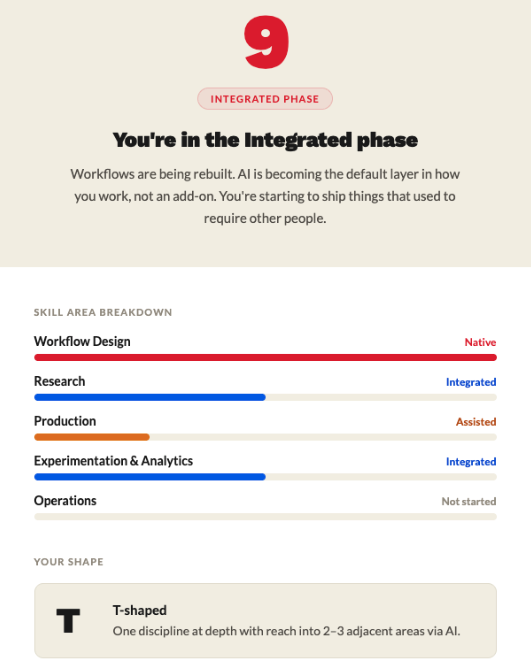
The assessment evaluates your current level across each of the five skill areas and identifies whether you’re currently operating as an AI-assisted, AI-integrated, or AI-native marketer. At the end, you receive a personalized score, a breakdown of your biggest gaps, and specific recommendations on where to focus next.
The marketers who build durable advantage over the next few years won’t simply be the ones using AI tools. They’ll be the ones who understand which systems to build, which workflows to redesign, and how to structure marketing operations so AI is the default, not an optional layer on top of a human-first process.
If you want to understand where you stand, take the assessment here.
Join CXL’s new AI Native Marketer program:
Marketing titles are becoming obsolete. What matters now is what you can actually ship.
The marketers pulling ahead are the ones building AI-powered systems, redesigning workflows, automating execution, and integrating AI into the way they operate every day.
At the same time, bandwidth has become one of the biggest pain points for marketers because learning AI initially costs time before it gives time back.
That’s why we built this program: to help marketers move from being AI-assisted or AI-integrated to becoming truly AI-native.
The program combines live workshops, on-demand lessons, frameworks, templates, and real implementation examples.
You can join the program here.
Related Posts
-

Earlier this week, Exit Five dropped a kickass B2B Marketing Salary Benchmark Report—a data-heavy and…
-
B2B marketing has changed. Most marketers haven’t. Most B2B marketers still think in funnels. Buyers…
-
Most B2B marketers still optimize content around the idea of a single query mapping to…
-
Most B2B enterprises waste thousands on content that never ranks, converts, or builds authority. You…