Most marketers will tell you they use AI every day. What the data shows is a different story.
A few weeks ago, we launched an AI skills assessment to help marketers identify where they actually stand, whether they’re AI-assisted, AI-integrated, or truly AI-native. The assessment was built to measure real competency across five areas: workflow, production, research, analytics, and AI operations.
Once the results came in, one pattern stood out immediately: the gap between how frequently marketers use AI and how advanced their actual skills are.
So we turned the data into a benchmark report. Here’s what we found and what it means for where the market is heading.
Table of contents
The three stages of AI maturity
| AI Maturity Stage | Share of Respondents |
|---|---|
| AI-Assisted | 57% |
| AI-Integrated | 34% |
| AI-Native | 9% |
More than half of marketers are still at the assisted stage. They’re using AI regularly, but as a task accelerator, not as an integrated part of how work flows.
About a third have crossed into integration: they’ve built repeatable prompting approaches, connected AI across multiple workflow steps, and started automating parts of the production process.
Only 1 in 10 reached native-level capability. At this stage, teams are designing systems rather than executing tasks. Workflows run with minimal manual intervention. AI handles orchestration, not just execution.
That 9% figure matters because it shows how early the market actually is. Despite years of hype, the vast majority of marketing teams are still in the earliest stage of AI adoption.
Frequency outruns skill
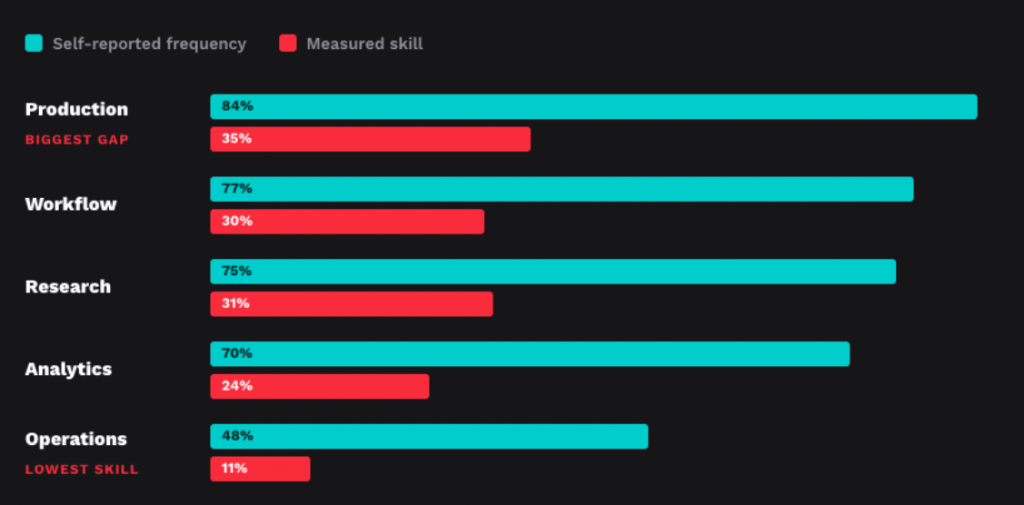
The most striking finding wasn’t about any individual skill area. It was the gap between how frequently marketers use AI and how skilled they actually are.
Across every category, self-reported frequency of use far outpaced measured skill level.
This pattern appeared consistently in workflow, research, analytics, and operations. AI makes it fast and easy to generate output, and that ease creates a false signal: if I’m using it every day and getting results, I must be getting good at it.
But using AI often isn’t the same as using it well. The benchmark separates those two things.
The story the data tells isn’t that marketers aren’t using AI. It’s that usage has raced well ahead of skill. High frequency masks low depth.
AI maturity by skill area
Looking at each competency individually shows just how uneven progress has been across different parts of marketing work.
| Skill Area | % AI-Assisted | % AI-Integrated | % AI-Native |
|---|---|---|---|
| Production | 54% | 34% | 12% |
| Research | ~70% | ~25% | ~5% |
| Workflow | ~68% | ~27% | ~5% |
| Analytics | ~85% | ~13% | ~2% |
| Operations | 90% | 8% | 2% |
Production
Production is the furthest along of any category. 34% of respondents have reached the integrated stage, and 12% have reached native-level capability in production work.
This makes intuitive sense. Content creation was the first place most marketers started using AI, generating drafts, rewriting copy, repurposing content across formats. That early exposure gave production the longest runway to develop.
Research and workflow
Both show moderate progress, but the majority remain task-based rather than system-based.
Marketers in these categories tend to use AI for point-in-time lookups, summarizing a document, researching a topic, drafting a brief. Fewer have built the kind of structured, repeatable processes that define integration.
Analytics and operations
This is where the numbers drop sharply.
In operations, 90% of respondents are still at the assisted stage. Only 2% reached native capability. In analytics, the story is similar.
These two categories require a different kind of AI skill, not just prompting, but understanding how to connect data sources, build measurement frameworks, and design workflows that run without constant manual input. That’s a harder skill to develop, and the data shows most teams haven’t developed it yet.
Everyone wants to build systems, few have the skills
Here’s the tension that runs through the entire benchmark.
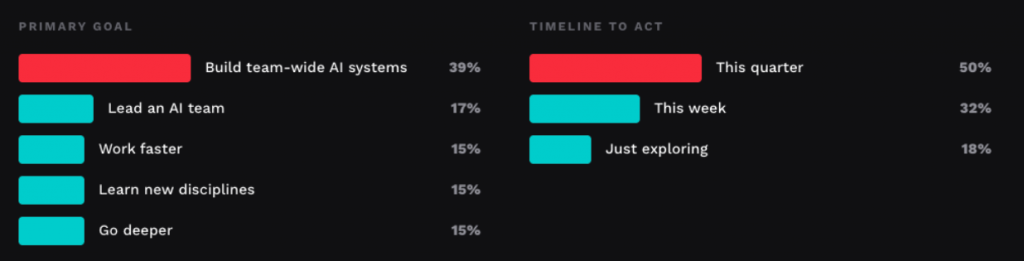
The top goal respondents selected was building team-wide AI systems.
Yet operations was simultaneously the lowest-ranked skill area in the entire assessment.
Put another way: the thing most marketers say they want to build is the thing they’re least equipped to build.
The urgency is real. Half of the respondents said they want to take action this quarter, and another 32% want to move immediately. This isn’t an audience experimenting casually with AI anymore. It’s a group actively trying to evolve, but still lacking the operational skills required to make that transition successfully.
The gap isn’t motivation. It’s capability. Specifically, the operational, measurement, and workflow design skills that sit between “using AI tools” and “building AI systems.”
Where do you stand?
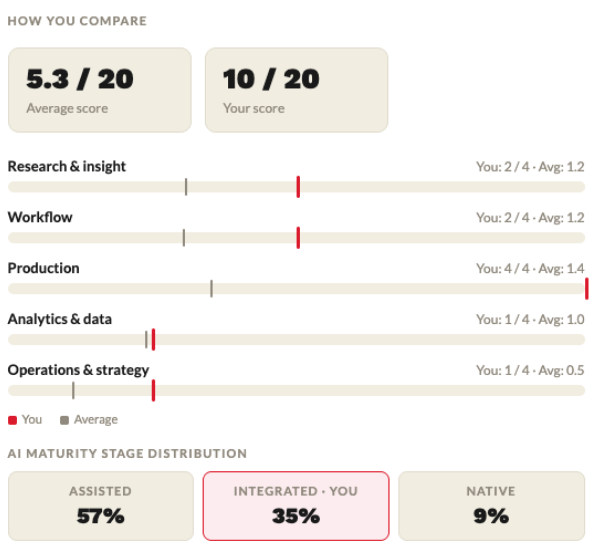
If you haven’t taken the AI skills assessment yet, it benchmarks your skills across the same five areas and shows you exactly where you are relative to other marketers.
The benchmark is useful because it separates frequency from skill. Most marketers will be surprised by which areas they’re stronger in than they expected, and which areas they’ve underestimated as gaps.
→ Take the AI skills assessment to see how your skills compare and identify where to focus next.
Join CXL’s new AI Native Marketer program:
Marketing titles are becoming obsolete. What matters now is what you can actually ship.
The marketers pulling ahead are the ones building AI-powered systems, redesigning workflows, automating execution, and integrating AI into the way they operate every day.
At the same time, bandwidth has become one of the biggest pain points for marketers because learning AI initially costs time before it gives time back.
That’s why we built this program: to help marketers move from being AI-assisted or AI-integrated to becoming truly AI-native.
The program combines live workshops, on-demand lessons, frameworks, templates, and real implementation examples.
You can join the program here.
Related Posts
-

Get data-backed ecommerce guidelines you can implement right away to increase revenue. If you're wondering what…
-

If you want to level up as a B2B marketer, follow people who are doing…
-
AI-assisted marketers are becoming more replaceable. Marketers who build AI systems around their work are…
-

The world's best marketers don't get to the top of their field by accident. They…