The change in skills requirements for AI in marketing jobs has gotten very specific very fast.
We scraped around 1,750 marketing job descriptions across two periods: roughly 1,000 from January 2026 and 750 from May 2026. Four months of job description data doesn’t sound like much. But when mentions of “AI tools” in marketing job descriptions triple, and specific tools like Claude quadruple, four months is significant enough.
The data shows that the expectations of AI marketing job requirements in 2026 are maturing from vague aspirations to operational requirements. And the marketers who can’t point to a working stack are increasingly going to find themselves filtered out before the first conversation.
Here’s what changed, why it matters, and what to do about it.
TL;DR
- CXL analyzed approximately 1,750 marketing job descriptions from January and May 2026. AI mentions increased from 30% to 37%, while mentions of specific AI tools tripled from 5% to 15%.
- ChatGPT, Claude, and Perplexity all appeared more frequently in job descriptions. Claude mentions saw the biggest relative increase, rising from 1.1% to 4.6%.
- AI expectations are moving beyond leadership. Director-level mentions rose from approximately 32% to 50%, while mid-senior roles increased from 30% to 40%.
- Performance and growth marketing saw the biggest shift in this dataset, with AI mentions rising from 32% to 63% in four months.
- Employers increasingly want marketers who can integrate AI into workflows, not just use individual tools. CXL’s separate Q3 2026 research found that 40% of sampled US marketing job descriptions explicitly required AI skills or responsibilities.
Table of contents
- How have AI requirements in marketing job descriptions changed in 2026?
- Which AI tools are employers asking marketers to know?
- Which marketing seniority levels saw the biggest growth in AI requirements?
- Which marketing functions saw the biggest increase in AI requirements?
- How should marketing teams adapt their hiring requirements for AI skills?
- How to build an AI-native marketing team with compounding systems
- What do changing AI job requirements mean for marketers?
How have AI requirements in marketing job descriptions changed in 2026?
The percentage of marketing job descriptions mentioning AI at all rose from 30% in January to 37% in May.
That increase is notable, but what’s more interesting is how the language changed.
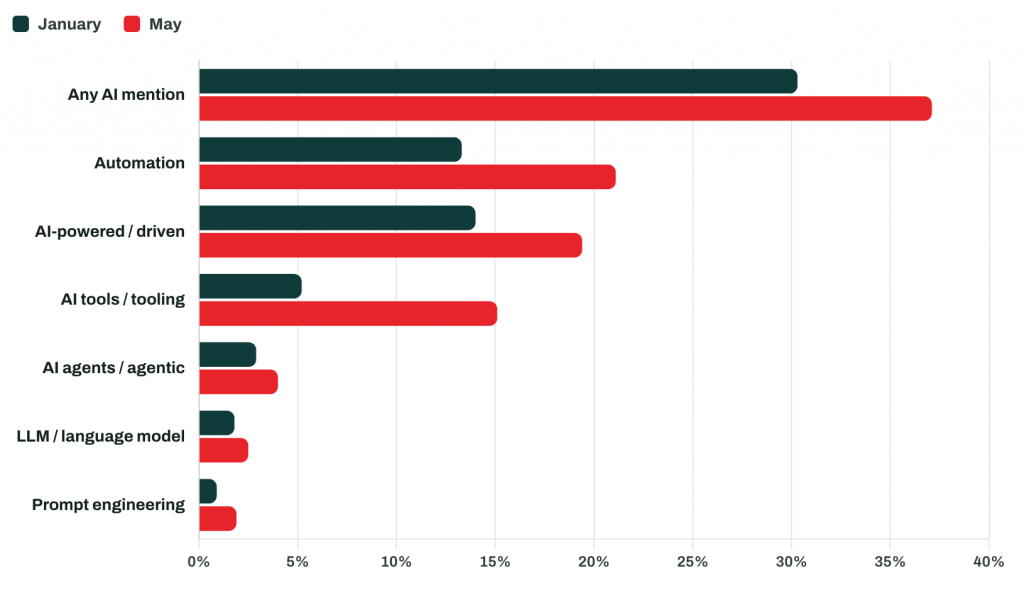
Mentions of “AI tools” or “AI tooling” jumped from 5% to 15%, while “automation” went from 13% to 21%. These aren’t the vague, untestable phrases such as”AI literacy” or “AI fluency” that dominated job posts a year ago. They’re operational requirements.
“AI literacy” as a phrase barely registered in January job posts. By May, it was appearing with increasing frequency. And while that sounds more subtle than “AI tooling,” it signals something important: companies are now trying to create a baseline floor. They want everyone to meet it, not just the AI-forward hires.
Phrases like “leverage AI,” “use AI to,” and “AI in your workflow” more than doubled, from 5% of posts in January to 12% in May. That’s the language of integration, not experimentation.
Takeaway: Employers aren’t asking if you’ve thought about AI. They’re asking if it’s already woven into how you work.
Which AI tools are employers asking marketers to know?
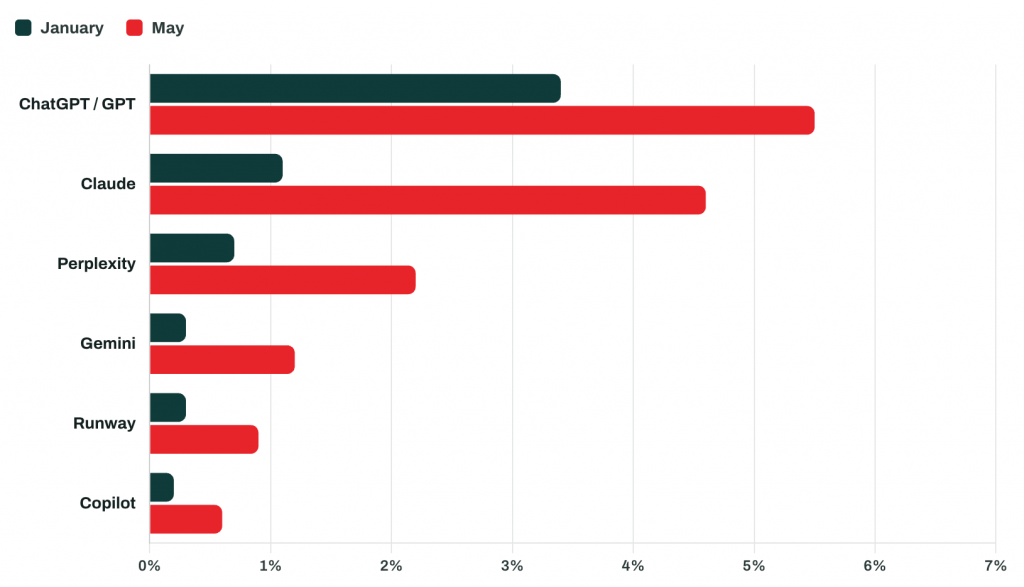
ChatGPT, Claude, and Perplexity all appeared more frequently in the marketing job descriptions we analyzed between January and May 2026. Here’s how mentions changed:
- ChatGPT / GPT: 3.4% → 5.5%
- Claude: 1.1% → 4.6%
- Perplexity: 0.7% → 2.2%
Content-generation tools like Runway and Midjourney also increased.
Think about what that means for hiring and for positioning yourself. Generic AI experience or terms like “uses AI” is no longer sufficient as a differentiator.
Takeaway: Specific tool fluency is becoming the filter. The new expectation is a named stack: which tools you use, how you’ve integrated them, and what you’ve produced faster as a result.
Which marketing seniority levels saw the biggest growth in AI requirements?
In the January–May 2026 data, explicit AI mentions increased most noticeably among directors and mid-senior marketers, while entry-level roles remained relatively flat. The shift is moving beyond AI strategy and into the people responsible for execution.
Back in January, AI expectations were heavily concentrated at the executive and director level. Companies wanted AI strategists—people who could define vision, guide adoption, and set direction. The expectation was that the executives would sort out AI, and the organization would follow.
That’s still happening. But the data shows the expectations are now cascading down:
- Director-level AI mentions: About 32% → 50%
- Mid-senior roles: About 30% → 40%
- Entry-level remained relatively flat
The growth at mid-senior isn’t directors anymore. It’s managers and senior ICs—the people who own execution. Companies still want leaders who can define AI strategy and operationalize it across marketing organizations. But they’re increasingly recognizing that strategy without operational fluency is worthless.
Entry-level holding flat is worth noting. AI requirements were becoming more explicit for experienced marketers, particularly those responsible for leading and executing work. Entry-level job descriptions weren’t changing at the same pace.
Takeaway: The explicit AI call-outs in job descriptions are for the people who need to lead and execute, not the people just starting out.
Which marketing functions saw the biggest increase in AI requirements?
Performance and growth marketing led the shift in CXL’s January–May sample. AI mentions increased from 32% to 63%, compared with 28% for content and SEO roles and 24% each for social/influencer and brand/creative roles in May.
If you’d asked most marketers which discipline AI would disrupt first, they’d probably say content. It’s the most obvious use case: generate drafts, scale output, and reduce production costs.
The data disagrees. Sharply.
AI mentions in performance and growth marketing roles nearly doubled in a single quarter, from 32% in January to 63% in May.
For comparison:
- Content / SEO roles: 28%
- Social / influencer roles: 24%
- Brand / creative roles: 24%
Performance marketing was already the most systematized discipline in the stack. Optimization loops, automation rules, experimentation frameworks, and data analysis aren’t new behaviors for performance marketers. AI slots directly into existing workflows instead of requiring a rethink of how the work gets done, which is why adoption is accelerating there faster than anywhere else in marketing.
But here’s the implication: if you’re a performance marketer who hasn’t deeply integrated AI into your analysis and automation workflows, your competition is about to face downward pressure. The output expectations will rise to match what AI-enabled peers can produce.
Speed and volume have always mattered in performance. Now the floor is higher.
Content marketers shouldn’t read this as good news for their discipline. The lower January–May numbers reflect slower adoption, not lower eventual impact. AI expectations are reaching disciplines that still rely more heavily on craft, judgment, and brand nuance.
And the latest data shows how quickly this is moving. In CXL’s Q3 2026 marketing hiring study, we analyzed another 878 US marketing job descriptions. This time, 54% mentioned AI, 40% explicitly required AI skills or responsibilities, and 35% mentioned automation. The full Q3 research report breaks down the requirements by role, seniority, and function.
How should marketing teams adapt their hiring requirements for AI skills?
Start specifying the AI workflows candidates should be able to build or run, not just the tools they know. Then test those skills during interviews and make sure existing team members can apply AI to the work they’re actually responsible for.
The data points to a few things that are easy to rationalize away, but probably shouldn’t be.
What AI skills should you include in a marketing job description?
Be specific about the tools, workflows, and outcomes the role requires. “Familiar with AI” isn’t a useful hiring requirement if you actually need someone who can automate reporting, analyze performance, or build repeatable processes.
The job descriptions we analyzed represent where companies thought they were in January vs. May. The operational reality inside most marketing teams is probably ahead of or behind what those job descriptions describe. Either way, your hiring signals are shaping the talent pool you can access.
The fix: If your job descriptions are vague on AI, you’re attracting candidates who are vague on AI. Be specific about which tools you expect fluency in, which workflows require AI integration, and what “fluency” looks like in practice.
How can you assess a marketer’s practical AI skills during hiring?
The fix: If you’re hiring, test for this directly. Ask candidates to walk you through an AI-assisted workflow they’ve built. Not a task they’ve done with AI, but a system they’ve created.
It’s relatively easy to say “candidates should know ChatGPT and Claude.” It’s much harder to assess whether someone can redesign a workflow around AI, building systems rather than using tools opportunistically. The job description language is getting more specific, but most interview processes haven’t caught up.
Why are AI workflow skills becoming a competitive advantage for marketers?
A marketer who can build repeatable AI systems for content production, analysis, and optimization is a different hire from someone who uses AI tools occasionally.
The fix: Start thinking about how that affects leveling and expectations before you’re forced to by the market.
How to build an AI-native marketing team with compounding systems
- Audit your own stack against the named tools in the market. If your team isn’t using ChatGPT, Claude, and Perplexity regularly, you don’t have an AI stack. Pick two tools and build workflows around them before adding more.
- Update your job descriptions to reflect operational expectations. “Experience with AI tools” is not a requirement. Get specific, name the tools, and describe the workflows, e.g. “Uses Claude to accelerate content production and performance analysis” is a requirement. It also filters your candidate pool in the right direction.
- Close the leadership-execution gap. If your director-level team members are AI-fluent but your managers aren’t, your AI strategy will die at the operational layer. And it’s not always a motivation problem—most marketers aren’t avoiding AI, they’re overwhelmed by it. Invest in hands-on enablement for senior ICs and managers, specifically those who own day-to-day execution. Workshops, working sessions, or shared prompt libraries: whatever moves it from “aware of AI” to “dependent on AI for certain workflows.”
- Pressure-test performance marketing first. If you have performance marketers who aren’t using AI for analysis, reporting, and campaign optimization, start there. The ROI case is easiest to make, the workflows are most amenable to AI integration, and the competitive pressure is highest.
- Build an internal AI fluency baseline before the market forces it on you. “AI literacy” barely registered in January but appeared more frequently in May, and our Q3 findings show that employers are continuing to make AI requirements more explicit. Get ahead of it by defining what AI fluency means for your team specifically; then assess it.
Frequently asked questions
What AI skills are employers looking for in marketing jobs in 2026?
Employers increasingly want marketers who can use AI in their daily workflows, automate recurring tasks, and work with tools such as ChatGPT and Claude. CXL’s Q3 2026 study of 878 US marketing job descriptions found that 40% explicitly required AI skills or responsibilities. The emphasis is shifting from general AI familiarity toward practical implementation and automation.
Which marketing roles have the highest demand for AI skills?
Growth, performance, and experimentation roles are among the strongest areas for AI-related requirements. In CXL’s Q3 2026 research, 54% of growth marketing roles and 56% of CRO/experimentation roles explicitly required AI skills. These functions already rely heavily on analysis, optimization, and repeatable processes, making AI integration particularly relevant to their day-to-day work.
Which AI tools should marketers learn to stay competitive?
ChatGPT, Claude, and Perplexity are useful starting points because they appeared increasingly often in CXL’s January–May 2026 job-posting analysis. But knowing the interfaces isn’t enough. Learn how to apply them to research, analysis, reporting, and automation. Employers are increasingly interested in what you can build and improve with AI, rather than how many tools you can list.
How can marketers demonstrate AI skills when applying for jobs?
Show working examples rather than simply adding AI tools to your resume. Document a workflow you’ve built, the problem it solves, the tools involved, and the results. That might be automated reporting, campaign analysis, content production, or a research process. A practical portfolio gives employers something specific to evaluate and helps distinguish tool familiarity from actual operational ability.
How should companies assess AI skills when hiring marketers?
Ask candidates to demonstrate how they’ve used AI to improve a real marketing workflow. Look at the problem they identified, the tools they selected, how they connected the steps, and what changed as a result. A candidate who can explain an end-to-end system provides stronger evidence of practical skills than someone who simply says they’re proficient in ChatGPT.
What do changing AI job requirements mean for marketers?
Knowing how to use ChatGPT isn’t much of a differentiator anymore. The advantage is being able to show the workflows you’ve built, the problems you’ve solved, and the results you’ve delivered. That’s the direction the hiring requirements are moving.
Four months of data showing a near-doubling of AI expectations in performance roles, a tripling of specific tool mentions, and the cascade of requirements from leadership to execution. This isn’t a trend in its early stages; it’s a trend hitting its acceleration phase.
The easy, vague requirement of AI in marketing jobs (“familiarity with AI tools”) is already being replaced by the operational requirement (“uses Claude and ChatGPT in daily workflows, builds automated processes”).
The cost of waiting is significant. Not because AI will replace marketers, but because the baseline of what a competent marketer can produce is rising. The teams and individuals who build the muscle memory, workflows, and institutional knowledge around AI tools will be operating at a level that’s genuinely hard to catch up to from a standing start.
The time for AI exploration is over. Build mode is the only mode that matters now.
What to do next
If your AI experience still starts and ends with prompting, the next step is to build something you can actually use. CXL’s Content automation for B2B marketers course shows how to build reusable workflows for content research, production, repurposing, and reporting. For performance marketers, B2B ad campaigns with Claude Code and n8n takes that into campaign execution, connecting ICP research to ad creation and automated performance monitoring. Both focus on the kind of operational skills employers are increasingly asking for.
