In May 2026, Google published its first official guide on generative AI optimization, and it’s the reset a lot of marketing teams needed.
Every week brings a new batch of AI-search optimization “hacks,” like llms.txt files, content “chunking”, AI-specific schema, or inauthentic brand “mentions”, and most of them aren’t worth the time. Google’s guide cuts through it.
The main takeaway is that AI search is still SEO. AEO and GEO aren’t separate disciplines; they’re just new labels for it.
But like most official search documentation, it only tells part of the story. The part it skips is the piece that independent research keeps surfacing as one of the biggest drivers of AI citation visibility.
Here’s where Google’s AI search optimization guide holds up against the data, where it’s incomplete, and where marketers still need more nuance.
TL;DR
- Google AI search optimization still relies on SEO fundamentals. AI Overviews and AI Mode use Google’s search infrastructure, so crawlability, indexing, useful content, and technical SEO still matter.
- Most GEO shortcuts aren’t supported by the evidence. Google doesn’t use llms.txt for Search, require AI-specific schema, or need content split into artificial chunks.
- Brand mentions correlate with AI visibility, but don’t guarantee citations. Ahrefs found a 0.664 correlation between web mentions and brand visibility in AI Overviews. That’s a relationship, not proof that more mentions cause more citations.
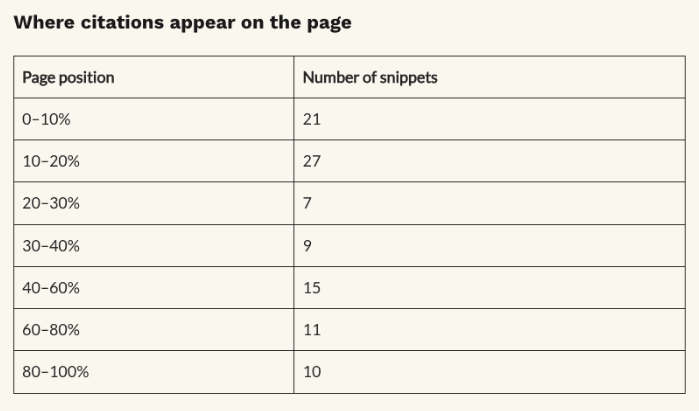
- Page structure can help make answers easier to find. CXL’s analysis of 100 AI Overview citations found that 55% of cited passages appeared within the first 30% of the source page.
- Google’s recommendations aren’t a complete GEO strategy. ChatGPT, Perplexity, and other AI platforms have different retrieval systems, so visibility needs to be evaluated across the platforms your buyers use.
Table of contents
- Is AEO and GEO optimization different from traditional SEO?
- Do llms.txt, AI-specific schema, and content chunking improve AI citations?
- How do off-site brand mentions relate to AI search visibility?
- Does content structure affect AI search retrieval?
- This guide is Google-specific. The AI search ecosystem isn’t.
- What should marketers prioritize for AI search optimization?
- The SEO fundamentals still win.
Is AEO and GEO optimization different from traditional SEO?
For Google AI Overviews and AI Mode, AEO and GEO build on the same foundations as traditional SEO. Google’s AI search features rely on its existing Search index and ranking systems, although AI-generated responses may retrieve and combine information from multiple related queries.
The guide’s core framing is this: AI Overviews and AI Mode are built on the same ranking systems as standard Search.
They use retrieval-augmented generation (RAG) and query fan-out to pull from Google’s existing index. Which means AEO and GEO aren’t parallel disciplines: they’re a generative layer on top of infrastructure you should already be optimizing.
The overlap with traditional rankings is smaller than you’d expect. In Ahrefs’ March 2026 analysis of 4 million AI Overview citation URLs, only 37.1% also ranked in the organic top 10 for the same query. Another 36.7% didn’t appear in the top 100 organic results. SEO is still the foundation, but ranking for the original query clearly isn’t the whole citation story.
Google recommends three main things to focus on:
- Create unique, non-commodity content with original insight, rather than rehashed takes.
- Maintain clear technical structure for crawling and indexing.
- Optimize local and e-commerce details through Merchant Center and Google Business Profiles.
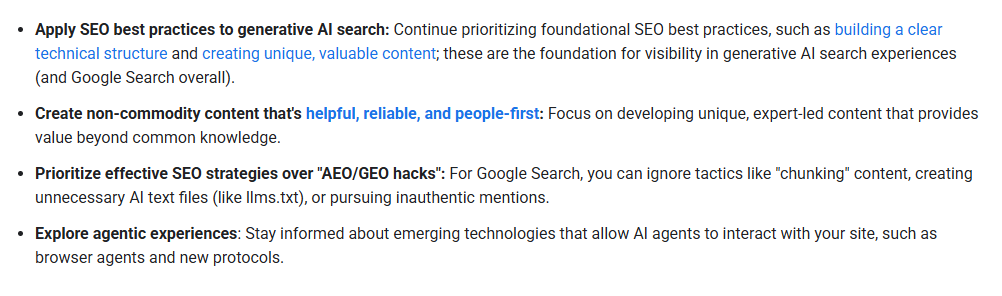
The guide also points ahead to agentic search: AI systems that interact with your site on behalf of users, comparing products, checking availability, and completing purchases.
For commerce teams, Google is signaling the Universal Commerce Protocol as the emerging standard for letting AI agents connect with business systems. For everyone else, the guidance is practical:
- Crawlable content
- Clear navigation
- Accessible forms
- Fewer UX patterns that block automated interaction
Do llms.txt, AI-specific schema, and content chunking improve AI citations?
Google doesn’t require llms.txt, special AI markup, or artificial content chunking to include pages in AI Overviews or AI Mode. Independent research also hasn’t established that adding llms.txt or extra schema increases AI citations. That doesn’t make structured data or clear content organization useless; it means they aren’t shortcuts to AI visibility.
Google’s AI search guide includes a mythbusting section, and this is where it gets interesting.
The specific AI search optimization tactics called out:
- llms.txt files: Not used, not required by Google
- “Chunking” content for AI: Not needed, Google handles long pages
- Rewriting content specifically for AI: Synonyms and meaning are already handled
- Structured data for AI visibility: Useful for rich results, not AI citations
- Inauthentic brand “mentions”: Seeking these out won’t help
And independent research backs this up.
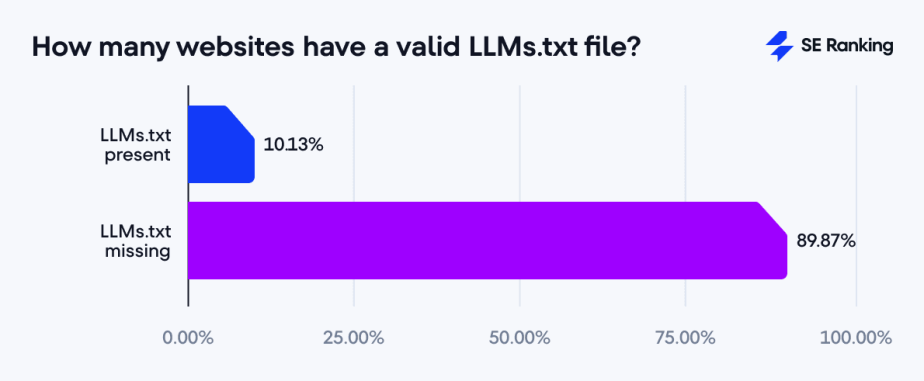
SE Ranking analyzed nearly 300,000 domains and found no meaningful relationship between having an llms.txt file and ChatGPT citation frequency. Removing the variable from its predictive model actually improved accuracy. That’s not a controlled test of adding the file, but it gives marketers little reason to prioritize it.
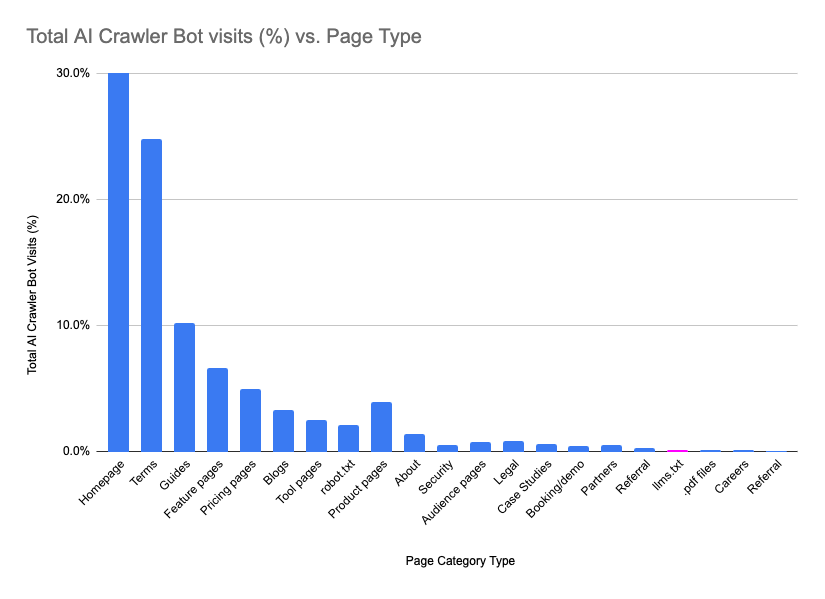
OtterlyAI’s 90-day log study found that just 84 out of more than 62,100 AI crawler visits to its test site targeted /llms.txt. That’s roughly 0.1% of requests. It’s one site’s crawler data, not an industry-wide measurement, but it doesn’t suggest AI bots are rushing to read these files.
On schema: Ahrefs tracked 1,885 pages that added JSON-LD against a matched control group. The treated pages showed no citation lift across AI Overviews, AI Mode, or ChatGPT.
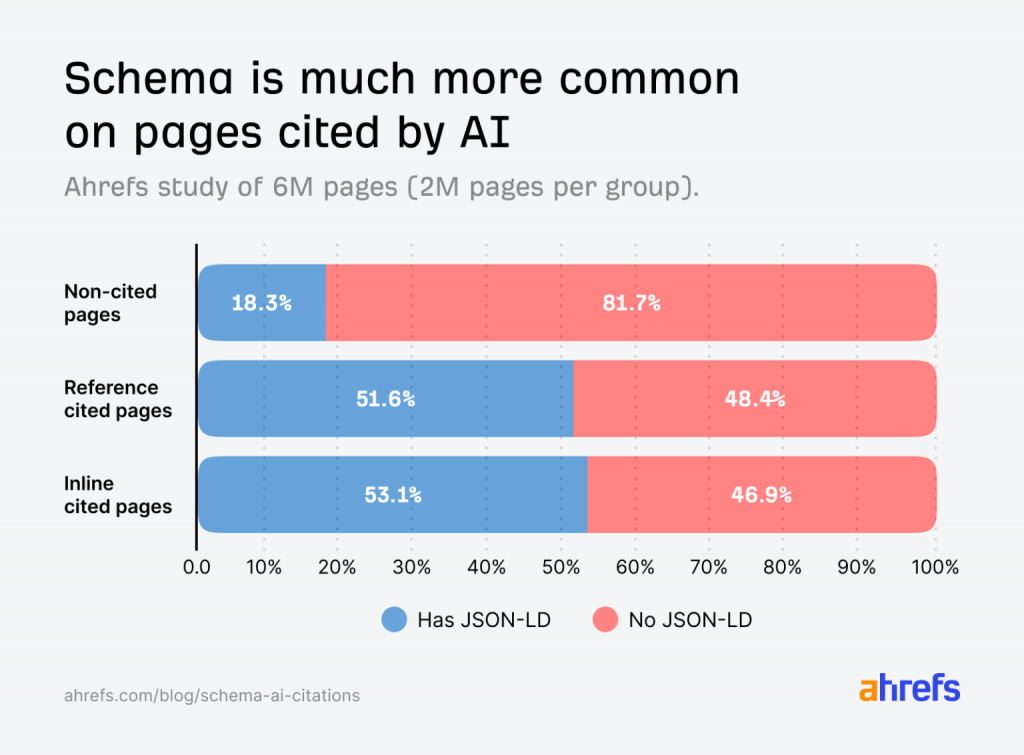
So on the technical ‘hacks’ side, Google and the independent data are mostly saying the same thing: these tactics look like AI Overviews optimization, but they don’t change whether you get cited.
How do off-site brand mentions relate to AI search visibility?
Independent studies have found strong correlations between brand mentions and visibility in AI-generated answers. But correlation isn’t causation. The evidence supports building genuine visibility through reputable publications, reviews, and industry discussions—not manufacturing mentions to manipulate citations.
Here’s where the guide is getting the most push-back.
Google warns against “inauthentic” brand mentions, and Lily Ray called this out on X as “classic Googlespeak.” She’s right that the language is vague enough to mean whatever Google needs it to mean later, and the practical implication for SEOs is unclear.
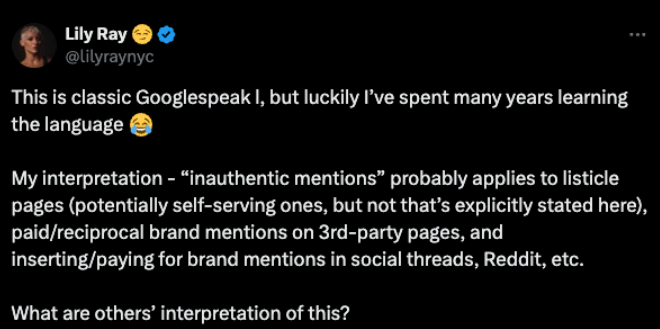
What the guide doesn’t say is that authentic off-site visibility is one of the strongest signals in every independent AI citation study.
The data is hard to ignore:
- SE Ranking (216,000+ pages): Domains with millions of Reddit mentions averaged 7 ChatGPT citations vs. 1.8 for low-mention domains—a 3.9x multiplier. Quora showed 4.1x.
- Semrush: Reddit and Wikipedia were still ChatGPT’s two most-cited domains, even after a sharp September drop in citation share.
- Ahrefs: Branded web mentions correlated at 0.664 with AI Overview visibility—one of the strongest signals in their dataset.
- Contently: Roughly 75% of the citation signal lives off-site.
Across four independent studies, off-site brand presence keeps surfacing as a primary driver of AI visibility.
But Google’s AI search guide doesn’t frame it that way.
It warns against gaming mentions and points you back to your own content. The advice isn’t wrong—manufactured mentions across low-quality sites aren’t a strategy. But the leap from “don’t fake it” to “focus on your own helpful content” leaves out the legitimate version of the thing that matters.
Real participation in forums, review sites, and third-party publications isn’t manipulation; it’s distribution. The guide conflates the two.
Does content structure affect AI search retrieval?
Clear headings, direct answers, and focused sections can make a page easier to navigate and its information easier to retrieve. Google doesn’t require a special writing format for AI search, but CXL’s citation analysis suggests answer placement is worth considering when structuring content.
Google’s generative AI optimization guide says you don’t need to write in a specific way for LLMs. Systems understand synonyms, which means you don’t need AI-only pages or separate versions of your articles.
But the nuance it skips is about retrieval, not writing style.
Our own analysis of 100 Google AI Overview citations found that 55% of cited snippets came from the first 30% of the source page. AI Overviews were more likely to cite answers that appeared early, were easy to extract, and directly addressed the query.
Ahrefs’ research on 1.4 million ChatGPT prompts found that cited pages aligned more closely with the fan-out sub-queries ChatGPT generated in the background than with the original prompt.
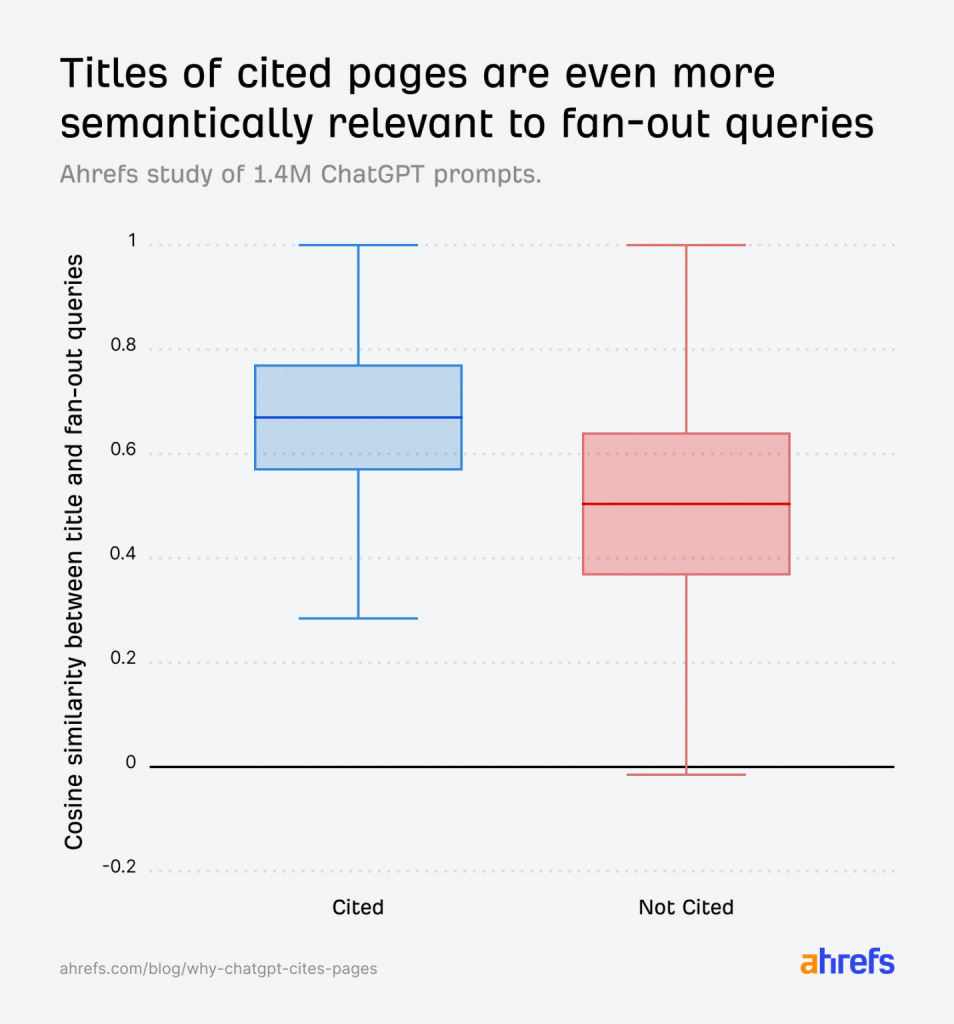
That matters because query fan-out happens before a page gets read. If AI Mode breaks a broad query into 6 sub-queries, your page needs to make clear which specific questions it answers, rather than just that it’s “about” the general topic.
The practical implication: You’re not rewriting content for AI; you’re making it easier to retrieve.
That means:
- Answers near the top, not buried in paragraph 4
- Titles and headings that map to specific questions, not vague category labels
- Introductions that state the answer, then explain it
- Sections that have a clear, singular purpose
Google’s framing implies on-page structure doesn’t matter much for AI. The citation data says it matters quite a bit, just not in the way old SEO keyword-stuffing assumed.
See our guide on how to structure content for AI citations.
This guide is Google-specific. The AI search ecosystem isn’t.
One thing the guide doesn’t flag: it covers AI Overviews and AI Mode. Not Gemini stand alone, ChatGPT, Perplexity, or Claude. The overlap is significant—crawlable pages, useful content, and clear structure, but the signals aren’t identical.
- ChatGPT has a partnership with Reddit that’s bringing more Reddit content into responses.
- Perplexity leans heavily on third-party publishers and review sources. These platforms pull from a broader mix than Google’s index-centric approach.
The core SEO fundamentals apply everywhere. But the off-site visibility layer that Google’s guide de-emphasizes is likely more important for AI platforms that aren’t anchored to Google’s own index.
Key takeaway: Don’t treat this guide as the full AI visibility playbook. It’s a useful piece of it, for one channel.
How should marketers measure AI search visibility?
Ranking and traffic still matter. But they’re no longer enough to explain what’s happening in AI search.
In Ahrefs’ February 2026 study, researchers analyzed 300,000 keywords and estimated that AI Overviews were associated with a 58% lower click-through rate for the top organic result, compared with the rate expected without an AI Overview. That’s an observational estimate, not proof that AI Overviews caused every lost click. But it’s a strong reason to stop treating traffic as the only measure of search performance.
There’s also a practical measurement update. Google’s Generative AI performance report in Search Console now shows impressions from AI Overviews and AI Mode, with breakdowns by page, country, device, and date.
Use that alongside the rest of your data:
- Visibility: Which pages receive impressions in Google’s generative AI features?
- Citations and mentions: Which buyer questions surface your brand or content, and which competitors appear instead?
- Traffic: Are organic clicks and CTR changing on queries where AI Overviews appear?
- Business impact: Are AI-assisted discovery journeys generating qualified visitors, leads, or conversions?
Third-party citation tracking can help fill some of the gaps, but don’t confuse a citation with a click or a brand mention with a recommendation.
The goal is to understand where your brand appears, how that visibility changes, and whether it contributes to the business.
For the commercial side of that measurement problem, see our analysis of LLM traffic versus Google traffic and why the quality of the visit matters more than raw click volume.
What should marketers prioritize for AI search optimization?
Start with the work that has evidence behind it: technical SEO, original content, clear answers, and authentic brand visibility. Audit where your pages and competitors are appearing in AI search before spending time on speculative GEO tactics.
- Don’t build llms.txt files, AI-specific schema, or artificially chunked content solely to improve Google AI citations. There’s no evidence these shortcuts deliver the result they’re supposed to.
- Audit your AI search presence off-site. Run your top buyer queries through ChatGPT, Perplexity, and AI Mode. Don’t just check if your pages show up—look at which third-party sources keep appearing. Are Reddit threads being cited? G2 pages? Quora answers? Comparison posts? Review sites? That’s your map of where AI systems are already pulling evidence from, and where your brand needs to show up through real participation.
- Prioritize retrieval on your most important pages. Don’t rewrite everything. Start with titles, headings, intros, and the first few sections. Make the answer clear early. Map sections to specific sub-questions your buyers actually ask. The goal is pages that are easier for AI to extract signal from, not pages that perform differently for humans.
- Build authentic off-site presence. Better reviews on G2 and Capterra. Thoughtful contributions to relevant Reddit threads. Useful comparisons on third-party industry sites. Partner pages that buyers actually trust. This isn’t a quick-win play; it compounds over time, but it’s where a disproportionate share of citation signal lives.
- Keep the SEO fundamentals. Google is right that AI search is still SEO. Crawlable pages, useful content, clear structure, trusted signals. The generative layer doesn’t replace these; it runs on top of them.
Frequently asked questions
Does Google recommend GEO or AEO as separate SEO strategies?
No. Google’s official guidance says AI Overviews and AI Mode build on existing search infrastructure. Traditional SEO fundamentals remain relevant, although other AI platforms may use different retrieval systems.
Does llms.txt improve visibility in Google AI Overviews?
No. Google explicitly says it doesn’t use llms.txt for Search. Independent research has also found no meaningful relationship between having an llms.txt file and receiving more ChatGPT citations.
Does structured data help content get cited by AI?
Structured data helps search engines understand content and can enable rich results. But Google doesn’t require AI-specific schema, and Ahrefs’ 2026 research found no meaningful citation uplift from adding JSON-LD markup.
Do pages need to rank in Google’s top 10 to appear in AI Overviews?
No. Ahrefs’ 2026 analysis found that only 37.1% of AI Overview-cited URLs also ranked in the organic top 10 for the same query. Traditional rankings matter, but AI citations can come from elsewhere.
How should marketers track AI search performance?
Track generative AI impressions in Google Search Console, monitor citations and brand mentions for priority queries, and compare referral traffic and conversions. Rankings alone won’t tell you how visible your content is in AI-generated answers.
The SEO fundamentals still win.
Google’s generative AI optimization guide is useful. It debunks a lot of the noise that’s been clogging AI search thinking for the past year, and reframes the discipline correctly: this is still SEO.
But it’s Google’s guidance for Google’s products, written from Google’s perspective. It doesn’t account for how ChatGPT, Perplexity, or Claude surface information. And it sidesteps the most consistently supported finding in independent AI citation research: that authentic off-site visibility is one of the biggest factors in whether AI systems find, trust, and cite you.
The practical takeaway isn’t complicated.
- Do the SEO fundamentals.
- Make your best pages easier to retrieve.
- Build brand presence in the places AI systems already trust.
- Stop spending engineering time on technical hacks that have no data behind them.
Most marketing teams will read this guide and go fix their llms.txt file anyway. The ones who won’t; the ones who’ll build the visibility strategy that compounds, tend to have a system behind their decisions.
Join CXL’s AI Native Marketing program
Knowing which GEO tactics don’t work is useful. Building systems that keep you from wasting time on them is better.
CXL’s AI Native Marketing program focuses on putting AI to work across marketing workflows. Its current sprint covers building a marketing brain, a campaign engine with quality checks, and a reporting agent. The point isn’t collecting more AI tactics. It’s building repeatable systems that turn information into decisions and execution.