SEO used to reward depth. If your article was an exhaustive piece on a topic that covered every angle and included a few keywords, clicks would usually follow.
Today, search rewards precision over sheer depth.
Ahrefs data shows Google AI Overviews have cut clicks to top-ranking content by up to 58%. As a result, getting cited in these AI-generated answers is becoming increasingly important for maintaining content visibility.
This is no longer limited to low-intent informational search. Semrush analyzed more than 600,000 keywords across 10 industries and found that the share of commercial-intent SERPs showing AI Overviews grew 71% between November 2025 and April 2026.
The question most content teams haven’t answered yet: what actually determines whether Google cites your page?
We had a hunch it wasn’t just domain authority or keyword density. While auditing sources behind AI Overview citations in Bing’s AI performance reporting tool, we kept noticing the same pattern: cited snippets consistently appeared near the top of their source pages. Not always, but often enough to investigate.
So we ran a structured analysis across 100 AI Overview citations, mapping exactly where within each source page the cited snippet appeared.
Here’s what we found.
TL;DR
- Treat answer placement as a retrieval consideration, not a guaranteed ranking factor. Google says standard SEO fundamentals still apply and there are no special technical requirements for appearing in AI Overviews.
- In CXL’s analysis of 100 Google AI Overview citations, 55% of cited passages appeared within the first 30% of the source page.
- The top 20% of pages accounted for 48 of the 100 citations, while the bottom 40% accounted for 21.
- Kevin Indig found a similar pattern across 18,012 verified ChatGPT citations: 44.2% came from the first 30% of a document.
- Page position is not the only factor. Ahrefs’ 2026 analysis found that only 37.1% of AI Overview-cited URLs also ranked in Google’s organic top 10 for the same query.
Table of contents
- TL;DR
- Where on a page do AI Overview citations come from?
- Why front-loading isn’t just good UX—it’s now a citation strategy
- What this means for your content structure right now
- Does content structure replace traditional SEO for AI Overviews?
- Frequently asked questions about Google AI Overview citations
- What should marketers do next?
Where on a page do AI Overview citations come from?
In our 100-citation sample, 55% of cited passages came from the first 30% of a page. A further 24% came from the middle section (30–60%), while the bottom 40% accounted for 21%.
Here’s the full breakdown:
Where citations appear on the page
| Page position | Number of snippets |
| 0–10% | 21 |
| 10–20% | 27 |
| 20–30% | 7 |
| 30–40% | 9 |
| 40–60% | 15 |
| 60–80% | 11 |
| 80–100% | 10 |
Page position = where the snippet appeared relative to article length
The concentration at the top isn’t subtle. The 10–20% zone alone accounts for more citations than any other segment. If your core answer lives at the 50% mark because you built up to it with context and storytelling, it sits in a part of the page that produced fewer citations in our sample.
This isn’t a Google-specific quirk either.
Kevin Indig’s analysis of 1.2 million search results and 18,012 verified ChatGPT citations found the same pattern: 44.2% of ChatGPT citations come from the first 30% of a document, after which citation likelihood drops sharply.
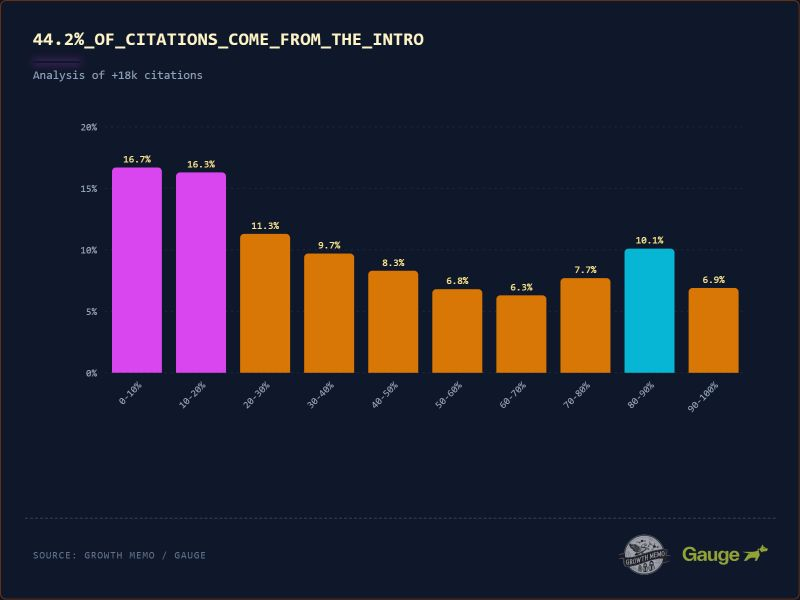
Indig describes it as a “ski ramp” effect: a steep cliff after the first third of the page, then a long, slow tail to the bottom.
“Burying key product features or definitions deep in the content reduces retrieval probability by a factor of 2.5 compared to the introduction.”
— Kevin Indig
Two different AI systems, with two independent datasets showing the same concentration of citations toward the beginning of source pages.
Traditional rankings still matter, but they don’t explain every citation
Page position is only one part of the picture.
Ahrefs analyzed four million AI Overview URLs across 863,000 Google SERPs in 2026. Only 37.1% of cited URLs also appeared in the organic top 10 for the same query. Another 26.2% ranked between positions 11 and 100, while 36.7% did not appear in the organic top 100.
That does not mean traditional SEO no longer matters. Google explicitly says pages must still be indexed and eligible to appear in Search, and its standard SEO guidance continues to apply to AI features.
But it does show why optimizing only for the original keyword ranking misses part of the retrieval process. Google confirms that AI Overviews and AI Mode can use query fan-out, issuing multiple related searches across subtopics and data sources before assembling a response.
Why front-loading isn’t just good UX—it’s now a citation strategy
The instinct to build context before delivering an answer is deeply embedded in content marketing. Hooks, narrative arcs, problem-agitate-solve structures: all of it is optimized for human reading patterns and time-on-page metrics.
A narrative build-up can delay the clearest answer. Both our AI Overview sample and the larger ChatGPT dataset show citations concentrating earlier in source pages.
If your article is about AI Overview citations, the definition of what an AI Overview is, combined with the clearest statement of your core finding, should appear in the first 20% of the page. Not after the third subheading, nor after you’ve “warmed the reader up”.
This creates a real tension for content strategists. Long-form content built for engagement and dwell time runs directly counter to a structure optimized for AI citation.
You don’t have to choose one or the other, but you do have to be intentional about both. The answer is to front-load without sacrificing depth: lead with the insight, then build the supporting case beneath it.
The one exception worth noting, however, is FAQ sections.
Several citations from the bottom of pages came from FAQ blocks addressing specific, discrete questions. Each question-and-answer pair is structurally self-contained, which may make the relevant passage easier to identify even when it appears late on the page.
That does not prove Google gives FAQ sections preferential treatment. But it does suggest that clear, self-contained answers can still be cited from deeper page positions.
What this means for your content structure right now
The practical implication isn’t “write shorter articles.” It’s “answer earlier.” Here’s how to operationalize that without dismantling your existing content strategy:
- Audit your top-traffic pages for answer depth. Find where the primary answer to your target query actually appears on the page. If it’s below the 30% mark, that’s your first optimization target. Move the core definition or finding up before the context-setting and the problem framing.
- Rewrite your introductions as answer-first summaries. Put the clearest direct answer and primary finding near the beginning of the page, then build the supporting context underneath it.
- Build FAQ sections with AI citation intent. Don’t use FAQ blocks as an SEO checkbox. Write them as standalone answer units: each question gets a crisp, complete answer in the first sentence. These are the structures most likely to get cited from deep-page positions.
- Use a tool to identify citation gaps. There are now Chrome extensions that analyze what AI Overviews are citing from competitor pages, compare it against your content, and surface what’s missing or poorly positioned. If you need help building your own, here’s how we did it.
- Measure generative AI visibility in Search Console. Google introduced dedicated Search Generative AI performance reports in June 2026 and rolled them out worldwide by August 31. These reports separate impressions generated through features such as AI Overviews and AI Mode, so you can now track AI-search visibility directly rather than relying entirely on third-party monitoring.
Does content structure replace traditional SEO for AI Overviews?
Rankings without citations are increasingly hollow. Showing up at position one means less when the AI Overview above it answers the query before the user ever scrolls.
The data from both Google and ChatGPT citation analysis points to the same conclusion: if your answer isn’t in the first third of the page, there’s a better than even chance it’s not getting cited at all.
The fix: Instead of producing more content, restructure what you already have: move answers earlier, tighten definitions, and build FAQ surfaces that function as discrete citation targets.
Frequently asked questions about Google AI Overview citations
Where do Google AI Overview citations come from on a page?
In CXL’s 100-citation sample, 55% of cited passages appeared within the first 30% of the source page.
Do you need to rank in Google’s top 10 to be cited?
No. Ahrefs found that 37.1% of AI Overview-cited URLs also ranked in the organic top 10 for the same query.
Does Google require special AEO or GEO markup?
No. Google says there are no additional technical requirements or special schema needed for AI Overviews or AI Mode.
Do FAQ sections help with AI Overview citations?
They can provide clear, self-contained answers, but there is no evidence that Google gives FAQ sections preferential citation treatment.
Does putting an answer higher guarantee an AI Overview citation?
No. The research shows a citation pattern, not a guarantee or causal ranking factor.
What should marketers do next?
AI Overview optimization still starts with strong SEO, but marketers now need to understand retrieval, citations, query fan-out, and how to measure visibility when a search does not produce a click.
Learn how to structure pages for AI retrieval and citation: CXL’s Technical SEO and AI Search training covers retrieval, query fan-out, passage-level optimization, and AI visibility.
Optimize content specifically for AI search: Optimize pages for AI search with GEO/AEO covers AI-search visibility, content structure, citation gaps, and comparison content.
Build AI visibility into your marketing systems: The AI Native Marketer program includes building an AI visibility baseline, monitoring citations and mentions, and identifying content gaps.
