The standard advice on AI-generated B2B content has been predictable: be careful with AI. Don’t let it water down your brand. Keep a strong human in the loop. Avoid the slop.
That advice isn’t wrong. But now that we have ranking data, we can be more specific about where AI content holds up and where the problems start.
Semrush analyzed 42,000 blog posts, human-written, AI-generated, and mixed, and tracked where each type lands in the SERP.
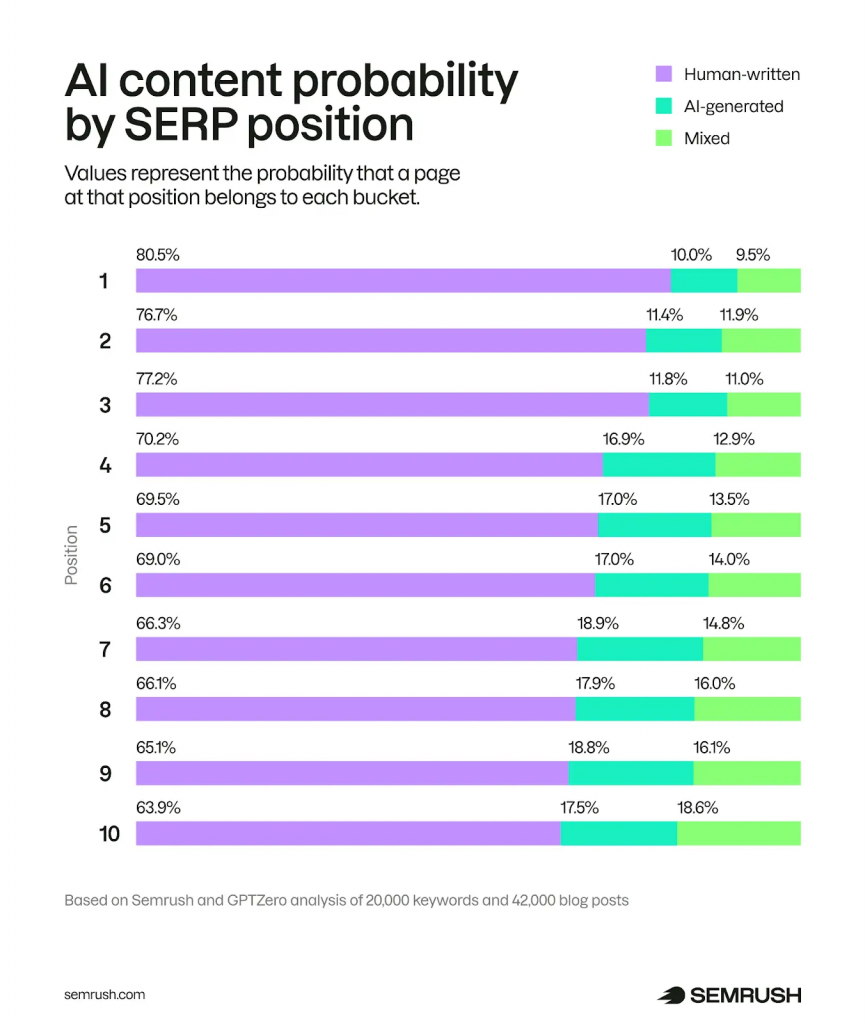
Among pages ranking #1, 80.5% were classified as human-written, compared with 10% classified as AI-generated.
The gap narrows further down page one. That doesn’t prove AI content ranks as well as human content—the study used an AI detector to classify existing pages, not to test what causes rankings. But it does show that AI-generated content is appearing in competitive search results.
So if AI content isn’t the problem, what is?
TL;DR
- To make an LLM write in your brand voice, start with your published content. Analyze your strongest articles for recurring patterns in structure, wording, tone, and use of evidence.
- Turn those patterns into specific prompting rules. Instructions like “lead with the insight” or “use two-sentence paragraphs” give an LLM more direction than “sound professional.”
- Give the LLM real examples of your writing. Use approved articles, a voice analysis report, or Markdown files as context alongside your instructions.
- Test and refine the output. Compare AI drafts against your original writing, identify where the voice drifts, and feed those corrections back into the prompt.
Table of contents
The real risk isn’t quality. It’s voice drift.
Scaling content has always been a consistency problem. Hire more writers, and you get more variation. Hire cheaper writers, and you get lower quality. Add AI, and suddenly you’re publishing at 3x the volume with 3x the chances of sounding like everybody else.
A 2026 Semrush study found that 70% of SEO professionals cited faster content production as a benefit of AI, but only 19% said it improved content quality. AI makes it easier to publish more. It doesn’t automatically make what you’re publishing any better.
Voice drift is what happens when no one’s monitoring brand content as output increases. One post sounds sharp and opinionated, while the next sounds like a LinkedIn thought leader on autopilot.
The fix: a tighter feedback loop between how you write and what your LLM outputs.
The problem with most AI content isn’t that it’s AI, it’s that it’s trained on the average of the internet. If your brand voice is anything other than average, you have to teach an LLM your tone of voice explicitly.
Feeding a generic prompt into Claude or ChatGPT, to get decent-ish output, then spending 40 minutes humanizing AI content or editing it back into something that sounds like you, isn’t a system. That’s manual correction with extra steps.
How do you identify your brand’s tone of voice?
To identify your brand’s actual tone of voice, analyze your best published content for recurring patterns in sentence structure, vocabulary, paragraph length, and use of evidence. Compare those patterns with your brand guidelines to find where the documented voice and the published voice differ.
Before you can teach an LLM your tone of voice, you need to know what your voice actually is: not the version in your brand guidelines, but the version that shows up in your best-performing posts.
Those are often very different.
While brand guidelines describe intentions, published content reveals patterns:
- What sentence structures do you use?
- How long are your paragraphs in practice?
- Do you lean on analogies, statistics, or direct commands?
- Do you ask questions or make declarations?
A tool that scrapes your recent posts and surfaces these patterns will tell you more about your real voice than any brief your marketing team has written. That’s the baseline. Work from that, rather than an idealized document.
If you have a tone of voice guide, don’t discard it—compare it.
Where your documented voice and your published voice diverge, you have a problem worth solving before you scale anything.
How do you prompt an LLM to match your brand voice?
An effective LLM brand voice prompt translates writing patterns into specific instructions about structure, vocabulary, tone, and evidence. Instead of asking for “conversational but professional” content, tell the model exactly how your best writing behaves.
“Write in a conversational but professional tone” does nothing. Every LLM defaults to something it calls “conversational but professional.” What you need is specific, behavioral instruction—not adjectives, but patterns.
Good LLM tone of voice prompts include:
- Sentence structure rules: “Lead with the insight, then explain. Never bury the main point in paragraph three.”
- Formatting constraints: “Short paragraphs. Two sentences, three at most. Use single-sentence paragraphs for emphasis.”
- Vocabulary bans: “Don’t use ‘leverage,’ ‘synergy,’ ‘unlock potential,’ or ’empower.’ These are off the list.”
- Proof requirements: “Every claim needs a specific example. No generic assertions.”
- Tone anchors: “Write like you’re explaining something to a smart colleague who’s skeptical, not a prospect you’re trying to impress.”
The more behavioral your prompt, the more your output reflects your actual voice.
Mastering your tone of voice and teaching it to your LLM is key, especially if you aim to scale content production consistently.
So we built a blog voice analyzer tool that does exactly that.
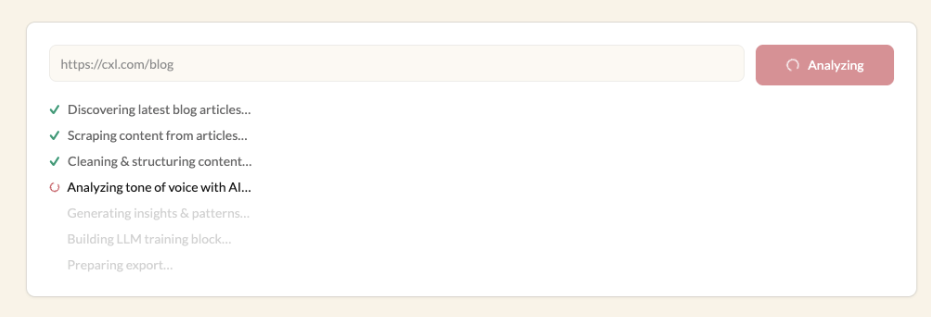
To build your own voice analyzer, you can also find the prompt used to build this app here.
If you’re using Claude Code, you can go further: export your analyzed posts as .md files and include them as direct context.
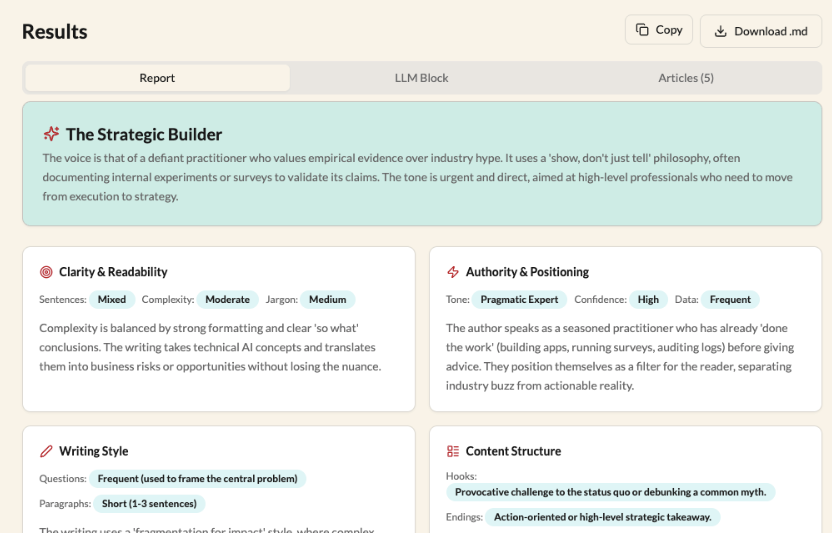
This gives your model real examples and much richer context to work with.
And if you already have your tone of voice documented, you can paste it into the tool.
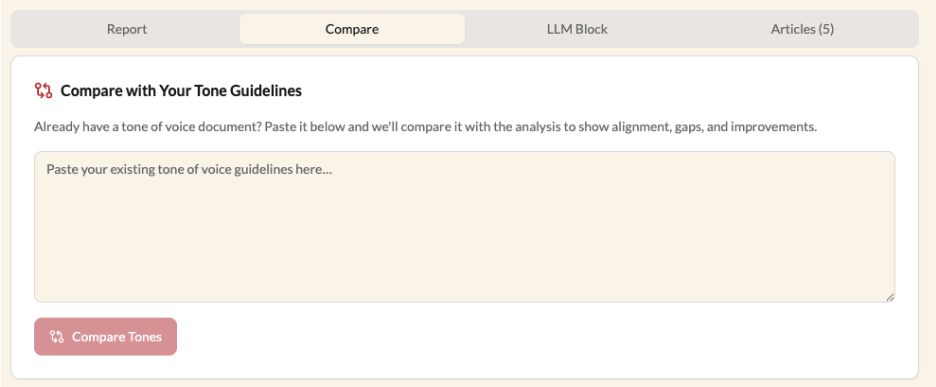
It will compare it with the generated report, show how closely they match, highlight any gaps, and suggest how to refine it even further.
How do you build a repeatable LLM brand voice workflow?
A repeatable LLM brand voice workflow has four steps: audit your strongest content, extract its writing patterns, convert them into a behavioral prompt, and use human editing to refine the instructions over time.
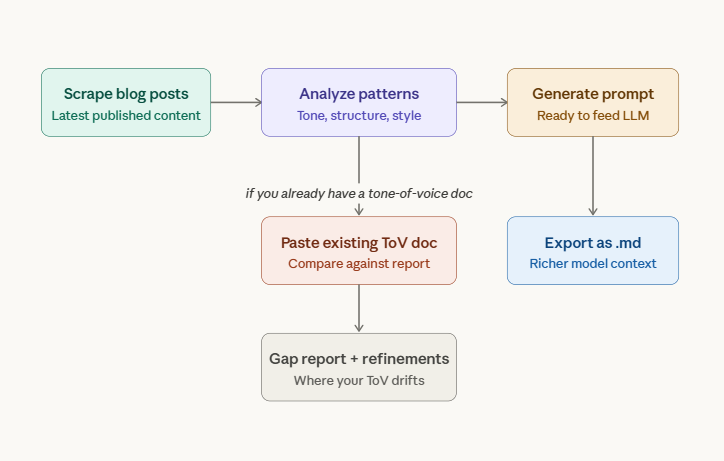
Getting your LLM to write in your tone of voice isn’t a one-afternoon project, but you can move fast.
- Audit your five best posts: Pick five pieces you’d show a new hire as examples of your brand at its best. Look for patterns: average paragraph length, how your H2s work—questions or declarations—and your ratio of data to opinion. This is your voice fingerprint.
- Run a scrape-and-analyze pass: Use a tool that processes your recent content and identifies structural patterns automatically. The goal isn’t a perfect brief; it’s a starting hypothesis you can refine. Compare what you find against whatever brand guidance you already have.
- Build a behavioral prompt, not an adjective list: Take the patterns you found and turn them into constraints. Be specific. “Two-sentence paragraphs” beats “punchy.” “Lead with the counter-intuitive finding” beats “engaging.” Test this prompt on a piece you’ve already written and see how close the output gets.
- Build a human review step: AI drafts, you humanize the AI content—but edit for voice, not just accuracy. Every time you change something, ask why. Those corrections are data. Feed them back into your prompt.
How do you measure whether an LLM matches your brand voice?
You measure LLM brand voice consistency by testing drafts against examples of your best writing, not by asking the model whether it sounds like you.
Start with three pieces of content your team would happily publish. Give the LLM the same briefs, then compare the output against your originals.
Look at four things:
- Structure: Does it lead with the insight, or bury the point under three paragraphs of setup?
- Language: Is it using your vocabulary, or drifting into generic AI phrases?
- Point of view: Does it make the kind of arguments your brand makes, with the same level of confidence and skepticism?
- Evidence: Does it support claims with relevant examples and data, or just sound convincing?
Score each draft against those criteria. Keep track of recurring failures and update the instructions accordingly.
If every draft still needs the same 40 minutes of editing, the problem isn’t the editor. Your prompt hasn’t learned enough from the feedback.
Frequently asked questions
What’s the difference between brand voice and tone in AI writing?
Brand voice is the consistent personality, language, and point of view behind your content. Tone changes depending on the audience, channel, or situation. An LLM should preserve your brand voice while adjusting its tone for different formats.
How many writing samples do you need to teach an LLM your brand voice?
Start with five strong examples of your published content. Analyze them for recurring patterns, then use those findings to build your prompt. Five is a starting point, not a guaranteed minimum. The quality and consistency of the examples matter more than volume.
Do you need to fine-tune an LLM to match your brand voice?
No. For many content workflows, a detailed system prompt, approved writing examples, and a structured review process are enough to start. Fine-tuning is a separate technical approach and isn’t necessary to apply the framework in this article.
Why does AI-generated content sound generic?
Generic AI content usually comes from vague instructions, limited brand context, and insufficient editorial feedback. Telling an LLM to sound “professional” gives it little to work with. Specific writing rules and examples make the intended voice easier to reproduce.
How do you maintain brand voice consistency across AI-generated content?
Use a shared set of voice instructions, approved examples, and review criteria across your content workflow. Compare drafts against those standards, record recurring corrections, and update the instructions. Without that feedback loop, different prompts and editors will produce different interpretations of the brand.
Make your LLM tone of voice a system, not a style guide.
The scaling content problem has been solved. Tools can write faster than any team can publish. That’s not the constraint anymore.
That problem shows up in Jasper’s 2026 State of AI in Marketing report. Based on a survey of 1,400 marketers, the report ranked brand, legal, and compliance reviews as the biggest barrier to scaling AI, with output quality second. Its findings also showed a 3.4x year-over-year increase in reported blockers from those review processes. Producing more content isn’t the hard part. Keeping it on-brand and ready to publish is.
The constraint is whether any of that output actually sounds like you: is it specific enough to be recognizable, sharp enough to be worth reading, and consistent enough to build trust over time.
Generic AI content loses that battle before it starts. An AI workflow using LLMs trained on your patterns, your proof points, and your actual published work is the differentiator. It’s a production system that compounds rather than dilutes.
If your content still depends on manual effort, inconsistent outputs, or endless editing to “make it sound right,” CXL’s B2B Marketing and AI and AI Agents for B2B Marketing programs are built to help you learn how to operationalize AI properly.
Join CXL’s AI Native Marketing program
Getting an LLM to sound like your brand is one part of the problem. Making that consistency hold across entire campaigns is another.
CXL’s AI Native Marketing program takes that further. Through practical workshops, you’ll build a marketing brain your AI tools can draw from, a campaign engine with built-in checks for brand voice and claims, and an automated reporting workflow. The goal is working AI systems, not another collection of prompts.
