Google’s AI Overviews don’t just summarize the top result. They cite whoever answers the query best, regardless of whether that page ranks first, fifth, or not at all.
Your brand could be invisible in AI answers while your domain authority sits at 60. That’s the new reality, and most SEO dashboards won’t tell you it’s happening.
Most marketers probably don’t even know if they’re being cited or not. There’s no standard report for this. No toggle in Search Console. No widget in Semrush that shows you, clearly, how often your brand appears in AI-generated answers versus your competitors.
So we built one.
Using Lovable and the Searchapi.io API, we vibecoded a simple web app that tracks Google AI Overviews citations, ran it against 500 real searches, and pulled out what actually drives citations. What we found challenged some assumptions about which content types actually earn AI visibility.
Here’s what the data showed, what it means for your B2B content strategy, and how to build the same AI visibility tracker yourself.
Table of contents
- What your 404 Your rankings don’t tell the whole story
- How we built the AI visibility tracker (and why Lovable worked)
- What 500 searches actually revealed
- Commercial vs. informational: What each type of content actually does
- Where on the page citations actually come from
- Two tactics worth running this week
- What to do next
- Rankings aren’t visibility anymore
What your 404 Your rankings don’t tell the whole story
Traditional SEO tools were built for a world where visibility meant ranking. Position 1 gets 30% of clicks, position 2 gets less, and so on. The model made sense when the SERP was a list. Now, the top of the page is an AI-generated paragraph that has already answered any questions users had in mind.
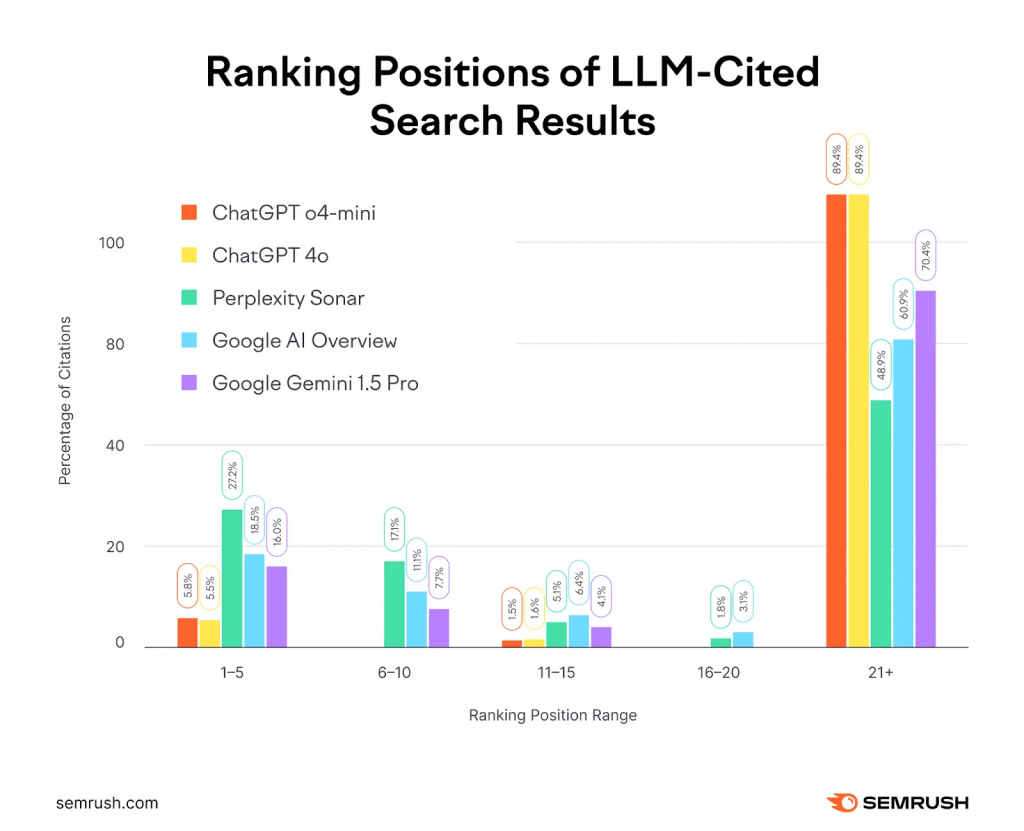
The Semrush research from 2025 made this concrete: 90% of pages cited by ChatGPT rank 21st or lower in traditional Google results. Ahrefs confirmed the same dynamic for AI Overviews. The pages getting cited aren’t necessarily the ones winning the ranking game. They’re the ones answering the question most directly.
That creates a measurement gap.
You can rank well and still not surface in AI answers. At the same time, you can rank poorly and get cited constantly. But, until you’re tracking citation frequency separately from rankings, you’re optimizing half the picture.
The citation tracker we built closes that gap, at least for Google AI Overviews.
How we built the AI visibility tracker (and why Lovable worked)
The original version was an n8n automation workflow. It worked, but sharing it was painful.
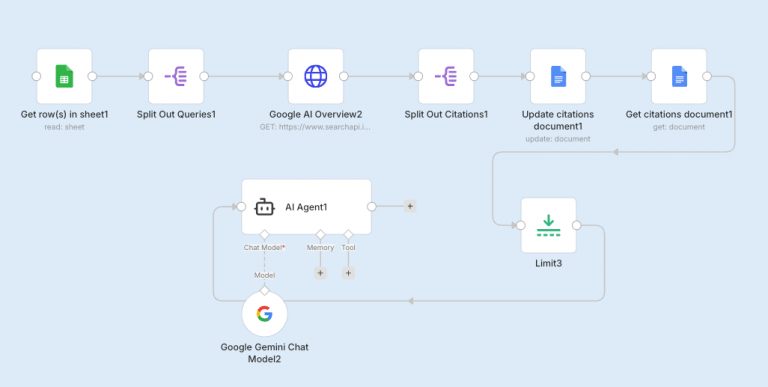
Handing a workflow file to a non-technical teammate and explaining how to run it isn’t a scalable process. We needed something anyone on the team could open in a browser and use immediately.
Lovable turned that into a five-minute build.
The prompt had three components: input, processing logic, and output.
- For input, users provide a brand name or domain and upload a CSV of queries they want to monitor.
- For processing, the app connects to Searchapi.io, runs each query against Google, retrieves the AI Overview result, and checks whether the brand appears.
- For output, it surfaces a clean dashboard showing total queries analyzed, brand mention frequency, and which competitors appeared most often across those same queries.
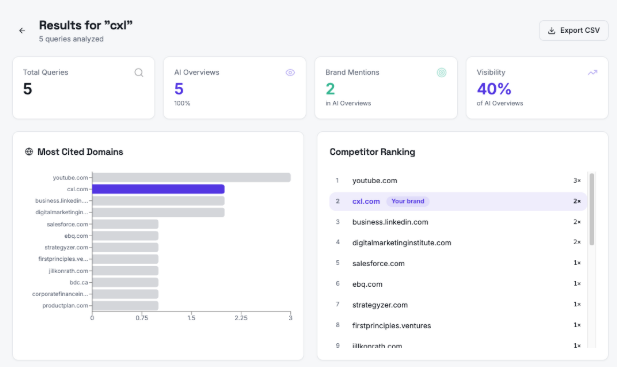
First try. Under five minutes. No debugging required.
From here, the same architecture can connect to OpenAI, Gemini, or Claude’s APIs to monitor citations across LLMs, not just Google’s AI Overview. That’s a natural next build if you want cross-platform coverage.
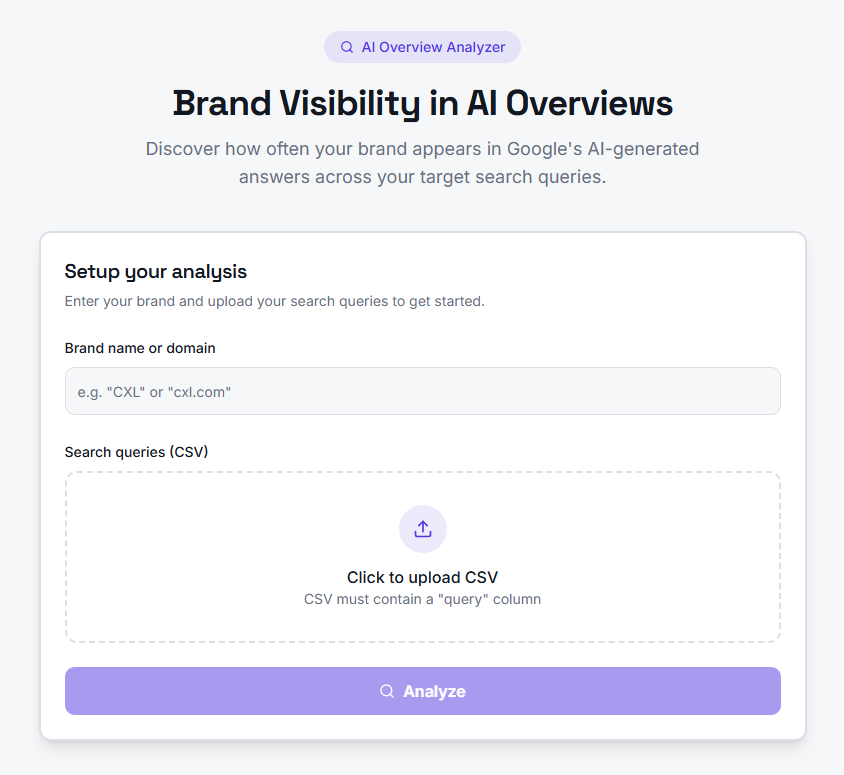
The app is available to test. It’s still experimental, so bug reports are welcome.
What 500 searches actually revealed
We opened the AI visibility tracker to readers, and within a week, it logged around 500 searches. Useful data, but there was a pattern in how people were using it.
68% of the queries were commercial. Things like “top CRM tools for B2B” or “best marketing automation platforms.” Only 32% were informational.
Here’s the problem with that distribution: commercial queries almost never trigger AI Overviews.
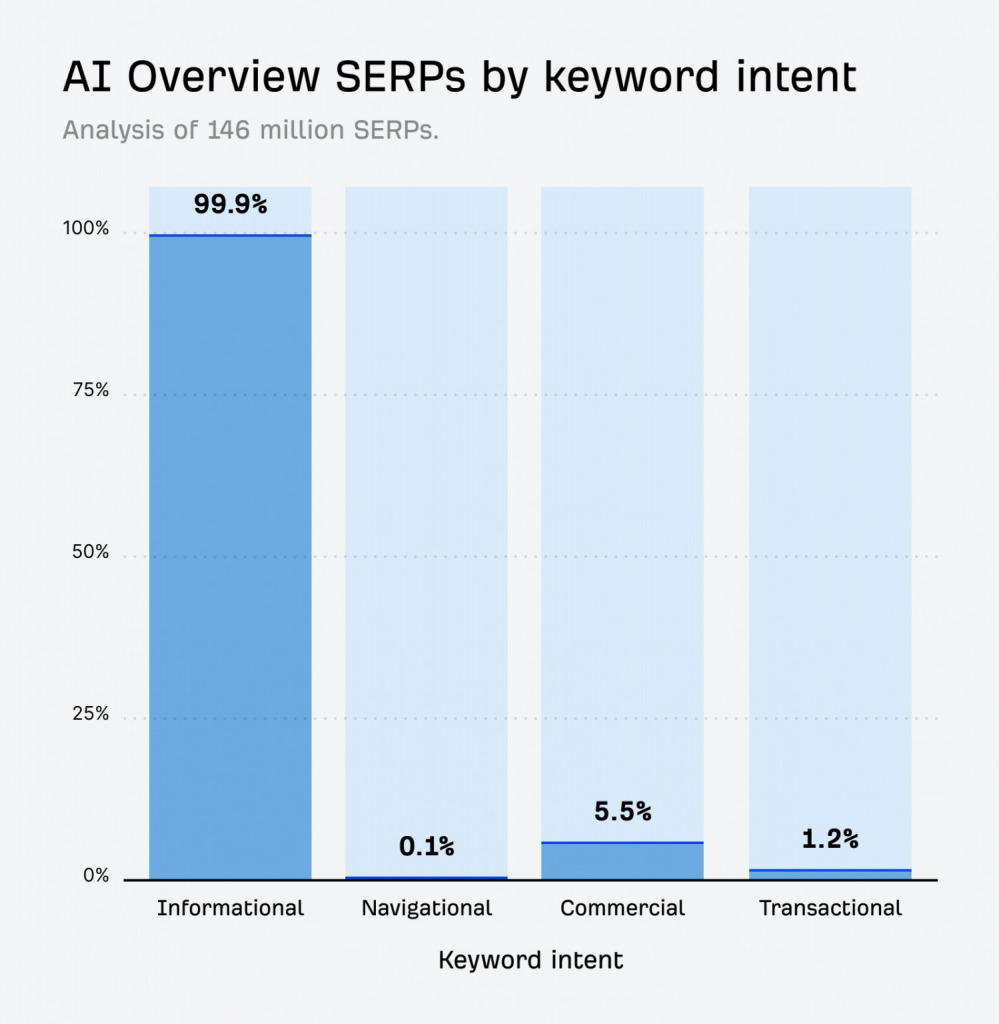
Ahrefs’ analysis of 146 million SERPs found that 99.9% of keywords that trigger them are informational in intent. Commercial intent: 5.5%. Transactional: 1.2%. Navigational: 0.1%.
So most of those 500 searches came back empty, not because the brand wasn’t being cited, but because the query type doesn’t generate AI Overviews in the first place. The citation tracker was working correctly. The query selection wasn’t.
This matters because it shapes what you optimize, where you look for signals, and how you interpret the absence of data. “No AI Overview” doesn’t mean “you’re losing.” It means you’re looking in the wrong place.
Commercial vs. informational: What each type of content actually does
This isn’t a new distinction, but AI search has sharpened its importance.
Commercial keywords still matter.
Comparison pages, product pages, pricing pages, and search ads live and die on commercial intent. That’s where buying decisions crystallize. AI Overviews rarely interfere with this part of the funnel, which is consistent with what Ahrefs found: roughly 70% of AI Overviews appear on keywords with a CPC under $1. Google isn’t burning ad revenue by inserting zero-click answers into high-intent commercial queries.
Informational keywords are where AI citations are won.
- “How to set up a lead scoring workflow.”
- “What is account-based marketing.”
- “Why does email deliverability drop after list import.”
These are the queries that trigger AI Overviews, and the pages that answer them clearly and early are the ones getting cited.
The implication: If your content strategy is weighted toward commercial and transactional terms, you’re likely not visible in AI answers, not because your brand lacks authority, but because you’re not publishing the type of content AI pulls from.
| Content type | AI Overview frequency | What it’s good for |
| Informational (“how to,” “what is”) | Very high | AI citations, top-of-funnel awareness |
| Commercial (“best,” “top,” “vs.”) | Low | Comparison pages, paid search, late-funnel |
| Transactional (“buy,” “pricing”) | Very low | Direct conversion, product pages |
| Navigational (brand queries) | Minimal | Brand defense, returning visitors |
If you’re monitoring AI citations and seeing nothing, audit your query list before you audit your content.
Where on the page citations actually come from
Knowing that informational content drives citations is useful. Knowing where on the page the citation gets pulled is more useful.
We ran a small analysis of 100 AI citations to look at page position. The finding was clear: 79% of cited snippets appeared in the top half of the page.
The top 20% of a page accounted for 48 out of 100 citations. The bottom 40% accounted for 21.
This has a direct implication for how you structure content. Long introductions that build context before answering the question are actively hurting your citation rate. AI doesn’t wait for you to finish warming up. It pulls from wherever the clearest answer appears, and that’s usually near the top.
The fix is structural, not just editorial.
Answer the question in the first paragraph. Front-load the direct response. Save context, nuance, and deeper explanation for below.
Two tactics worth running this week
Audit your informational content first.
Go to your blog and filter for “how to” and “what is” posts. These are your citation candidates. Check whether the primary question gets answered in the opening section, or whether you bury the lede. Restructure the top 10% of the page if needed. This is fast, low-risk, and directly tied to what the data shows.
Analyze what cited pages are doing differently.
For any query where a competitor is getting cited and you’re not, read their page. What are they explaining that you aren’t?
We’ve been testing a Chrome extension internally that extracts the AI Overview answer, compares it to the page in question, and flags missing information.
It’s a manual gap analysis made faster. You can build your own version using the same approach.
Make sure you track the right queries.
If you’re using our AI visibility tracker or building your own, seed your CSV with informational keywords, not commercial ones.
- “How to reduce churn in SaaS.”
- “What is MQL to SQL conversion rate.”
- “Why B2B email open rates are falling.”
These are the queries that generate AI Overviews and the ones worth monitoring for citation frequency.
What to do next
- Build or use the citation tracker: The app is live. Upload a CSV of 20–30 informational queries relevant to your category. Run it. See where you appear and which competitors are being cited instead.
- Restructure your top informational posts: Take your five highest-traffic “how to” or “what is” posts. Move the direct answer to the first paragraph. Cut any preamble that delays the response. Then recheck citation frequency in two to four weeks.
- Expand tracking to other LLMs: The same architecture that queries Google AI Overviews can be pointed at OpenAI, Gemini, and Claude APIs. If you’re already investing in AI visibility, don’t optimize only for Google.
- Separate your citation KPIs from your ranking KPIs: Citation frequency in AI answers and keyword rankings measure different things. Both matter, but optimizing for one doesn’t guarantee the other. Track them separately.
Rankings aren’t visibility anymore
The marketers still chasing Page 1 rankings as their primary metric are optimizing for a measurement that’s becoming less meaningful every quarter.
AI search doesn’t care about your domain authority. It cares about whether your page answers the question clearly, early, and completely. Which means small sites with well-organized informational content can outcompete established brands in AI citations, and many already are.
The 2028 “Traffic Flip” that Semrush is projecting isn’t a sudden event. It’s a gradient. Every month, more queries get answered in the SERP before anyone clicks. Every month, the gap between brands that are cited and brands that aren’t gets wider.
If you want the strategic depth behind AI search optimization, these live sessions go further than most:
- Measuring the modern AI-powered funnel
- Optimizing B2B content funnels with AI
- Increase your visibility and revenue from AI-based discovery engines.
- Content strategy for LLM visibility and changing search habits
- Optimize pages for AI search with GEO/AEO
→ For the automation layer, so monitoring runs without you, the 5-day n8n webinar series is the most practical place to start.
→ And if you want the full picture — strategy, systems, and measurement — CXL’s AI in B2B Marketing program is where it lives.
