
Most marketing agencies think they’ve made the shift. They’ve added “AI-powered” to their website, run a few ChatGPT prompts for client deliverables, and nodded along at the last industry conference when someone said the future is now.
It’s no secret that AI is reshaping marketing agencies, but we wanted to know how.
In our 2026 survey, we found that clients expect more speed, lower costs, and stronger strategic value from agencies. On the agency side, the focus is shifting toward strategy, consulting, and AI workflow design rather than execution alone.
For our 2026 marketing agency AI report, we asked two groups:
- If you work at an agency → what skills will matter most going forward?
- If you work with agencies → how have your expectations changed?
And a lot was revealed.
TL;DR
- CXL’s 2026 agency survey found that 25% of client-side responses highlighted expectations for greater speed and lower costs, while another 25% pointed to more work being handled in-house.
- Strategy and consulting topped the agency-side priorities at 36%, followed by AI orchestration and agentic workflow design at 26%.
- Being AI-ready means more than using ChatGPT for client deliverables. Agencies need to rethink how they work, what they offer, and where human expertise adds value.
- CXL’s Agency AI Readiness Scorecard evaluates how agencies use AI, how they position their services, and where they have opportunities to improve.
Table of contents
What did CXL’s survey reveal about AI-ready marketing agencies?
CXL’s 2026 survey found that clients increasingly expect faster delivery, lower costs, and greater strategic value from marketing agencies. On the agency side, strategy and consulting ranked as the most important future skills (36%), followed by AI orchestration and agentic workflow design (26%).
We didn’t just want theory. So we asked, and here’s what the data revealed.
- How have your expectations towards agencies changed?
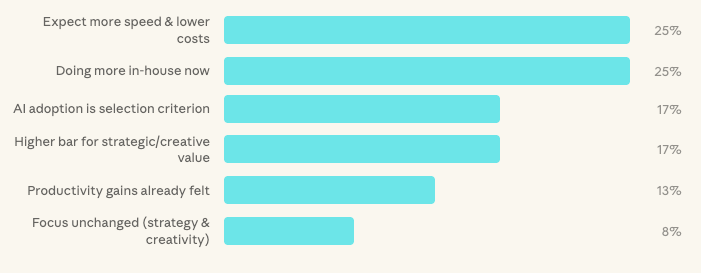
On the client side: Expectations are moving toward:
- More speed
- Lower costs
- A growing willingness to bring execution in-house
This all hinges on the fact that AI can now handle a big part of execution, which is a huge plus for lean internal teams.
- What skills matter most for agencies moving forward?
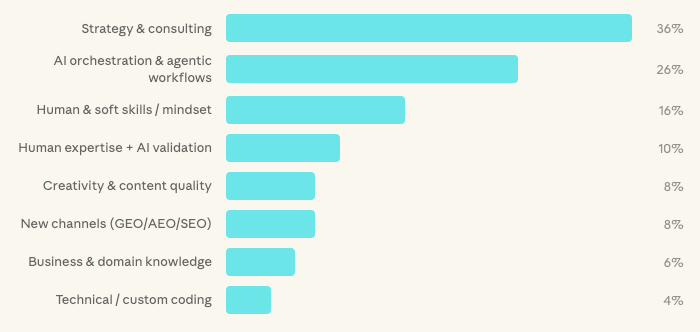
On the agency side: The value proposition is moving toward strategy, consulting, and anything AI still struggles with, plus some new capabilities.
The work that retains (and grows) client relationships is moving toward three things:
- Strategic consulting: Helping clients figure out what to do, not just doing it
- AI orchestration and agentic workflow design: Building and managing the systems that make AI output useful at scale
- Mindset, expertise, and AI validation: Taking the flood of AI-generated content, data, and analysis and turning it into decisions
None of that is surprising. What’s surprising is how few agencies are structurally repositioned to deliver on it.
How AI-ready is your agency?
An AI-ready marketing agency has moved beyond using AI for isolated tasks. It has integrated AI into repeatable workflows, developed the skills to manage those systems, and can demonstrate how AI improves its client offering. CXL’s Agency AI Readiness Scorecard evaluates these capabilities alongside how the agency positions itself.
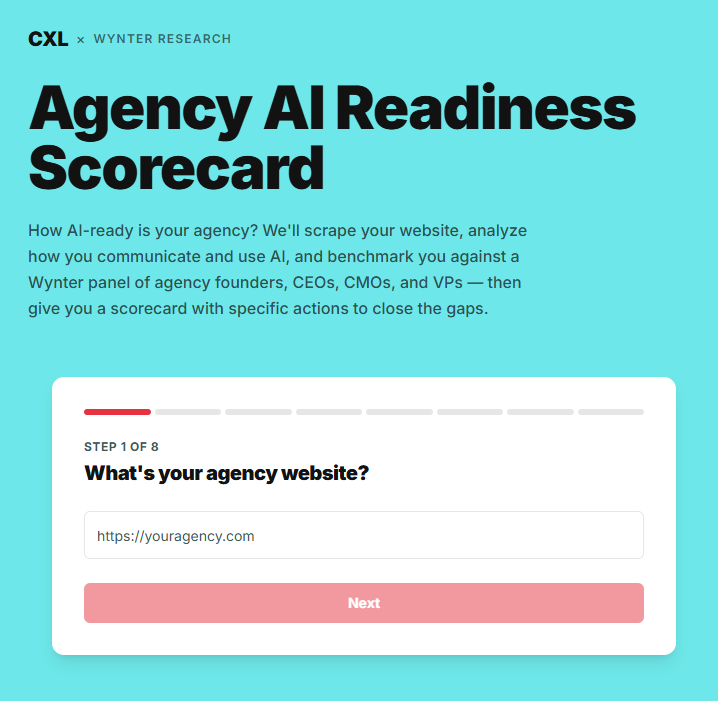
We didn’t want this to just be insights, so we turned all of this into something usable–an AI marketing agency assessment.
Here’s how it works:
- It asks you a few focused questions about your team, your workflows, and how you’re actually deploying AI day-to-day.
- Then it scans your website to see how AI shows up (or doesn’t) in your positioning.
What you get back is a breakdown of:
- Your readiness level
- Specific gaps
- The opportunities you’re likely missing
- How you stack up against the data we collected from agencies and their clients.
It takes a few minutes. The output is direct. If you’re curious about where you actually stand, you can take the assessment here.
Frequently asked questions
What makes a marketing agency AI-ready?
An AI-ready marketing agency integrates AI into repeatable workflows rather than using it for occasional tasks. It combines AI-driven execution with strategic consulting, human expertise, and services that deliver measurable value to clients.
How can a marketing agency assess its AI readiness?
Agencies can assess their AI readiness by evaluating their workflows, team capabilities, AI adoption, and service positioning. CXL’s Agency AI Readiness Scorecard combines an agency questionnaire with website analysis to identify capability gaps and opportunities for improvement.
What do clients expect from AI-powered marketing agencies?
CXL’s 2026 survey found that 25% of client-side responses highlighted faster delivery and lower costs, while another 25% indicated that more work was being handled in-house. Clients also identified stronger strategic and creative value as an expectation.
Which AI skills matter most for marketing agencies?
Strategy and consulting ranked first in CXL’s 2026 agency survey at 36%, followed by AI orchestration and agentic workflow design at 26%. These skills help agencies move beyond selling execution toward providing strategic guidance and connected marketing systems.
How should marketing agencies adapt their services to AI?
Agencies should identify which execution tasks AI can handle and reposition their services around strategic judgment, specialized expertise, and workflow design. The objective is to deliver value clients cannot easily replicate with their own AI tools.
What to do next
If your assessment highlights gaps in how your agency positions its services, CXL’s Unique positioning for agencies course covers how to differentiate your offer and attract better-fit clients. For agencies looking to build more advanced AI workflows, B2B ad campaigns with Claude Code and n8n covers using AI for ICP-driven campaign creation and automated performance reporting.
