AI in marketing job descriptions: What 1,750 job posts reveal
The change in skills requirements for AI in marketing jobs has gotten very specific very fast.

We scraped around 1,750 marketing job descriptions across two periods: roughly 1,000 from January 2026 and 750 from May 2026. Four months of job description data doesn’t sound like much. But when mentions of “AI tools” in marketing job descriptions triple, and specific tools like Claude quadruple, four months is significant enough.
The data shows that the expectations of AI marketing job requirements in 2026 are maturing from vague aspirations to operational requirements. And the marketers who can’t point to a working stack are increasingly going to find themselves filtered out before the first conversation.

Here’s what changed, why it matters, and what to do about it.

The language shift in AI marketing job descriptions

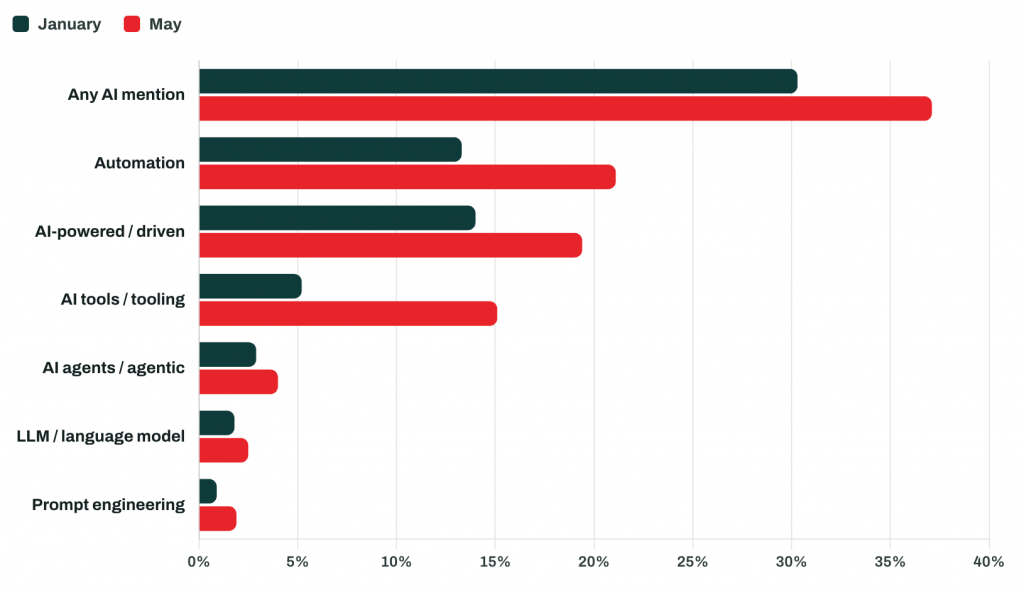
The percentage of marketing job descriptions mentioning AI at all rose from 30% in January to 37% in May. 

That increase is notable, but what’s more interesting is how the language changed.

Bar graph showing specific AI requirements in marketing job descriptions

Mentions of “AI tools” or “AI tooling” jumped from 5% to 15%, while “automation” went from 13% to 21%. These aren’t the vague, untestable phrases such as”AI literacy” or “AI fluency” that dominated job posts a year ago. They’re operational requirements.

“AI literacy” as a phrase barely registered in January job posts. By May, it was appearing with increasing frequency. And while that sounds more subtle than “AI tooling,” it signals something important: companies are now trying to create a baseline floor. They want everyone to meet it, not just the AI-forward hires.

Phrases like “leverage AI,” “use AI to,” and “AI in your workflow” more than doubled, from 5% of posts in January to 12% in May. That’s the language of integration, not experimentation. 

Takeaway: Employers aren’t asking if you’ve thought about AI. They’re asking if it’s already woven into how you work.

Specific AI tools are now table stakes

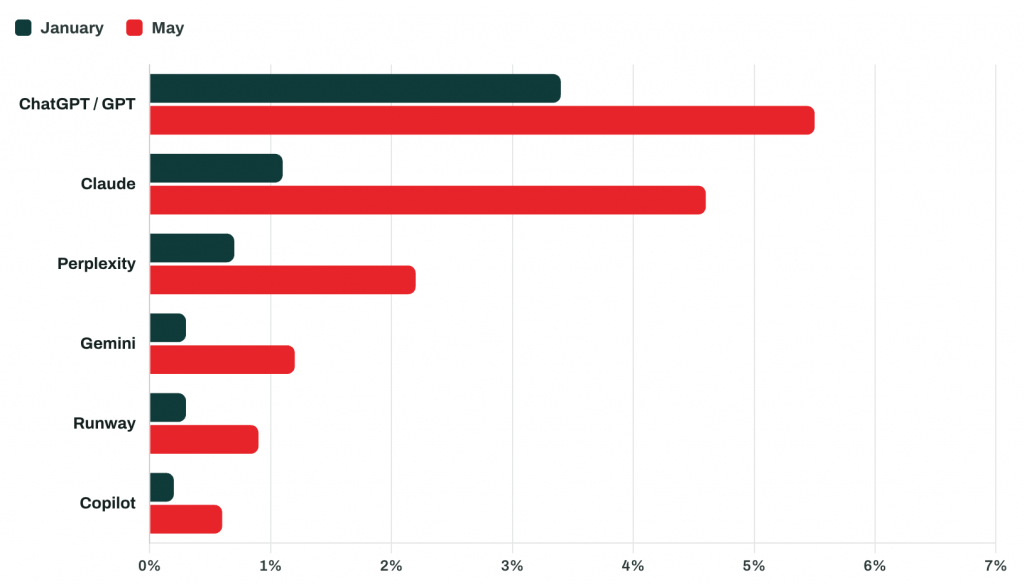
Here’s where the data gets concrete. Every named AI tool we tracked increased in mentions across those four months:

  • ChatGPT / GPT: 3.4% → 5.5%
  • Claude: 1.1% → 4.6%
  • Perplexity: 0.7% → 2.2%

Content-generation tools like Runway and Midjourney also increased.

Bar graph showing specific AI tools mentioned in marketing job descriptions

Think about what that means for hiring and for positioning yourself. Generic AI experience or terms like “uses AI” is no longer sufficient as a differentiator. 

Takeaway: Specific tool fluency is becoming the filter. The new expectation is a named stack: which tools you use, how you’ve integrated them, and what you’ve produced faster as a result.

Leadership skills are moving down in comparison to AI in marketing jobs

Back in January, AI expectations were heavily concentrated at the executive and director level. Companies wanted AI strategists—people who could define vision, guide adoption, and set direction. The expectation was that the executives would sort out AI, and the organization would follow.

That’s still happening. But the data shows the expectations are now cascading down:

  • Director-level AI mentions: About 32% → 50%
  • Mid-senior roles: About 30% → 40%
  • Entry-level remained relatively flat

The growth at mid-senior isn’t directors anymore. It’s managers and senior ICs—the people who own execution. Companies still want leaders who can define AI strategy and operationalize it across marketing organizations. But they’re increasingly recognizing that strategy without operational fluency is worthless

Entry-level holding flat is worth noting. It’s not that entry-level roles don’t need AI skills; it’s that employers expect those candidates to have absorbed this on their own. It’s already assumed. 

Takeaway: The explicit AI call-outs in job descriptions are for the people who need to lead and execute, not the people just starting out.

Performance marketing is getting hit hardest

If you’d asked most marketers which discipline AI would disrupt first, they’d probably say content. It’s the most obvious use case: generate drafts, scale output, and reduce production costs.

The data disagrees. Sharply.

AI mentions in performance and growth marketing roles nearly doubled in a single quarter, from 32% in January to 63% in May. 

For comparison:

  • Content / SEO roles: 28%
  • Social / influencer roles: 24%
  • Brand / creative roles: 24%

Performance marketing was already the most systematized discipline in the stack. Optimization loops, automation rules, experimentation frameworks, and data analysis aren’t new behaviors for performance marketers. AI slots directly into existing workflows instead of requiring a rethink of how the work gets done, which is why adoption is accelerating there faster than anywhere else in marketing.

But here’s the implication: if you’re a performance marketer who hasn’t deeply integrated AI into your analysis and automation workflows, your competition is about to face downward pressure. The output expectations will rise to match what AI-enabled peers can produce. 

Speed and volume have always mattered in performance. Now the floor is higher.

Content marketers shouldn’t read this as good news for their discipline. The lower current numbers reflect slower adoption, not lower eventual impact. The transformation is coming; it’s just further behind in a discipline that still relies more heavily on craft, judgment, and brand nuance. Give it two more quarters.

What this means if you’re building or managing a team

The data points to a few things that are easy to rationalize away, but probably shouldn’t be.

Your job descriptions are a lagging indicator of your actual requirements. 

The job descriptions we analyzed represent where companies thought they were in January vs. May. The operational reality inside most marketing teams is probably ahead of or behind what those job descriptions describe. Either way, your hiring signals are shaping the talent pool you can access. 

The fix: If your job descriptions are vague on AI, you’re attracting candidates who are vague on AI. Be specific about which tools you expect fluency in, which workflows require AI integration, and what “fluency” looks like in practice. 

The workflow integration requirement is harder than the tool requirement. 

It’s relatively easy to say “candidates should know ChatGPT and Claude.” It’s much harder to assess whether someone can redesign a workflow around AI, building systems rather than using tools opportunistically. The job description language is getting more specific, but most interview processes haven’t caught up. 

The fix: If you’re hiring, test for this directly. Ask candidates to walk you through an AI-assisted workflow they’ve built. Not a task they’ve done with AI, but a system they’ve created.

The gap between AI-fluent and AI-adjacent marketers is a competitive issue. 

A marketer who can run AI-assisted content production, analysis, and optimization at 2-3x the output of a non-AI-enabled peer is a different hire. 

The fix: Start thinking about how that affects leveling and expectations before you’re forced to by the market.

How to build an AI-native marketing team with compounding systems

  1. Audit your own stack against the named tools in the market. If your team isn’t using ChatGPT, Claude, and Perplexity regularly, you don’t have an AI stack. Pick two tools and build workflows around them before adding more.
  2. Update your job descriptions to reflect operational expectations. “Experience with AI tools” is not a requirement. Get specific, name the tools, and describe the workflows, e.g. “Uses Claude to accelerate content production and performance analysis” is a requirement. It also filters your candidate pool in the right direction.
  3. Close the leadership-execution gap. If your director-level team members are AI-fluent but your managers aren’t, your AI strategy will die at the operational layer. And it’s not always a motivation problem—most marketers aren’t avoiding AI, they’re overwhelmed by it. Invest in hands-on enablement for senior ICs and managers, specifically those who own day-to-day execution. Workshops, working sessions, or shared prompt libraries: whatever moves it from “aware of AI” to “dependent on AI for certain workflows.”
  4. Pressure-test performance marketing first. If you have performance marketers who aren’t using AI for analysis, reporting, and campaign optimization, start there. The ROI case is easiest to make, the workflows are most amenable to AI integration, and the competitive pressure is highest.
  5. Build an internal AI fluency baseline before the market forces it on you. “AI literacy” went from nearly zero mentions to a substantial presence in job descriptions in four months, and it’s going to keep growing. Get ahead of it by defining what AI fluency means for your team specifically; then assess it.

The window for “exploring AI” is closing

Four months of data showing a near-doubling of AI expectations in performance roles, a tripling of specific tool mentions, and the cascade of requirements from leadership to execution. This isn’t a trend in its early stages; it’s a trend hitting its acceleration phase. 

The easy, vague requirement of AI in marketing jobs (“familiarity with AI tools”) is already being replaced by the operational requirement (“uses Claude and ChatGPT in daily workflows, builds automated processes”).

The cost of waiting is significant. Not because AI will replace marketers, but because the baseline of what a competent marketer can produce is rising. The teams and individuals who build the muscle memory, workflows, and institutional knowledge around AI tools will be operating at a level that’s genuinely hard to catch up to from a standing start.

The time for AI exploration is over. Build mode is the only mode that matters now.

If the data here reflects where the market is going, CXL’s AI Agents for B2B Marketing program is built for where you need to be. 

Live cohorts and on-demand courses covering the full operational stack:

Don’t miss our latest AI-native Marketers webinar — build the system, run the experiment, ship the workflow.

AI in marketing job descriptions What 1,750 job posts reveal

The change in skills requirements for AI in marketing jobs has gotten very specific very fast.

We scraped around 1,750 marketing job descriptions across two periods: roughly 1,000 from January 2026 and 750 from May 2026. Four months of job description data doesn’t sound like much. But when mentions of “AI tools” in marketing job descriptions triple, and specific tools like Claude quadruple, four months is significant enough.
Keep reading

When it comes to AI adoption, the dominant narrative amongst marketers is that they’re falling behind.  That every new tool, every new model, every new AI marketing workflow announced on LinkedIn is a gap you need to close—now. And the more you scroll, the more that feeling compounds. 

The anxiety isn’t irrational, but the response to it usually is.

Keep reading

ChatGPT skips web search entirely on roughly 65% of queries. This means (optimized or not, indexed or not), if the model already has the answer, the content you published last Tuesday never had a shot.

The AI search optimization industry has built an entire content category around a behavior that not only happens a third of the time, but is actively declining.

Keep reading

For the past two years, the dominant advice in B2B content marketing has been some version of: be careful with AI. Don’t let it water down your brand. Keep a strong human in the loop. Avoid the slop.

That advice made sense when it was speculative. It makes less sense now that we have data.

Keep reading

Most marketing agencies think they’ve made the shift. They’ve added “AI-powered” to their website, run a few ChatGPT prompts for client deliverables, and nodded along at the last industry conference when someone said the future is now.

It’s no secret that AI is reshaping marketing agencies, but we wanted to know how.

Keep reading

Categories

AI agents for B2B marketing

Automate content, SEO, and ads. Add buyer strategy, content funnels, apps, and AI readiness.

This program is designed to keep you up-to-date with B2B marketing and AI.

Check out the program