ChatGPT skips web search entirely on roughly 65% of queries. This means (optimized or not, indexed or not), if the model already has the answer, the content you published last Tuesday never had a shot.
The AI search optimization industry has built an entire content category around a behavior that not only happens a third of the time, but is actively declining.
That’s not to say citation strategy doesn’t matter. It does.
But Semrush’s 17-month analysis and Ahrefs’ breakdown of 1.4 million prompts show something more specific than “optimize for AI”: there are two or three narrow signals that actually drive citation selection.
ChatGPT citations are concentrated among a much smaller pool of pages than most marketers assume. And the factors that get you cited have almost nothing to do with what most teams are spending time on.
Here’s what the data says, and what to do with it.
Table of contents
- ChatGPT and Google aren’t competing, they’re stages in the same funnel
- ChatGPT isn’t even searching most of the time
- Your title is doing the real work
- Reddit informs, but doesn’t get credited
- What this means for your B2B content strategy
- You don’t need more content to get cited; you need the right content.
ChatGPT and Google aren’t competing, they’re stages in the same funnel
The framing that AI is replacing search was always wrong, but now we have numbers to prove it.
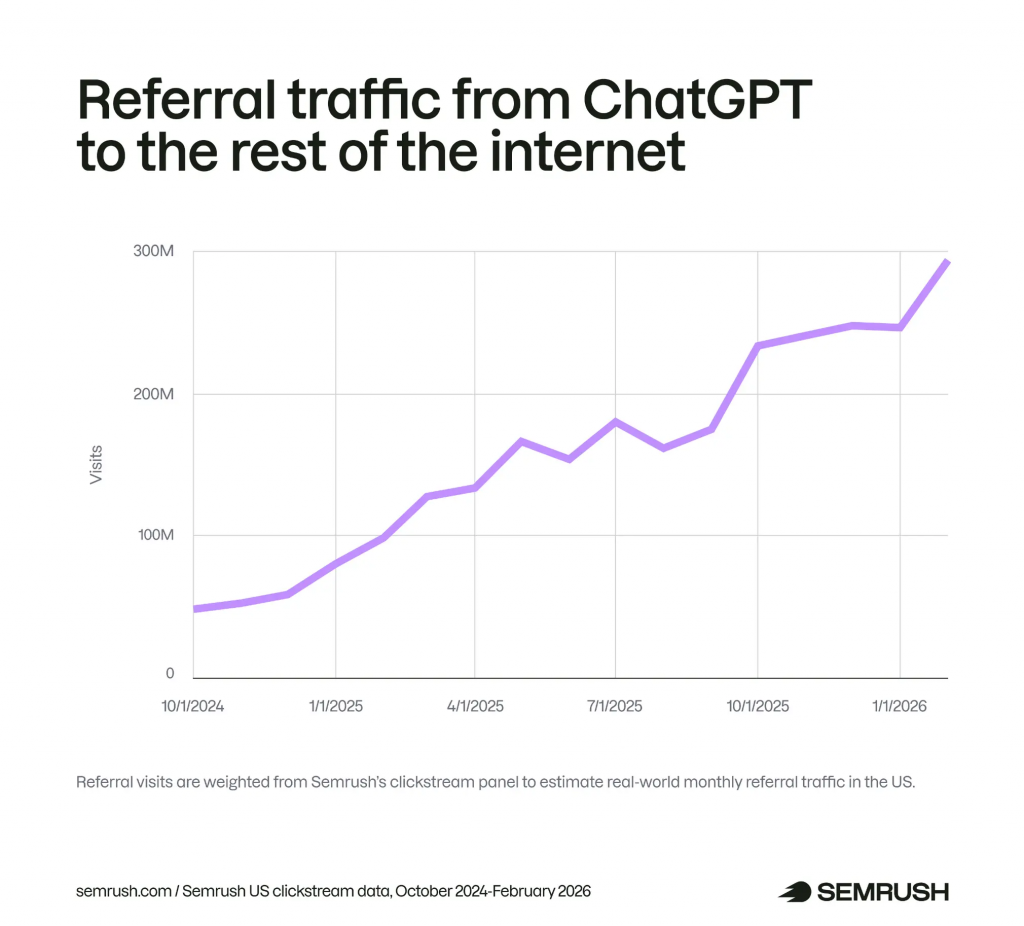
ChatGPT referral traffic to the broader web grew 206% in 2025, and the single biggest beneficiary of that traffic was Google:
- Google captures 21% of all outbound clicks from ChatGPT
- The top 10 domains capture 30% of all outbound clicks combined
The behavioral pattern is clear: a user asks ChatGPT something, gets an answer that mentions a brand or product, then goes to Google to verify, compare, or actually buy.
If you’re only tracking direct referral traffic from ChatGPT, you’re measuring the wrong thing entirely. AI visibility is creating branded search intent that never shows up in your ChatGPT analytics.
This matters because it changes the ROI calculation completely.
Being cited in ChatGPT doesn’t have to generate a direct click to create value. It can, and increasingly does, trigger a branded search query instead.
If you’re not tying AI citation tracking to branded search volume, you’re missing metrics that could connect AI visibility to revenue.
ChatGPT isn’t even searching most of the time
Here’s the part that should fundamentally change how you think about “AI search optimization”: ChatGPT only uses web search on 34.5% of queries. That’s down from 46% in 2024.
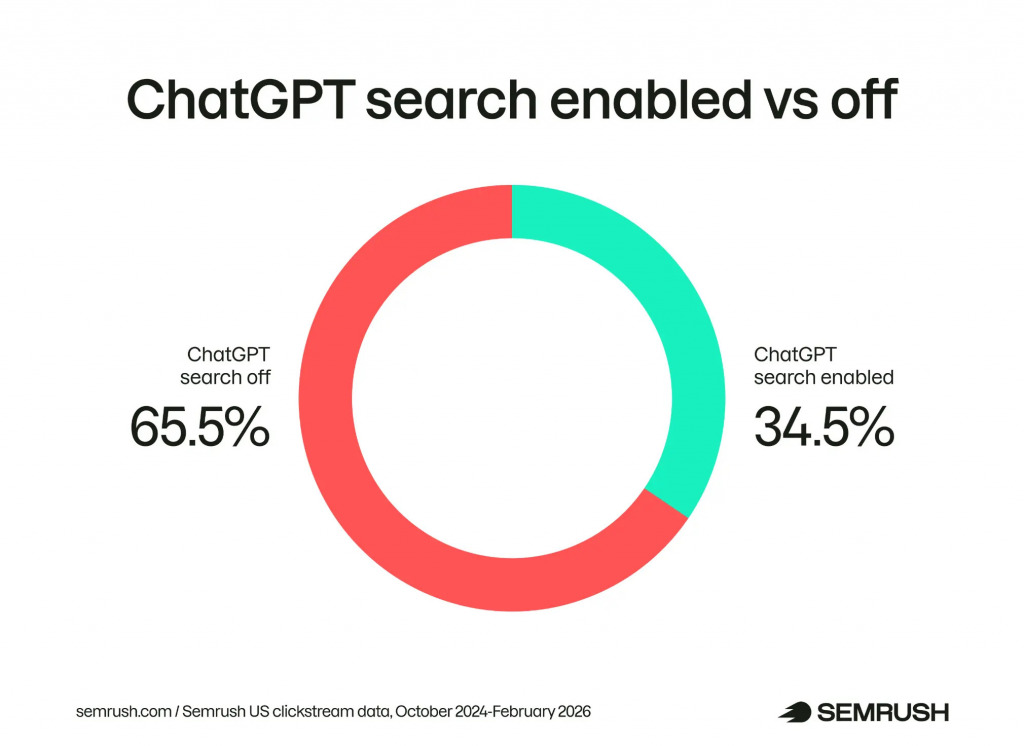
Two-thirds of prompts are answered entirely from training data. No crawl. No search. No opportunity for your content to surface, no matter how well-optimized it is.
Web search gets triggered for recent facts, post-cutoff events, or cases where the model is uncertain. So, if your evergreen B2B content hasn’t been updated in the last six months, it’s likely that the model already has that information and doesn’t need your page.
This means that the ChatGPT citation opportunity is narrower than most B2B teams initially thought. You’re not competing for every prompt. You’re competing specifically for prompts where ChatGPT decides it needs to look outside its training data.
That’s a more selective opportunity, but a more winnable one if you understand it.
Your title is doing the real work
When ChatGPT does decide to search, the Ahrefs data reveals exactly how the selection process works, and it’s more mechanical than marketers want to believe.
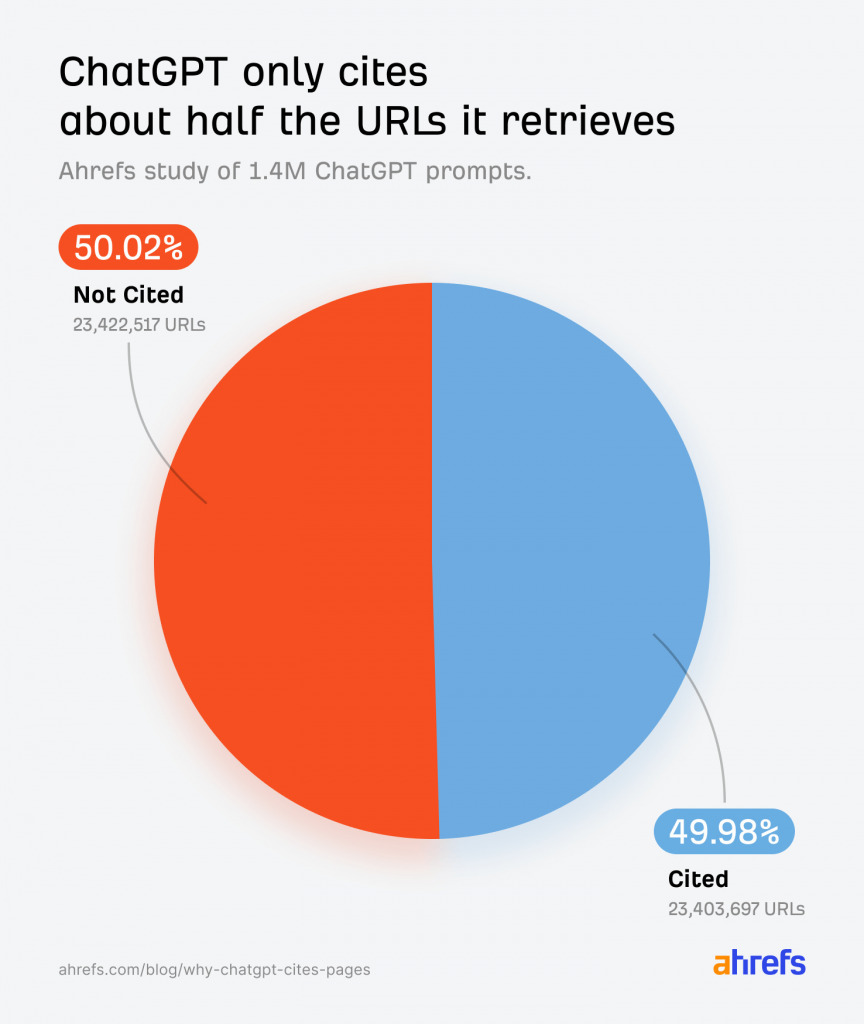
ChatGPT retrieves roughly 33 pages per query, and cites only about half of them. That means it’s already filtering heavily before reading anything in full. The selection happens on title, URL, and snippet alone.
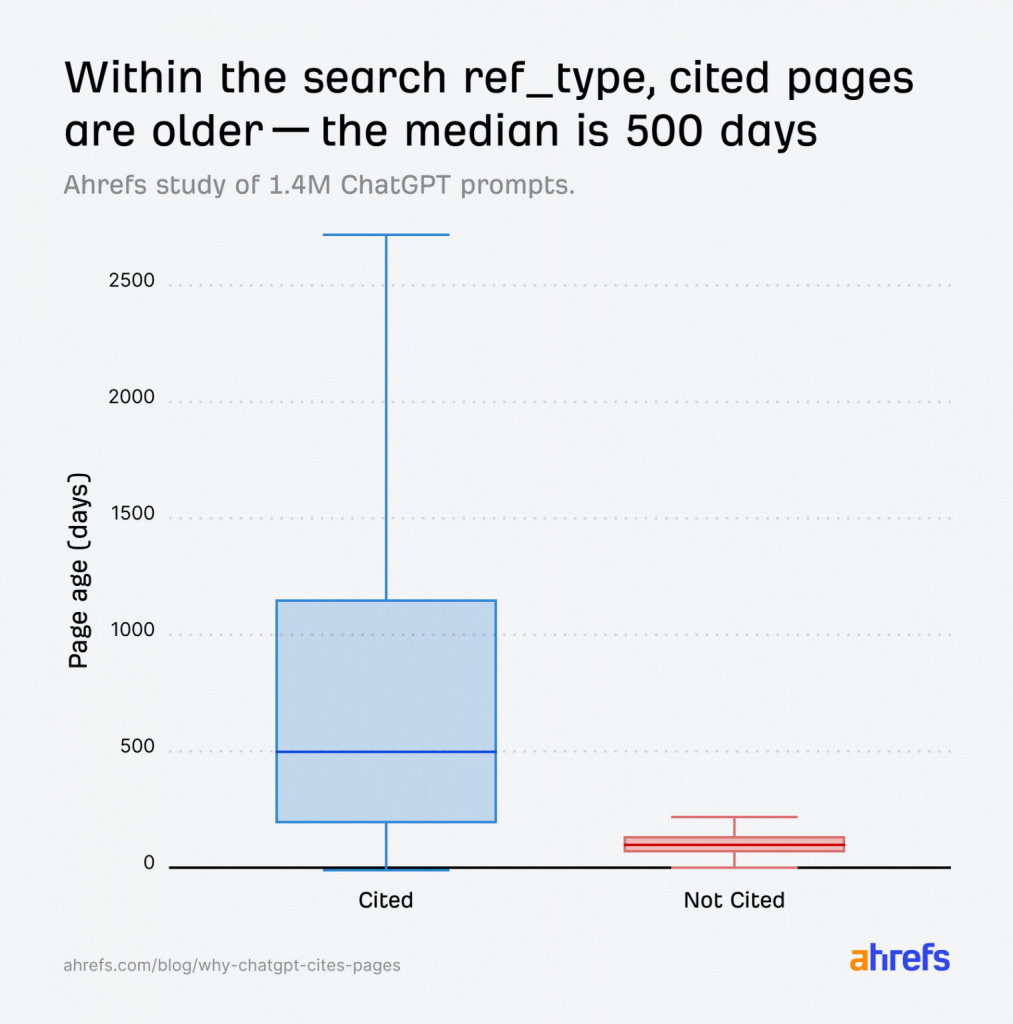
The biggest driver of citation isn’t freshness; the average cited page is about 500 days old. It’s not backlinks either, which will surprise anyone who’s spent the last decade building DA. It’s title relevance to fan-out queries: the sub-questions ChatGPT internally generates before structuring its response.
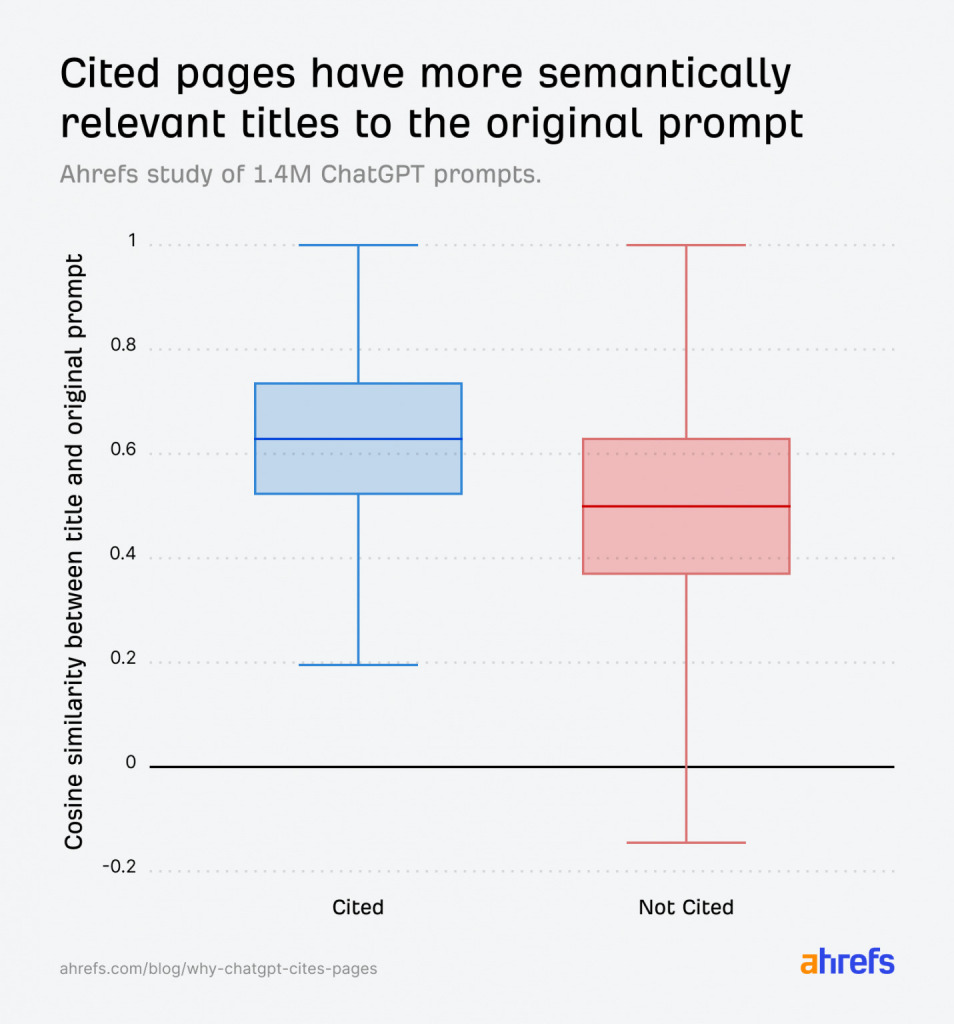
Cited pages score 0.602 on semantic similarity to the original prompt. Non-cited pages score 0.484. But measure against fan-out queries instead of the original prompt, and cited pages jump to 0.656. The gap widens because ChatGPT isn’t just evaluating your page against the user’s question; it’s evaluating it against its own internal question decomposition.
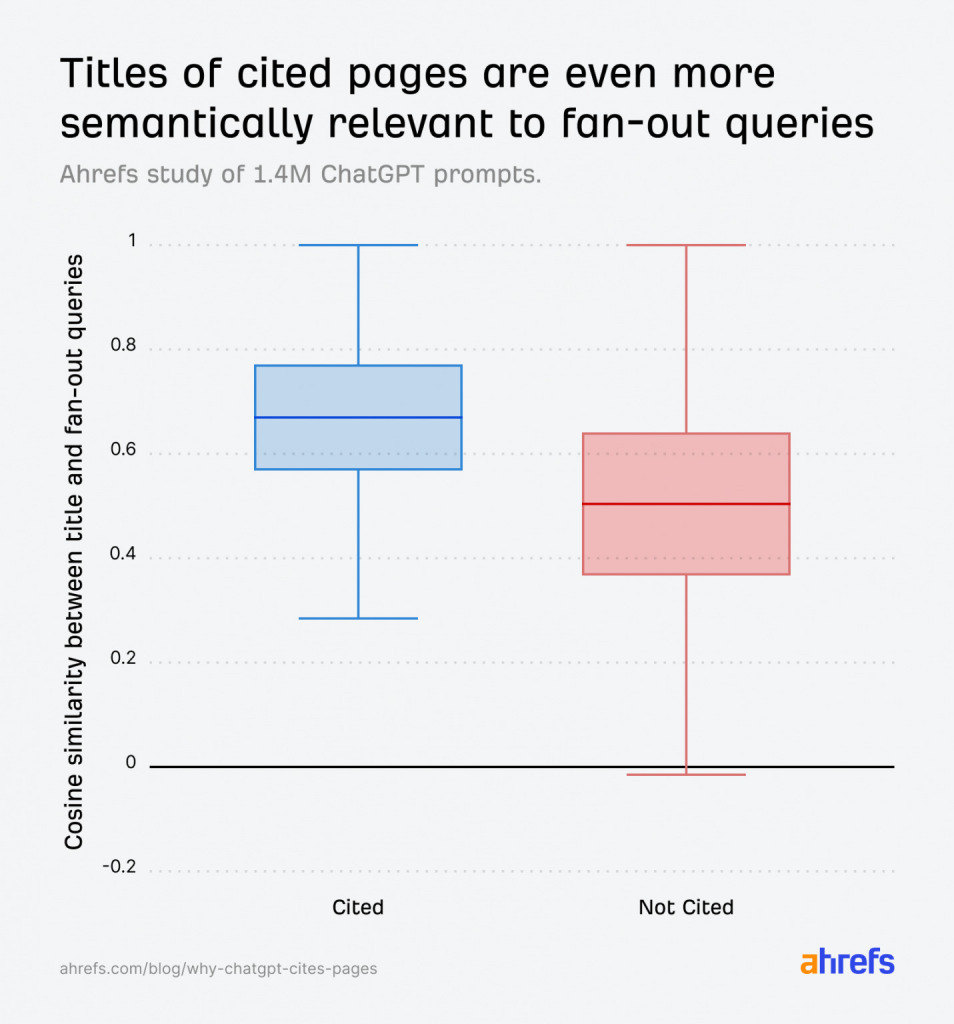
If your title answers the broad topic but not the specific sub-question ChatGPT is trying to resolve, you’re getting retrieved and discarded.
Natural-language URL slugs compound this effect. Pages with readable, descriptive slugs had an 89.78% citation rate versus 81.11% for those without. A URL like /what-is-intent-data/ is giving ChatGPT more signal at the retrieval stage than /resources/article-47/. That eight-point gap in citation rate is pure overhead you’re creating for yourself.
Reddit informs, but doesn’t get credited
One of the more revealing details from the Ahrefs study is what happens with Reddit specifically.
Reddit makes up 67.8% of non-cited URLs in the dataset, with a citation rate of just 1.93%. ChatGPT is pulling Reddit content heavily during retrieval. It’s using it to understand how people talk about topics, what language they use, and what consensus looks like. Then it cites something else.
The pattern is consistent: While Reddit shapes the answer, the standard web index gets the credit.
This is a direct challenge to the “show up on Reddit, and you’ll win AI search” narrative that’s been circulating in SEO circles.
Participation in Reddit threads helps the model understand your topic area, but it won’t get you cited. If you want the citation, you still need a page in the traditional search index that ChatGPT is willing to attribute.
The search index still underlies AI visibility. 88.46% of ChatGPT citations come from standard indexed content. Whatever you thought about social content replacing SEO, that story isn’t playing out in the citation data.
What this means for your B2B content strategy
The compounding failure mode here is teams chasing AI visibility metrics that don’t connect to citations, while neglecting the on-page signals that actually drive selection.
A few things that actually matter:
- Write titles that answer the sub-question.
Not the broad topic; the specific intent fragment ChatGPT is likely to generate internally. “What is intent data?” is a better title than “Intent Data: The Complete Guide” if the user’s underlying question is definitional. Map your titles to the fan-out query, not the head term.
- Clean up your URL slugs.
This one requires almost no effort and has a measurable impact on citation rate. If you have generic URLs like /p=183 or date-based slugs that don’t describe the content, fixing them is a high-leverage task. Prioritize it.
- Stop measuring AI traffic like organic traffic.
Direct referral clicks from ChatGPT are one signal. Branded search lift is another, and in many cases it’s bigger. Set up a tracking framework that monitors both, and segment branded search trends by channel to catch the halo effect.
- Protect your position in the search index.
Reddit and YouTube surface frequently during retrieval, but rarely get cited. The distribution of where citations actually come from (88.46% from the standard web index) should settle the debate about whether traditional SEO still matters for AI visibility. It does, which is more than most people want to admit right now.
→Reverse-engineering YouTube growth with AI
→Where Google AI Overviews pull their answers from: What 100 citations reveal
You don’t need more content to get cited; you need the right content.
The instinct in content marketing is always to publish more. More pages, more keywords, more coverage.
But that instinct doesn’t necessarily translate to AI citations. Since ChatGPT is only citing half of the third of all pages it retrieves, it’s clear where you should be spending your time.
- Instead of increasing content volume, audit titles for fan-out query relevance.
- Instead of building more backlinks, you’re better off fixing URL slugs.
- Instead of measuring direct referral traffic, monitor branded search volume as a downstream signal.
A small number of pages capture a disproportionate share of ChatGPT citations. It’s the same pattern you see with organic search, just compressed. The goal isn’t to show up everywhere; it’s to be the page that gets selected when ChatGPT decides to search.
The opportunity in AI search is there, but it’s concentrated.
CXL’s B2B Marketing and AI, and AI Agents for B2B Marketing programs not only help you optimize for AI citation, but how to build the infrastructure that keeps you in the selection pool continuously.
Relevant sessions if you’re building toward this:
- Measuring the modern AI-powered funnel
- Build content automations for lead generation with n8n
- B2B buyer pain-led GTM strategy
- Optimizing B2B content funnels with AI
- SEO automation with n8n and Claude Code
- Increase revenue and visibility from AI search and LLMs
- Content strategy for LLM visibility and changing search habits
→ Join our upcoming Claude Code webinar focused on moving from manual workflows to fully systemized, automated execution.