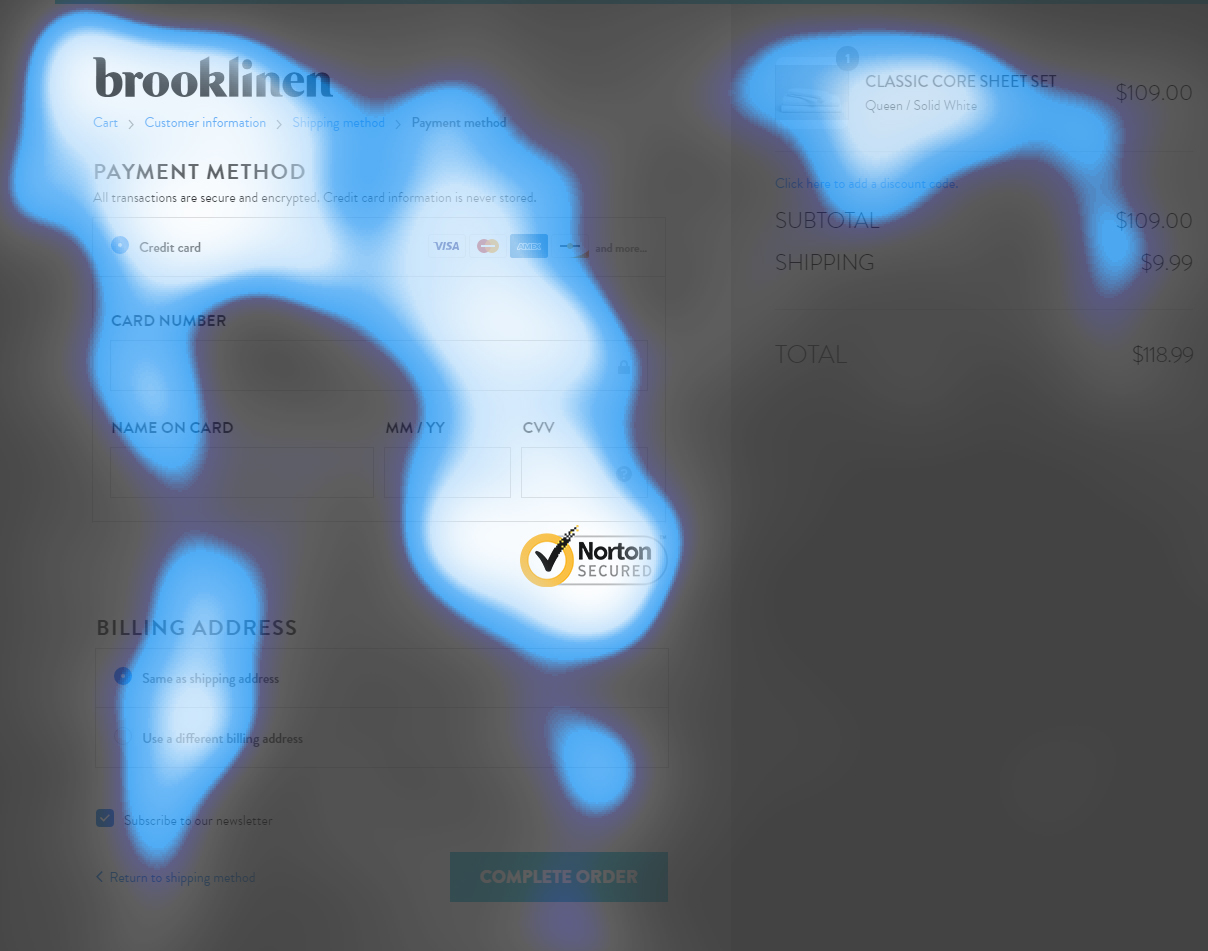
As marketers, we spend countless hours acquiring traffic and crafting persuasive content, but too often we drop the ball at the final stage of the lead gen funnel—form design.
We’ve all heard stories about the impact that forms have on conversion rates, like how Expedia made an extra $1 million per year by removing one field on their form or how Marketo received 34% more leads by experimenting with their form length.
Despite the impact a well-optimized form can have on the bottom line, most marketers still use “paper forms on the web” (web forms that look like forms you’d fill out on paper).
Keep reading
Your design team likely thinks your website is number one compared to your competitors, but a quantified UX benchmark might tell you differently.
We all have our opinions on what good design looks like, but quantifying that and comparing it to competitors, really shows where you stand. Once you know that, you can take action based upon the insights.
This article outlines a UX benchmark study we conducted in partnership with Jeff Sauro and his team over at MeasuringU. We studied five road bike websites. We learned a lot in doing so, and you’ll certainly find some instant takeaways from our insights.
Keep reading
Conversion optimization is a little different if you’re in B2B.
Some of the same underlying principles apply, but because of the inherent differences in buying decisions and sales cycles, pulling B2C optimization practices straight from the book might be a bad idea.
Keep reading
Every company wants their visitors (i.e. potential customers) and customers to leave their site with a lasting positive memory. Of course, that’s much easier said than done when you consider technical issues, copy confusion, price barriers and the like.
If you want to bring a smile to people’s faces when they hear your company name, you’ll need to understand how memory works and how you can design for it.
Keep reading
It will come as no surprise, but like most things in life, conversion optimization will benefit from a strong strategic approach.
This generally includes aligning your goals and resources to build out a roadmap, or at least a framework/process, for your experiments.
Keep reading
This study, conducted through CXL Institute, is the first of a two-part series exploring security perceptions on checkout pages. We compare the effectiveness of six popular trust badges on an actual checkout page.
Keep reading
We want other people to like us. It’s a human desire.
We also want other people to like our websites. If, on our site, we come across as likable, we tend to become more profitable.
So, in conversion optimization, likability is an important and powerful psychological trigger.
Keep reading
Ever scroll through a website and get irrationally angry? Maybe it was the slow loading time, the poor design, the frustrating lack of clarity – no matter the case, I’m sure you can relate.
Though you might not like to hear it, a substantial amount of your customers are going through the same thing on your site right now. This is inevitable. The real money comes from finding these common frustrations and fixing them.
But how?
Keep reading
Here’s something not many people talk about: no one at your organization really wants optimization to succeed – at least not in way that is most powerful and revenue impacting.
Let that sink in.
Keep reading
Just when you start to think that A/B testing is fairly straightforward, you run into a new strategic controversy.
This one is polarizing: how many variations should you test against the control?
Keep reading