SEO used to reward depth. If your article was an exhaustive piece on a topic that covered every angle and included a few keywords, clicks would usually follow.
Today, search rewards precision over sheer depth.
Ahrefs data shows Google AI Overviews have cut clicks to top-ranking content by up to 58%. As a result, getting cited in these AI-generated answers is becoming increasingly important for maintaining content visibility.
The question most content teams haven’t answered yet: what actually determines whether Google cites your page?
We had a hunch it wasn’t just domain authority or keyword density. While auditing sources behind AI Overview citations in Bing’s AI performance reporting tool, we kept noticing the same pattern: cited snippets consistently appeared near the top of their source pages. Not always, but often enough to investigate.
So we ran a structured analysis across 100 AI Overview citations, mapping exactly where within each source page the cited snippet appeared.
Here’s what we found.
Quick overview
| AI Overviews tend to cite answers that appear early in a page. In our analysis, 55% of citations came from the first 30% of content, while only 21% came from the bottom 40%. Because AI systems prioritize clear answers they encounter first, placing key information within the first 150–200 words significantly increases the chances of being cited. |
Table of contents
AI Overviews doesn’t read your whole article (and neither does ChatGPT)
The data is unambiguous: 55% of AI Overview citations come from the top 30% of a page. A further 24% come from the middle section (30–60%), while the bottom of the page (everything after the 60% mark) accounts for just 21% of citations.
Here’s the full breakdown:
Where citations appear on the page
| Page position | Number of snippets |
| 0–10% | 21 |
| 10–20% | 27 |
| 20–30% | 7 |
| 30–40% | 9 |
| 40–60% | 15 |
| 60–80% | 11 |
| 80–100% | 10 |
Page position = where the snippet appeared relative to article length
The concentration at the top isn’t subtle. The 10–20% zone alone accounts for more citations than any other segment. If your core answer lives at the 50% mark because you built up to it with context and storytelling, AI systems are frequently not getting there.
This isn’t a Google-specific quirk either.
Kevin Indig’s analysis of 1.2 million search results and 18,012 verified ChatGPT citations found the same pattern: 44.2% of ChatGPT citations come from the first 30% of a document, after which citation likelihood drops sharply.
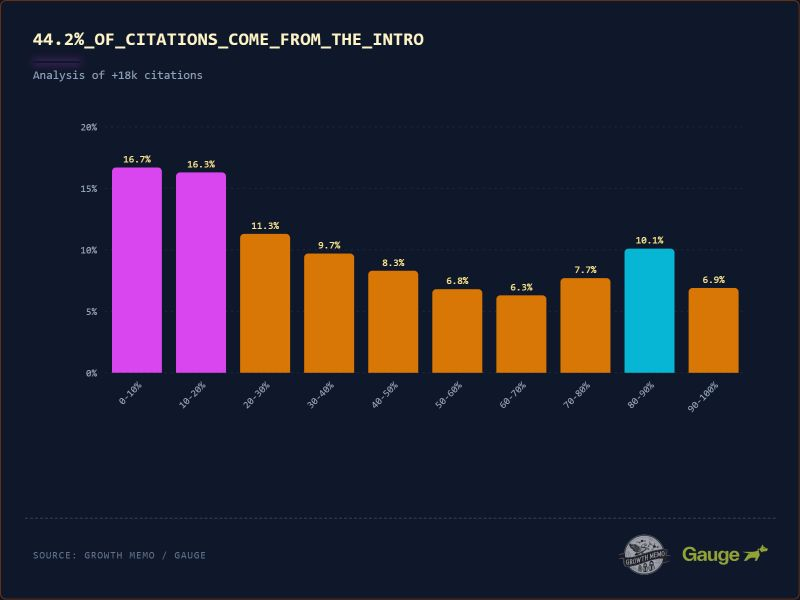
Indig describes it as a “ski ramp” effect: a steep cliff after the first third of the page, then a long, slow tail to the bottom.
“Burying key product features or definitions deep in the content reduces retrieval probability by a factor of 2.5 compared to the introduction.”
— Kevin Indig
Two different AI systems. Same structural bias toward early answers.
Why front-loading isn’t just good UX—it’s now a citation strategy
The instinct to build context before delivering an answer is deeply embedded in content marketing. Hooks, narrative arcs, problem-agitate-solve structures: all of it is optimized for human reading patterns and time-on-page metrics.
AI citation behavior doesn’t care about your narrative arc. What it appears to reward is definitional clarity, early.
If your article is about AI Overview citations, the definition of what an AI Overview is, combined with the clearest statement of your core finding, should appear in the first 20% of the page. Not after the third subheading, nor after you’ve “warmed the reader up”.
This creates a real tension for content strategists. Long-form content built for engagement and dwell time runs directly counter to a structure optimized for AI citation.
You don’t have to choose one or the other, but you do have to be intentional about both. The answer is to front-load without sacrificing depth: lead with the insight, then build the supporting case beneath it.
The one exception worth noting, however, is FAQ sections.
A meaningful share of bottom-of-page citations in our analysis came from FAQ blocks addressing specific, discrete questions. These work because they’re structurally self-contained. Each question-answer pair functions like a mini article with its own clear answer at the top.
So, if you’re building FAQ sections as an afterthought, you may want to rethink this as they’re actually one of the highest-leverage citation surfaces on the page.
What this means for your content structure right now
The practical implication isn’t “write shorter articles.” It’s “answer earlier.” Here’s how to operationalize that without dismantling your existing content strategy:
- Audit your top-traffic pages for answer depth. Find where the primary answer to your target query actually appears on the page. If it’s below the 30% mark, that’s your first optimization target. Move the core definition or finding up before the context-setting and the problem framing.
- Rewrite your introductions as answer-first summaries. Your first 150–200 words should contain the clearest, most direct statement of what the article covers and what its core finding is. This isn’t an abstract; it’s a citation target, so treat it like one.
- 3. Build FAQ sections with AI citation intent. Don’t use FAQ blocks as an SEO checkbox. Write them as standalone answer units: each question gets a crisp, complete answer in the first sentence. These are the structures most likely to get cited from deep-page positions.
- 4. Use a tool to identify citation gaps. There are now Chrome extensions that analyze what AI Overviews are citing from competitor pages, compare it against your content, and surface what’s missing or poorly positioned. If you need help building your own, here’s how we did it.
Structure is the new ranking signal
Rankings without citations are increasingly hollow. Showing up at position one means less when the AI Overview above it answers the query before the user ever scrolls.
The data from both Google and ChatGPT citation analysis points to the same conclusion: if your answer isn’t in the first third of the page, there’s a better than even chance it’s not getting cited at all.
The fix: Instead of producing more content, restructure what you already have: move answers earlier, tighten definitions, and build FAQ surfaces that function as discrete citation targets.
→ Get the latest insights on how to improve content visibility and optimize for AI Overview search with AI B2B Marketing strategy:
- Measuring the modern AI-powered funnel
- Optimizing B2B content funnels with AI
- Increase your visibility and revenue from AI-based discovery engines.
- Content strategy for LLM visibility and changing search habits
- Optimize pages for AI search with GEO/AEO
→ Grab your seat at our 5-day n8n webinar series and learn how to automate manual marketing tasks
→ Catch our free webinar: 5-day AI Adoption for Leaders with Ramir Arya and Ilinca Munteanu (Co-Founders of WeSimplify)
Discover more on-demand B2B AI courses and start outperforming before your competitors become the sources AI cites.
