Product analytics is the process of using behavioral data to understand how people use a product, where they experience value, and what changes can improve activation, engagement, retention, and revenue.
That skill is becoming more important as analytics moves beyond static dashboards. Mixpanel’s 2026 State of Digital Analytics analyzed more than 22 billion user actions across eight industries and found that leading teams are increasingly using analytics to reduce time to value, identify friction, improve retention, and decide what to do next rather than simply report what happened.
The eight product analytics courses below cover those skills from different angles, including measurement strategy, event tracking, funnels, cohorts, retention, experimentation, SQL, AI-assisted analytics, and tools such as Amplitude and Mixpanel.
- Best for building an analytics measurement foundation: CXL Strategic Analytics Framework for GA4
- Best advanced product analytics course: Reforge Mastering Product Analytics
- Best university-backed course for beginners: University of Virginia Product Analytics and AI
- Best for product managers focused on iteration: eCornell Product Analytics and Iteration
- Best beginner course: Escuela Escribano Fundamentals of Product Analytics
- Best free product analytics course: Amplitude Analytics 101
Table of contents
- Why are product analytics skills important in 2026?
- Product analytics courses compared
- Best product analytics courses
- 1. Strategic Analytics Framework for GA4 — CXL
- 2. Mastering Product Analytics — Reforge
- 3. Product Analytics & Experimentation Certification — Product School
- 4. Product Analytics and AI — University of Virginia
- 5. Product Analytics and Iteration — eCornell
- 6. The Ultimate Product Analytics Course — Product Analytics Academy
- 7. Fundamentals of Product Analytics — Escuela Escribano
- 8. Analytics 101 — Amplitude Academy
- What should a product analytics course teach in 2026?
- How did we choose the best product analytics courses?
- How do you choose the right product analytics course?
- Our recommendation for product and growth teams
- FAQs about product analytics courses
- Build deeper analytics skills with CXL
Why are product analytics skills important in 2026?
Product analytics skills matter because acquiring users is not enough; teams need to understand whether those users reach value, adopt the product, and continue using it.
Amplitude’s analysis of more than 2,600 companies found no meaningful correlation between strong acquisition and strong retention. Its product benchmark data also showed a substantial retention gap: products at the 90th percentile retained 18.5% of users after three months, compared with 3.8% for median products.
Early product behavior matters particularly strongly. In the same dataset, 69% of products with strong early activation were also strong three-month retention performers, showing why teams increasingly measure activation and time to value alongside acquisition.
Product analytics itself is changing too. Mixpanel’s 2026 research describes analytics as moving from a reporting layer toward an active decision system that can help teams identify friction, anticipate behavior, personalize experiences, and align product, marketing, growth, and data teams around shared outcomes.
That means product analytics is no longer only a specialist analyst skill. Product managers, growth marketers, designers, and other operators increasingly need enough analytics fluency to ask the right questions, interrogate behavioral data, and turn findings into decisions.
Product analytics courses compared
| Course | Best for | Level | Format | Price |
|---|---|---|---|---|
| CXL Strategic Analytics Framework for GA4 | Product and growth teams building a reliable behavioral analytics foundation | Beginner–intermediate | On-demand | CXL subscription or standalone purchase |
| Reforge Mastering Product Analytics | Experienced product professionals building stronger analytics systems | Intermediate–advanced | Live course | $1,995/year Reforge membership |
| Product School Product Analytics & Experimentation Certification | Product professionals using analytics and experimentation to drive growth | Intermediate–advanced | Live online certification | $2,999 |
| University of Virginia Product Analytics and AI | Beginners wanting university-backed product analytics training with modern AI applications | Beginner | Self-paced via Coursera | Coursera access options vary |
| eCornell Product Analytics and Iteration | Product managers using data to improve products after launch | Intermediate | Instructor-led online | Part of eCornell Product Management programs |
| Product Analytics Academy Ultimate Product Analytics Course | PMs wanting hands-on metrics, Mixpanel, SQL, and experimentation skills | Beginner–intermediate | Self-paced | $175 currently; normally $299 |
| Escuela Escribano Fundamentals of Product Analytics | Beginners wanting structured, practical analytics training | Beginner | Self-paced | €399 |
| Amplitude Analytics 101 | Product teams learning hands-on analytics in a major product analytics platform | Beginner | Self-paced | Free |
Best product analytics courses
1. Strategic Analytics Framework for GA4 — CXL
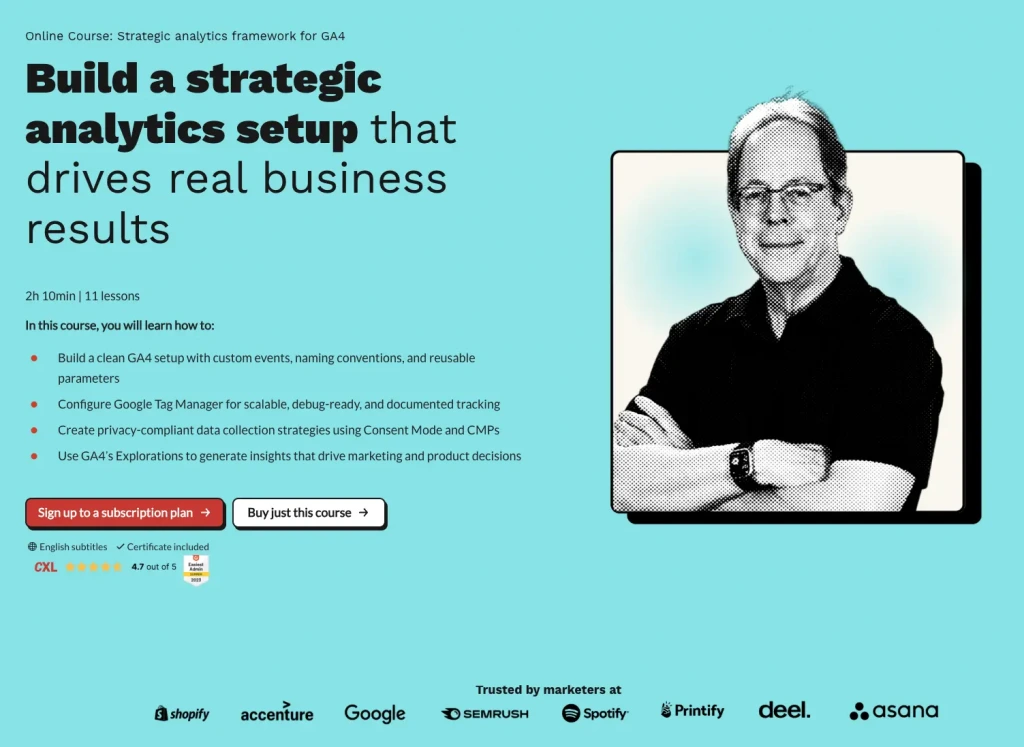
Best for: Product, growth, and analytics professionals who need a reliable measurement framework for tracking user behavior and making data-informed product decisions.
Course details
- Provider: CXL
- Instructor: Fred Pike
- Price: Available individually or through a CXL subscription
- Format: On-demand
- Duration: 2 hours 10 minutes
- Content: 11 lessons
- Level: Beginner to intermediate
- Certification: Yes
What you’ll learn
- Translate business objectives into measurable KPIs.
- Understand GA4’s event-based data model.
- Decide which user interactions and behaviors should be tracked.
- Build scalable custom event taxonomies.
- Create structured measurement plans before implementation.
- Configure Google Tag Manager for reliable GA4 tracking.
- Develop privacy-conscious data collection strategies.
- Use GA4 Explorations and behavioral data to support marketing and product decisions.
Why we picked it
CXL’s Strategic Analytics Framework for GA4 focuses on one of the foundations of effective product analytics: collecting the right behavioral data in the first place.
Rather than simply teaching users how to navigate GA4 reports, the course covers measurement strategy, KPIs, event architecture, custom events, tracking implementation, and data collection. CXL explicitly positions the course around turning raw analytics data into insights that support both marketing and product decisions.
It is particularly useful for product and growth teams that need to establish a trustworthy analytics foundation before moving into more advanced funnel, retention, cohort, or experimentation analysis.
Pros and cons
| Pros | Cons |
|---|---|
| Strong focus on measurement strategy and clean behavioral data | GA4-focused rather than a dedicated product analytics platform |
| Covers events, KPIs, GTM, and data collection | Does not go as deeply into retention and cohort analysis as specialist product analytics courses |
| Current CXL course with certification | More implementation-focused than strategic product management training |
2. Mastering Product Analytics — Reforge

Best for: Experienced product managers and product leaders that already work with data but want a more systematic approach to product analytics.
Course details
- Provider: Reforge
- Host: Crystal Widjaja
- Price: $1,995/year for an individual Reforge membership
- Format: Builder Live course
- Level: Intermediate to advanced
- Access: Included with Reforge membership
What you’ll learn
- Identify the metrics that matter for a specific product decision.
- Use quantitative data to understand user behavior.
- Segment users to uncover meaningful behavioral differences.
- Use retention cohorts to understand how behavior changes over time.
- Evaluate the reliability and structure of datasets before making decisions.
- Build repeatable analytical processes rather than one-off analyses.
- Communicate quantitative insights in a way that supports product prioritization.
Why we picked it
Reforge is better suited to experienced product professionals than someone learning analytics from scratch. Mastering Product Analytics focuses on developing a repeatable process for using quantitative evidence to make better product decisions.
The curriculum goes beyond reporting into segmentation, retention cohorts, data reliability, analysis design, and collaboration with data teams. That makes it particularly useful for product managers working in organizations where analytics already exists but is not consistently influencing product strategy.
Pros and cons
| Pros | Cons |
|---|---|
| Strong strategic and decision-making focus | Expensive if you only want one course |
| Built for experienced product professionals | Not suitable as an introduction to analytics |
| Covers segmentation, cohorts, data quality, and analytical processes | Less focused on learning individual analytics platforms |
3. Product Analytics & Experimentation Certification — Product School
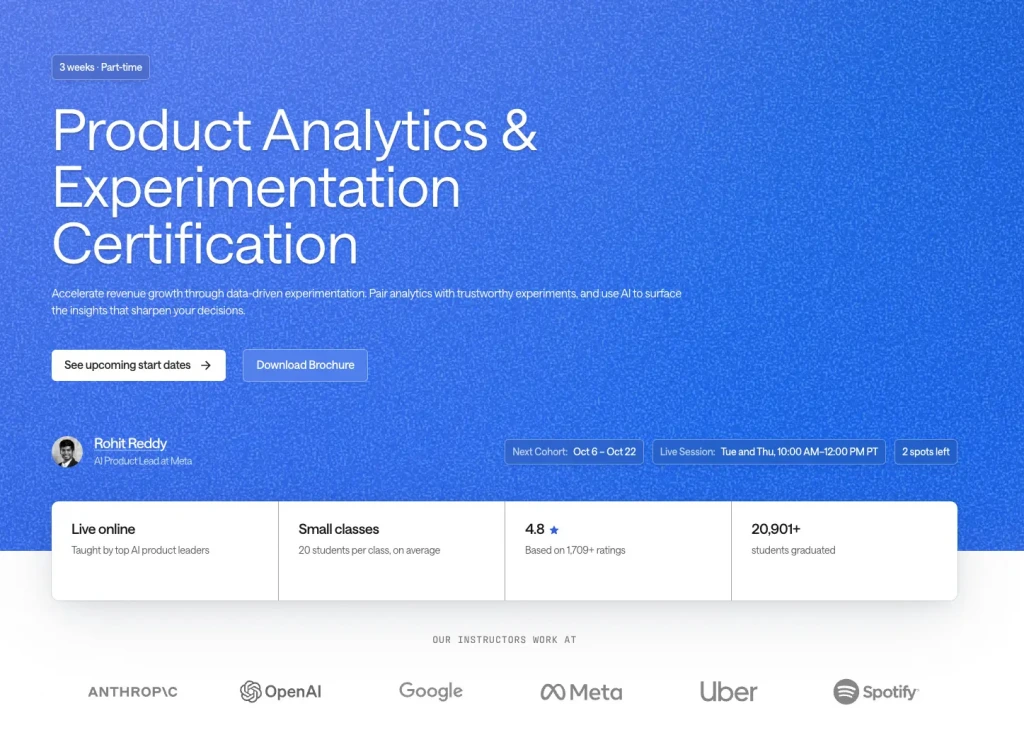
Best for: Experienced product managers and growth-focused professionals that want to combine analytics with systematic experimentation.
Course details
- Provider: Product School
- Price: $2,999 for a single certification
- Format: Live online
- Duration: 3 weeks
- Content: 6 modules, 6 live sessions, 12 live hours, 11 hands-on labs, 6 artifacts, and a graded final project
- Level: Intermediate to advanced
- Certification: Yes
What you’ll learn
- Build product-led growth systems around measurable user behavior.
- Identify and prioritize growth hypotheses.
- Design experiments beyond basic A/B testing.
- Analyze acquisition and activation flows.
- Use experimentation to improve retention and engagement.
- Test pricing, monetization, bundling, and upsell strategies.
- Build repeatable experimentation processes across a product organization.
- Use analytics and AI-assisted analysis to support product decisions.
Why we picked it
Product School gives this list a stronger live, experimentation-led option. The course is explicitly designed for people with existing product experience rather than beginners, and it combines analytics with the experiments that turn insights into measurable product changes.
The hands-on labs, artifacts, and final project also make it more applied than courses built mainly around video lessons. It is particularly relevant for product and growth professionals responsible for activation, retention, monetization, or experimentation programs.
Pros and cons
| Pros | Cons |
|---|---|
| Live instruction with substantial hands-on work | One of the most expensive options on the list |
| Connects analytics directly to experimentation and growth | Not designed for product beginners |
| Covers acquisition, activation, retention, and monetization | Requires attendance at scheduled live sessions |
4. Product Analytics and AI — University of Virginia
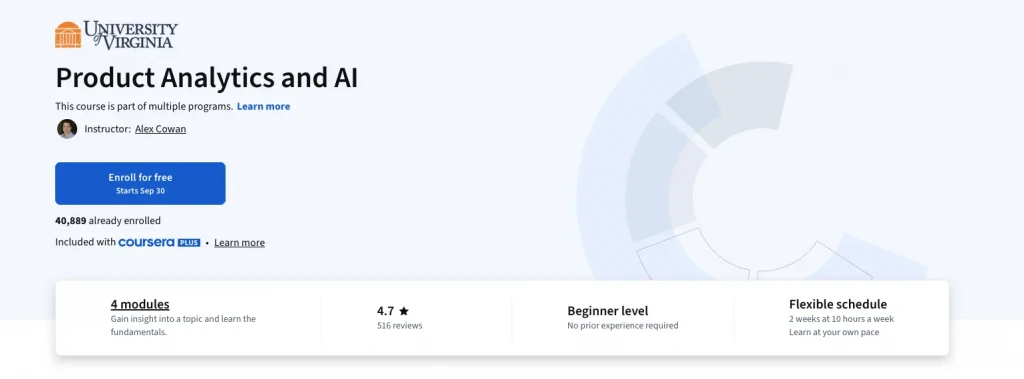
Best for: Beginners who want a university-backed introduction to product analytics, experimentation, and the growing role of AI in product decision-making.
Course details
- Provider: University of Virginia Darden School of Business via Coursera
- Instructor: Alex Cowan
- Price: Coursera subscription; access and free-trial options vary
- Format: Self-paced
- Duration: Approximately 2 weeks at 10 hours per week
- Content: 4 modules
- Level: Beginner
- Certification: Shareable Coursera certificate
What you’ll learn
- Connect product work to actionable analytics and user value.
- Combine customer hypotheses with quantitative evidence.
- Instrument products so teams can observe user behavior.
- Test product propositions before investing heavily in development.
- Use analytics to guide Agile product iterations.
- Understand where predictive and generative AI fit within modern analytics workflows.
- Collaborate more effectively with data-science teams.
- Apply data-driven thinking to product development and improvement.
Why we picked it
The University of Virginia course is a useful alternative to practitioner-led training because it provides a structured academic foundation without becoming overly theoretical.
It has also been updated to address AI alongside analytics, including data science, generative AI, experimentation, instrumentation, and product decision-making. That makes it more current than many university product analytics courses that still focus exclusively on traditional analytics workflows.
Pros and cons
| Pros | Cons |
|---|---|
| University-backed curriculum | Less advanced than Reforge or Product School |
| Includes analytics, experimentation, and AI | Broader product focus rather than deep analytics specialization |
| Suitable for complete beginners | Limited platform-specific training |
5. Product Analytics and Iteration — eCornell

Best for: Product managers who want to use analytics to evaluate launched products, validate hypotheses, and decide what to improve next.
Course details
- Provider: Cornell University / eCornell
- Course author: Keith Cowing
- Format: 100% online and instructor-led
- Duration: 2 weeks
- Workload: Approximately 3–5 hours per week
- Level: Intermediate
- Certification: Included within Cornell product management certificate pathways
- Prerequisites: Developing a Product Hypothesis and Personas and User Personas and Product Vision
What you’ll learn
- Measure whether a product is progressing toward its objectives.
- Collect and interpret data after launching a minimum viable product.
- Validate or update product hypotheses using quantitative evidence.
- Identify what is and is not working within a product.
- Use findings to recommend changes to product strategy.
- Adjust product roadmaps based on evidence.
- Present product learnings and recommendations to stakeholders.
- Build iteration into the wider product-management process.
Why we picked it
eCornell approaches analytics specifically from the perspective of product iteration. Rather than teaching analytics as an isolated technical discipline, it focuses on what happens after a product or MVP launches and how data should influence what the team builds next.
That makes it particularly relevant for product managers who already understand product discovery and roadmapping and want a more disciplined process for evaluating results and deciding when to change direction.
Pros and cons
| Pros | Cons |
|---|---|
| Cornell-backed instructor-led training | Requires prerequisite courses |
| Strong connection between analytics and product iteration | Not available as a simple standalone beginner course |
| Focuses on translating findings into roadmap decisions | Less technical than dedicated analytics programs |
6. The Ultimate Product Analytics Course — Product Analytics Academy
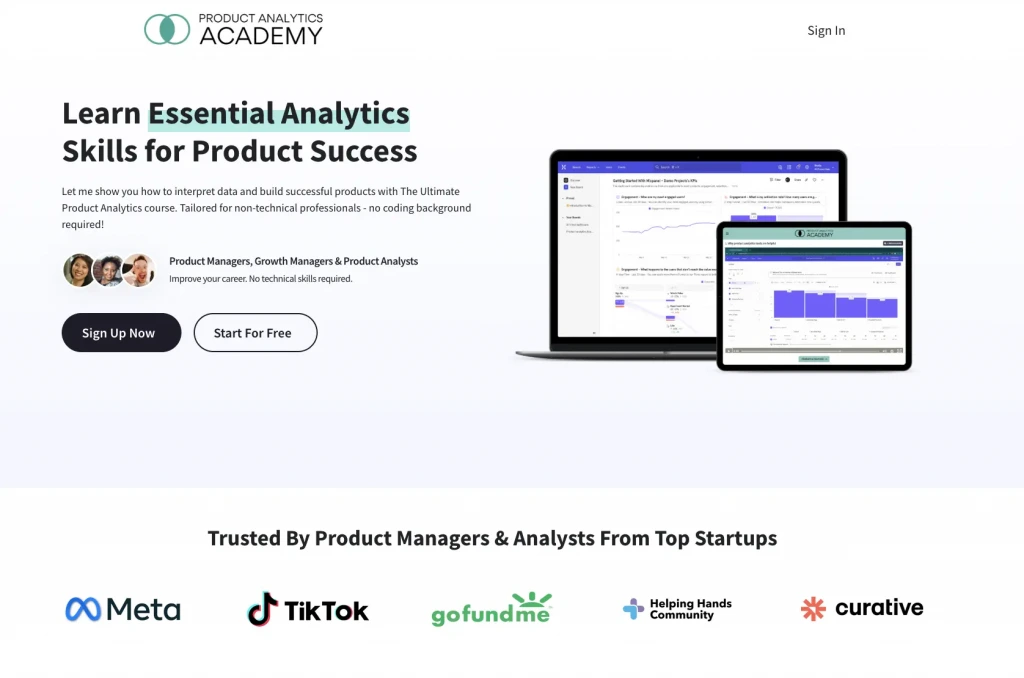
Best for: Product managers and analysts who want practical training across metrics, Mixpanel, tracking, experimentation, and SQL.
Course details
- Provider: Product Analytics Academy
- Instructor: Ali from Mentat Analytics
- Price: Currently $175; normally $299
- Format: Self-paced
- Access: Lifetime access
- Level: Beginner to intermediate
- Certification: Available after completing the capstone project
What you’ll learn
- Define meaningful success metrics and KPIs.
- Build a tracking plan for a digital product.
- Analyze product behavior using Mixpanel.
- Understand the SQL product managers actually need.
- Design and evaluate A/B tests.
- Avoid common experimentation and measurement mistakes.
- Apply product analytics concepts to realistic scenarios.
- Complete a capstone project using the skills covered in the course.
Why we picked it
Product Analytics Academy is one of the more hands-on options on this list. It combines the strategic side of product analytics, such as choosing metrics and designing tracking plans, with practical skills in Mixpanel, SQL, and experimentation.
The curriculum is also specifically built around product analytics rather than being a broader data-analysis or product-management program with a single analytics module. That makes it useful for product professionals who want to become more technically capable without moving into a full data-science curriculum.
Pros and cons
| Pros | Cons |
|---|---|
| Covers metrics, tracking, Mixpanel, SQL, and experimentation | Less widely recognized provider than CXL, Cornell, or Reforge |
| Practical exercises and capstone project | Strong Mixpanel emphasis may not suit every analytics stack |
| Lifetime access and relatively low price | Self-paced format offers less accountability than live programs |
7. Fundamentals of Product Analytics — Escuela Escribano
Best for: Product managers, designers, engineers, founders, and marketers with little or no analytics experience who want a structured practical foundation.
Course details
- Provider: Escuela Escribano
- Instructors: Javier Escribano and Juan Luis Hernández
- Price: €399
- Format: Self-paced with practical exercises and personalized support
- Duration: Approximately 40 hours
- Content: 67 lessons
- Level: Beginner
- Language: Available in English and Spanish
What you’ll learn
- Understand the main types of data used in product analytics.
- Apply analytics across discovery, prioritization, launch, and iteration.
- Use spreadsheets to manipulate and analyze product data.
- Work with averages, medians, ratios, percentages, and other basic analytical concepts.
- Segment customers by characteristics and behavior.
- Define and interpret product KPIs.
- Analyze funnels, conversion, retention, engagement, and feature usage.
- Understand basic product data-collection methods.
- Create clear charts and visualizations.
- Work with tools including Amplitude, Google Analytics, and Tableau.
- Present analytical findings clearly to stakeholders.
Why we picked it
Escuela Escribano offers considerably more depth than many introductory product analytics courses. The curriculum combines analytical fundamentals with product-specific metrics, funnels, segmentation, visualization, and practical exercises.
It is also designed around learning how to think through product and business problems using data rather than teaching one particular analytics platform. The approximately 40-hour workload makes it a substantial beginner program for people who want more than a short overview.
Pros and cons
| Pros | Cons |
|---|---|
| Extensive practical beginner curriculum | Significant time commitment |
| Covers spreadsheets, KPIs, funnels, segmentation, and visualization | Less internationally recognized than larger providers |
| Includes exercises, solutions, and personalized support | Does not teach SQL in the fundamentals course |
8. Analytics 101 — Amplitude Academy
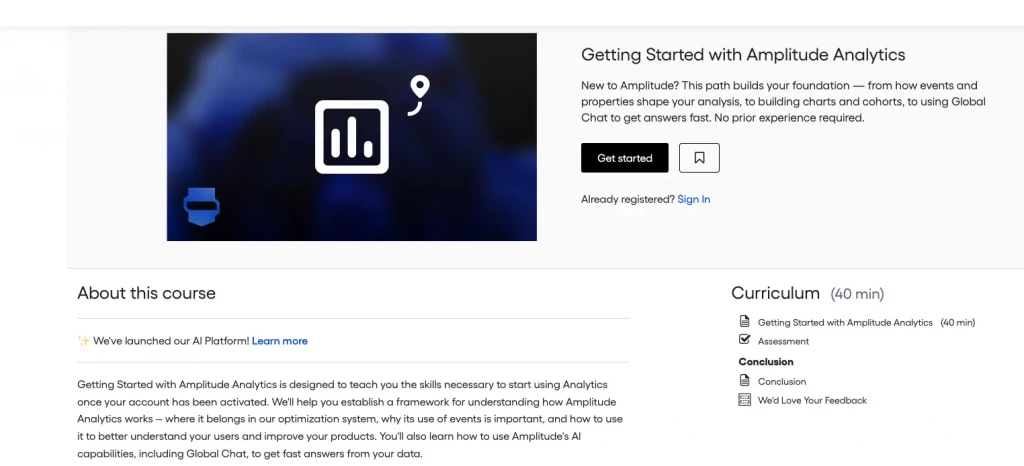
Best for: Product managers, marketers, analysts, and growth teams that want free hands-on experience using a major product analytics platform.
Course details
- Provider: Amplitude Academy
- Price: Free
- Format: Self-paced
- Level: Beginner
- Platform: Amplitude Analytics
- Access: Available through Amplitude Academy and its free demo environment
What you’ll learn
- Understand the fundamental features of Amplitude Analytics.
- Analyze the actions users perform inside a product.
- Use event segmentation to explore user behavior.
- Build funnels to identify where users convert or drop off.
- Analyze retention and recurring product usage.
- Explore cohorts and different groups of users.
- Apply analytics concepts using real product data and an interactive analytics environment.
- Use behavioral data to answer practical product questions.
Why we picked it
Amplitude is one of the major platforms built specifically for product analytics, which makes its training useful for anyone who wants to move from analytics theory into an actual product analytics environment.
Analytics 101 is free and self-paced, and Amplitude provides a demo account with preloaded data so learners can practice rather than simply watch tutorials. Amplitude Academy also offers more advanced learning paths covering analytics, experimentation, retention, and other product-growth skills.
Pros and cons
| Pros | Cons |
|---|---|
| Free training from a major product analytics platform | Primarily teaches the Amplitude ecosystem |
| Hands-on practice with a preloaded demo account | Not a broad product analytics qualification |
| Covers funnels, segmentation, retention, and user behavior | Less strategic depth than CXL or Reforge |
What should a product analytics course teach in 2026?
A good product analytics course should teach you how to turn user behavior into better product decisions.
Look for training that covers:
- Measurement strategy and KPIs
- Event tracking and instrumentation
- Funnels, activation, and retention
- Segmentation and cohort analysis
- Experimentation and testing
- Tools such as Amplitude, Mixpanel, GA4, or SQL
- Communicating insights to product and growth teams
The best courses teach transferable analytical skills rather than simply how to navigate one platform.
How did we choose the best product analytics courses?
We prioritized courses that teach practical product analytics rather than general data analysis.
Our selections were based on:
- Instructor credibility: Established practitioners, universities, and analytics platforms.
- Curriculum quality: Strong coverage of behavioral analytics, measurement, retention, or experimentation.
- Current relevance: Active courses reflecting modern analytics workflows.
- Practical application: Exercises, projects, tools, or frameworks you can use at work.
- Value: A mix of free, paid, beginner, advanced, live, and self-paced options.
How do you choose the right product analytics course?
Start with the skill you actually need to improve.
- Beginners: Look for metrics, funnels, segmentation, retention, and instrumentation fundamentals.
- Experienced product professionals: Prioritize experimentation, cohort analysis, and advanced decision-making.
- Need technical skills: Choose training that includes SQL, Mixpanel, Amplitude, or BigQuery.
- Need practical experience: Look for projects, exercises, and real datasets rather than lecture-only courses.
- Need a credential: Choose a recognized certification, but prioritize skills you can demonstrate at work.
Our recommendation for product and growth teams
If you’re new to product analytics, start with the University of Virginia Product Analytics and AI course or Escuela Escribano Fundamentals of Product Analytics for a structured foundation.
For hands-on behavioral analytics, add Amplitude Analytics 101 or Product Analytics Academy. More experienced product professionals will get greater value from Reforge Mastering Product Analytics or Product School’s Product Analytics & Experimentation Certification.
The goal is to move from collecting data to using it to decide what to build, test, fix, or prioritize.
FAQs about product analytics courses
What is the best product analytics course for beginners?
University of Virginia’s Product Analytics and AI is a strong short introduction. Escuela Escribano is better if you want a more comprehensive beginner curriculum covering metrics, funnels, segmentation, and analytics tools.
What is the best free product analytics course?
Amplitude Analytics 101 is a strong free option because it lets you learn behavioral analytics inside a dedicated product analytics platform using practical data.
Do product managers need to know SQL?
Not always, but basic SQL can make product managers more independent when exploring data. Product Analytics Academy includes practical SQL, while some advanced courses such as Reforge assume you already have access to analytical support.
What is the difference between product analytics and web analytics?
Web analytics typically focuses on traffic, acquisition, pages, and conversions. Product analytics goes deeper into what users do inside a product, including activation, feature adoption, engagement, retention, and churn.
Are product analytics certifications worth it?
They can demonstrate structured learning, but practical ability matters more. You should be able to define useful metrics, analyze user behavior, evaluate experiments, and turn findings into product decisions.
What skills do you need for product analytics?
Core skills include KPI design, event tracking, funnels, segmentation, cohort analysis, activation, retention, experimentation, and data interpretation. More technical roles may also require SQL and statistical knowledge.
Can marketers benefit from learning product analytics?
Yes. Product analytics helps marketers understand what happens after acquisition, including whether customers activate, adopt the product, retain, upgrade, or churn.
Build deeper analytics skills with CXL
If you want to go further, these CXL courses build on the product analytics skills covered above:
- Strategic Analytics Framework for GA4: Build a reliable measurement system around business goals, KPIs, events, and user behavior.
- BigQuery and GA4: Learn SQL basics, connect GA4 with BigQuery, analyze behavioral data, and build more advanced reporting workflows.
- AI Native Marketer: Build AI-powered marketing systems for research, measurement, reporting, experimentation, and execution.
Click the icons to ask AI to match the best course to your career goals
Describe your career goals and let AI personalize the courses shown here.