When researching a new product, buyers use 10 or more channels to interact with companies. Each channel presents a chance to make a good impression.
Optimize each channel, and you’ll win new customers, enjoy higher order rates, and retain customers. Get them wrong, and you risk damaging brand perception and trust.
In this post, we’ll explore lessons from brands that use omnichannel marketing to deliver a seamless customer experience.
A unique selling proposition (USP) explains what makes your product, service, or brand meaningfully different from the alternatives available to your customer.
The strongest USPs do more than describe a product. They give a specific audience a reason to choose you by communicating a distinctive benefit, approach, purpose, or point of view.
The 21 examples below show how B2B, ecommerce, and direct-to-consumer brands have approached differentiation. Some screenshots and messages are historical examples rather than the brands’ current homepage copy. That’s intentional: positioning evolves, but the principles behind effective differentiation remain useful.
Consistency is the cornerstone of good marketing. You only have to look at top brands to see this in action: Apple’s sleekness, Coca-Cola’s playfulness, Disney’s magic.
Consistency is equally critical for startups. Stacked Marketer turned a free newsletter into a six-figure revenue generator by staying actionable, convenient, and entertaining.
Being consistent earns trust and cements brand status—qualities that add 10–20% to your overall growth, according to LucidPress research. On the flip side, inconsistency confuses consumers, limiting your chance to generate leads.
A marketing playbook, whether B2B or B2C-focused, helps you achieve brand consistency across channels and campaigns.
In this article, we’ll explain how to create a marketing playbook to align your teams and boost your sales opportunities.
You should be dedicating resources to encouraging each new and existing customer to increase their spending. If not, you’re missing out on a play that can deliver exponential returns.
Recommending additional products or services can help customers solve problems while upping their investment. This will improve customer lifetime value (CLTV), making customer acquisition costs (CAC) healthier.
It’s called cross-selling; a tactic that drives 35% of sales for Amazon and helps leading SaaS companies reduce churn.
In this post, we’ll show how to put it into practice by breaking down examples of cross-selling done well.
Every business needs leads. The biggest challenge for marketers is getting them.
Account-based marketing (ABM) and lead generation both offer a way to do this. Done right, both can help attract the kind of high-quality leads that become long-term customers and advocates.
Snowflake achieved over 300% growth with ABM. Templafy generated 475% ROI with lead generation. DocuSign combines both to fuel its sales funnel.
In this article, we’ll look at both disciplines, explaining what they are and when they’re best used. You’ll also learn how to approach ABM and lead generation to engage your ideal customer.
An account-based marketing strategy decides three things before any campaign runs: which accounts you will go after, who inside those accounts you need to win over, and how sales and marketing will work those accounts together. Get those right and the tactics are the easy part. Get them wrong and ABM becomes expensive lead generation with a smaller list.
This guide covers what ABM looks like in 2026, when it fits, how to pick and tier accounts, which signals to watch, how to align sales and marketing, which plays to run, how to measure it, and a step-by-step plan to launch your first program. For real campaigns and their results, see our account-based marketing examples and case studies.
Key takeaways
ABM starts with a named list of accounts, not a lead target. Everything else follows from that list.
It fits when deal sizes are large, the number of good-fit accounts is finite, and several people inside each account influence the purchase.
Tier accounts into one-to-one, one-to-few, and one-to-many, and match spend and personalization to each tier.
Use fit to build the list and signals (intent, engagement, triggers) to decide which accounts get attention this quarter.
Sales and marketing must share one account list, one definition of progress, and one dashboard.
Measure account progression, pipeline, and revenue from target accounts, not MQLs.
What is account-based marketing in 2026?
Account-based marketing (ABM) is a B2B go-to-market approach where marketing and sales select a defined set of high-value accounts and coordinate their activity to engage, win, and grow those specific accounts, including the full buying group inside each one.
Steve Watt, who teaches CXL’s account-based marketing course, defines it as “a sustained, coordinated, strategic approach to identifying, engaging, closing, and growing the accounts that we know we should win.” Each word does work:
Sustained. ABM is not a campaign or a channel. It is an operating model that runs for quarters, not weeks.
Coordinated. Marketing, sales, and leadership work the same accounts at the same time. It does not stop when marketing hands over a lead.
Strategic. Watt calls it “chess, not checkers”: you plan several moves ahead for each account.
Identifying, engaging, closing, growing. ABM covers the whole lifecycle, including expansion and retention, not just acquisition.
Accounts. Individuals don’t make B2B buying decisions; groups do. ABM targets the buying group, not one contact.
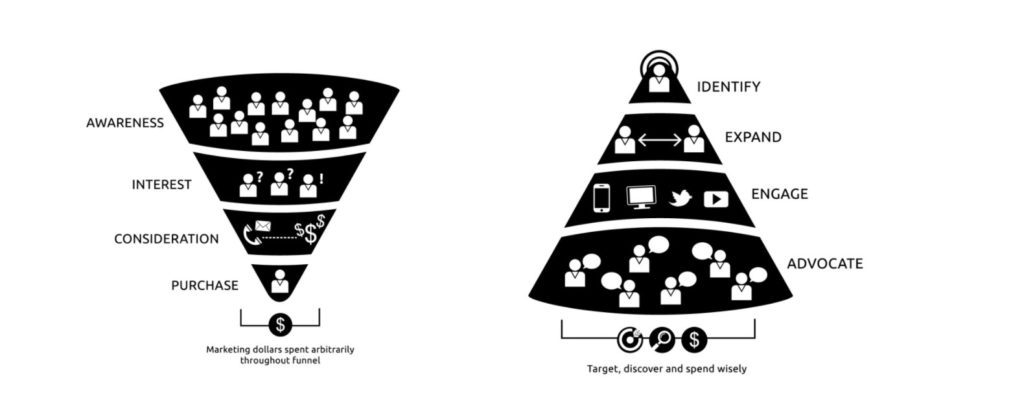
In practice, ABM flips the traditional funnel. Instead of attracting as many leads as possible and filtering down to the good ones, you start with the accounts you want and work outward to the people in them.
ABM is now mainstream in B2B. 6sense’s Marketing Measurement Benchmark found that 8 in 10 B2B organizations reported having an ABM program, rising to more than 90% among organizations selling solutions worth over $250,000 a year.
What has changed in the last few years is less the definition and more the execution:
Buying groups over contacts. Strong programs map and track the whole group (economic buyer, champion, technical evaluator, users, procurement) instead of scoring individual leads.
Signals over static lists. The account list is fixed for a period, but which accounts get attention this week depends on intent, engagement, and trigger events.
Buyers research before they talk to you. Much of the evaluation happens in peer conversations, review sites, and AI assistants before a rep is involved. ABM has to put a clear, differentiated point of view in front of the buying group early, not just book meetings.
Account-level measurement. Teams increasingly judge ABM on pipeline and revenue from target accounts rather than lead volume.
The buying group, whether they raised a hand or not
Personalization
By persona or segment
By account or cluster of similar accounts
Sales involvement
Starts at handoff
From account selection onward
Most companies run both. Lead generation keeps a steady flow of inbound demand; ABM concentrates effort on the accounts that matter most. For a deeper comparison, read account-based marketing vs. lead generation.
When does an ABM strategy fit?
ABM is resource-heavy. It pays off when the value of a won account is high enough to justify research, personalization, and coordinated sales time. Before you commit, answer these questions with your leadership team:
How big is the deal? The higher the contract value, the more customization you can afford per account.
How many good-fit accounts exist? If your total market is a few thousand companies or fewer, ABM is a natural fit. If it is hundreds of thousands of small businesses, it usually isn’t.
How many people are involved in buying? A single decision-maker rarely needs ABM. A buying group of five to fifteen people usually does.
How complex is the product? Complex products need more explanation tied to each account’s specific goals.
How strategic are certain accounts? Some logos open an industry. Winning two or three companies in a vertical can make the rest easier, which can justify one-to-one effort even on smaller deals.
How well known are you? Low awareness in your target market means more work to get noticed before you can get considered.
How crowded is the market? The more established competitors you face, the more your message has to be specific to the account.
What can your team actually run? A team of two cannot personalize for 400 accounts. Be honest about capacity, tools, and budget.
ABM usually fits: enterprise and mid-market B2B, long sales cycles, high contract values, expansion-heavy businesses, and companies moving upmarket.
ABM usually doesn’t fit (as the main motion): low-price self-serve products, transactional sales with one buyer, and markets so large and uniform that account-level personalization adds little.
The three ABM tiers: one-to-one, one-to-few, one-to-many
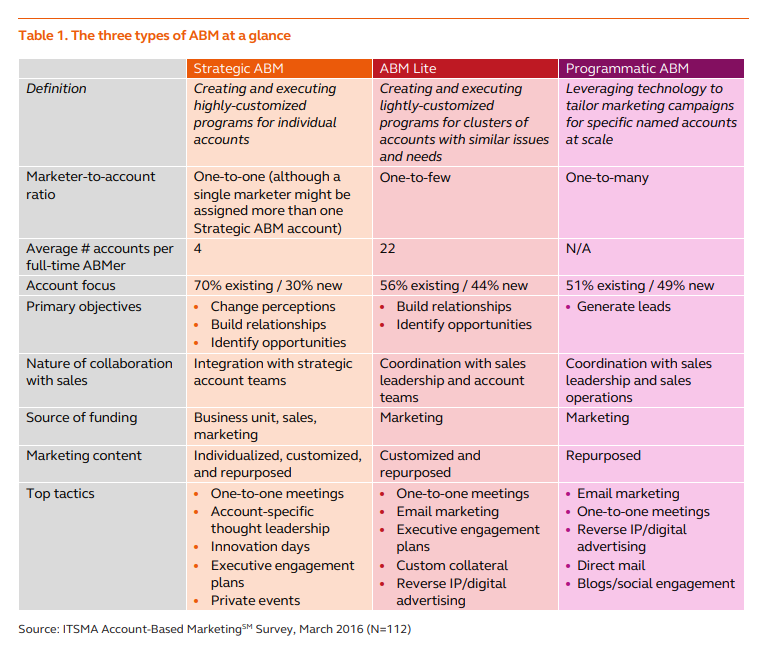
Most ABM programs combine three levels of investment. ITSMA’s ABM framework, which coined the terms, calls them Strategic ABM, ABM Lite, and Programmatic ABM.
The figures below come from ITSMA’s 2020 ABM benchmark. They are medians, so use them as a sense of scale, not a budget.
Tier
Typical deal size
Accounts
Median spend per account
Personalization
One-to-one (Strategic ABM)
$2M+
Around 14
$36K to $50K
Fully custom per account and often per stakeholder
One-to-few (ABM Lite)
$250K+
Around 50
$3K to $15K
Per cluster of accounts with a shared industry, problem, or trigger
One-to-many (Programmatic ABM)
$50K to $250K
Around 725
$1K to $3K or less
Light, driven by account data and automation
Accounts move between tiers. A one-to-many account that starts showing strong buying signals can graduate to one-to-few. A one-to-one account that goes quiet for two quarters can drop down. Review tier assignments at least quarterly.
How to build an account-based marketing strategy: 9 steps
Step 1: Set the business objective and get executive buy-in
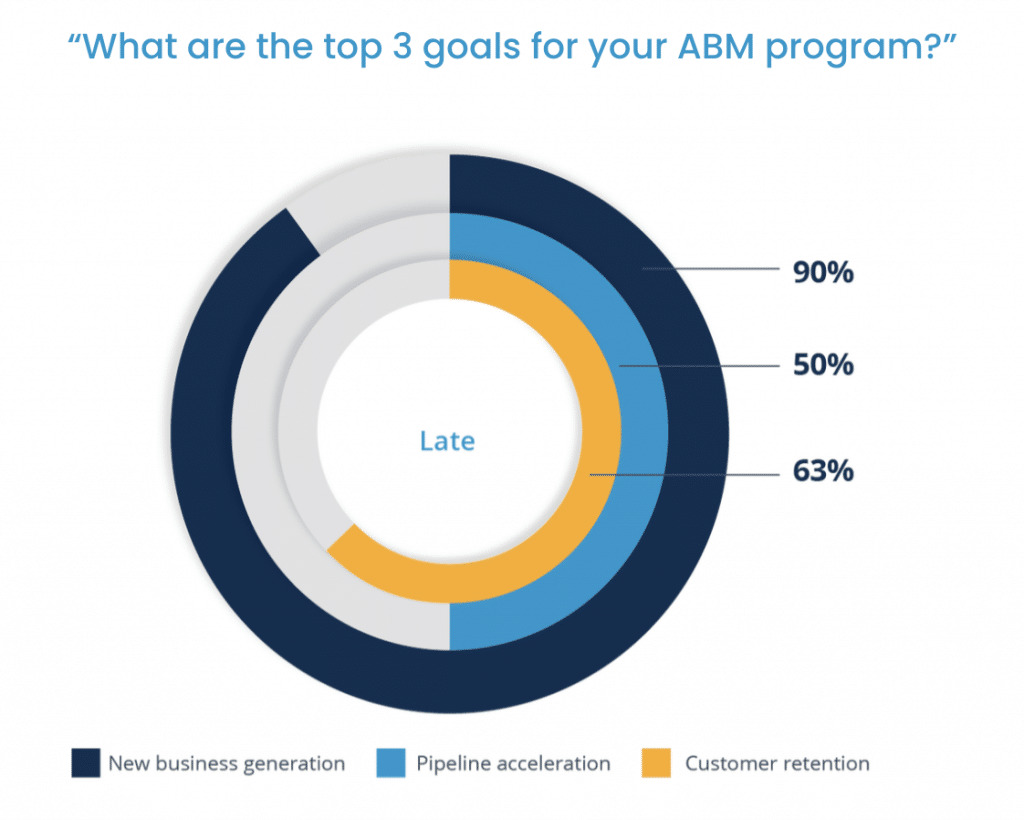
Start with what ABM is supposed to change. New logo acquisition is the most common goal, but it is not the only one:
Win new logos in a target segment or vertical;
Increase deal size or win rate on enterprise opportunities;
Shorten sales cycles;
Expand into more business units of existing customers;
Protect renewals at strategic accounts.
Then make the financial case. Watt suggests leadership should be able to answer: What is our current market position? How fast are we growing, and are we on track for our mid- and long-term targets? Do we understand our CAC, LTV, and payback period? Are we willing to invest in people and programs if ABM shows profitable growth? Who on the executive team will sponsor it?
Executives fund ABM when it is framed as a revenue plan for specific accounts, not a marketing experiment.
Step 2: Define your ideal customer profile and build the target account list
Start from your best existing customers, not your aspirations. Pull closed-won deals from the CRM and look for what the best ones (highest value, fastest close, best retention) have in common:
Technographics: tools they use that you integrate with or replace;
Situation: the problem or change that made them buy (new regulation, expansion, a migration, a new leader);
Relationship: existing contacts, past opportunities, partners in common.
Turn that into an ideal customer profile (ICP), then into a list. Two methods work well.
Fit, intent, and engagement. Filter the market by fit (the ICP attributes above), then layer on intent (signs an account is researching your problem) and engagement (accounts already visiting your site, attending events, or following you). Accounts that score on all three go to the top.
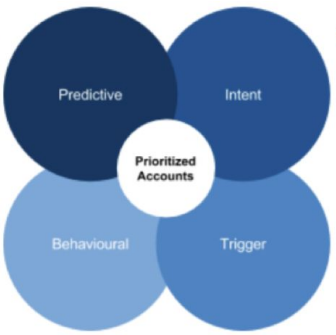
Larger organizations with big account universes often extend this to four lenses: predictive (models trained on your customer base), intent, behavioral (your own web and social analytics), and trigger (events like expansion or new product launches).
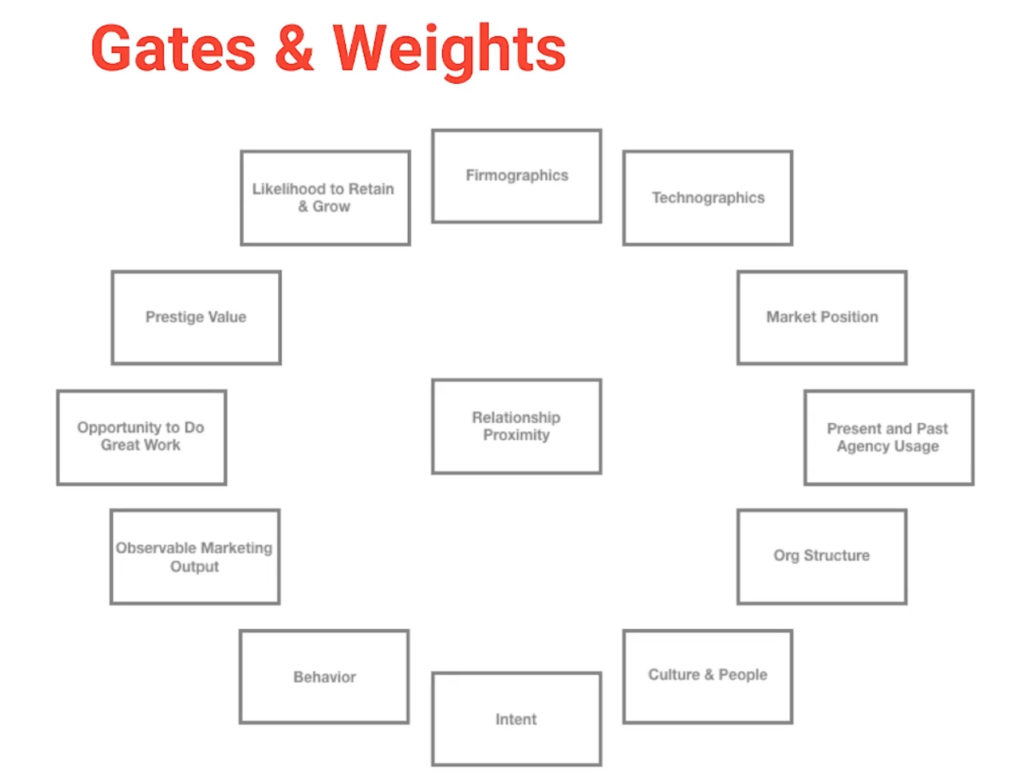
Gates and weights. List every factor that might matter (firmographics, technographics, intent, structure, market position, likelihood to grow, your relationship proximity), group and weight them, build an ideal account profile from the most important ones, then pass candidate accounts through hard gates. For example: annual revenue above your threshold? If yes, next gate: do they have the team that would use your product? If not, they drop out. What survives is a short, defensible list.
Size the list from your goal, not from what the data tool returns. If a new account is worth $10K and you want 20 new accounts ($200K), and your historical close rate on comparable accounts is 5%, you need roughly 400 target accounts. If that is more than your team can work properly, lower the goal or extend the timeline.
Whatever method you use, sales must agree on the final list. An account list marketing built alone is a list sales will ignore.
Step 3: Tier the accounts
Assign every account on the list to one-to-one, one-to-few, or one-to-many based on potential value, strategic importance, and current signals. Keep the one-to-one tier small. It is where most of the effort per account goes.
Snowflake is a good model. When it moved to ABM to triple revenue, it defined an ICP with sales (companies already using a data warehouse, with a defined plan to move to the cloud, and using competitor cloud tools). Each marketing development rep was limited to 100 accounts and aligned with three to four sales reps, for about 400 target accounts in total. Each salesperson then elevated their top 10 accounts to fully customized one-to-one programs, reviewed quarterly. Everything else got engagement-driven one-to-few programs.
To keep everyone aligned on why an account was chosen, Snowflake built an account intelligence snapshot scoring each account on Fit, Intent, Relationships, and Engagement (FIRE). According to its ITSMA award submission, Snowflake grew over 300% within 15 months of the switch.
Step 4: Map the buying group in each account
For each one-to-one and one-to-few account, identify the roles involved in a purchase like yours, then find the people who hold them:
Economic buyer: owns the budget and the business outcome;
Champion: wants the change and will sell it internally;
Technical evaluator: checks integration, security, and fit;
Users: will live with the product every day;
Procurement, legal, and blockers: can slow or stop the deal.
The fewer accounts in a tier, the deeper the research. For one-to-many, personas and segment-level insight are enough. For one-to-one, personas don’t matter; individuals do. Useful questions:
What are the account’s top priorities this year and over the next three years?
How do they compare with their competitors, and where are they weak?
Which tools do they use today, and where would you fit?
How is the company structured, and who reports to whom?
What are their leaders saying in interviews, podcasts, earnings calls, and conference talks?
Which roles are they hiring for, and how do they describe them?
What do you have in common (mutual connections, customers, partners)?
Step 5: Decide which signals trigger action
The list tells you who you could sell to. Signals tell you who to focus on now. Group them into four types and agree on what each one triggers:
Signal type
Examples
Typical action
Third-party intent
Account researching topics related to your category on publisher networks or review sites
Move into active advertising and SDR outreach with topic-matched messaging
First-party engagement
Multiple people from one account on your pricing, integration, or comparison pages; webinar attendance; email replies
Alert the account owner; add to a stage-specific nurture
Trigger events
New executive in your buyer role, funding round, acquisition, expansion, relevant job postings, tech stack change
Personal outreach referencing the change; consider moving the account up a tier
Relationship
A past champion joins a target account; a shared partner or investor; an existing customer in the same group
Warm introduction or referral play
You can start without paid tools: Google Alerts on target accounts, LinkedIn for hires and departures, and your own analytics for company-level visits. Intent platforms add scale, but no tool replaces a rep who reads the account’s news.
One caution: a signal is a reason to look closer, not proof of a buying cycle. Watch for several signals from the same account and from more than one person in it.
Step 6: Align sales and marketing around the accounts
ABM fails most often here. Sales should not feel it is helping marketing, and marketing should not feel it is passing leads for sales to close. Both own the account. In practice that means:
One account list in the CRM, with an owner on each side for every one-to-one and one-to-few account;
Account pods: for example an AE, an SDR, a marketer, and (for one-to-one) a solutions engineer or customer success manager working the same accounts;
Shared definitions of account stages (unaware, engaged, in conversation, opportunity, customer) and of what moves an account from one to the next;
A written SLA: how fast sales follows up on a signal, and what marketing delivers for each tier;
A weekly or biweekly account review to decide next moves per account;
One dashboard both teams look at. Caroo’s Director of ABM credited a live CRM dashboard for sales reps as one of the biggest drivers of its program.
Make sales leaders part of the ABM leadership team from the pilot onward. They become the people who sell ABM internally. For more on fixing the underlying relationship, see sales and marketing misalignment.
Step 7: Build the message for each account or cluster
Personalization is not putting the company name in a subject line. It is showing that you understand the account’s situation and have a view on what it should do about it.
One-to-one: an account-specific point of view, such as a short brief on their market, a benchmark against peers, or a teardown of a process your product improves, tailored by stakeholder.
One-to-few: a message built around the shared problem or trigger of the cluster (for example, mid-market insurers going through a core system migration).
One-to-many: industry and role-level messaging, with account data used to choose which version each account sees.
Test the core message before you scale it. A message that sounds compelling internally can land as generic with the people you are trying to reach, and in ABM every wasted touch costs more because the list is short.
Step 8: Choose channels and plays
Think of the buyer’s journey as “the account is here, and it needs to get there.” An account that has never heard of you needs to notice you first; an account in an active evaluation needs proof and access to the right people. As Watt puts it, “think in terms of plays, not silver bullets.” A play is a coordinated sequence across channels with a clear goal, owner, and next step.
Tier
Plays that work well
One-to-one
Custom microsite or landing page per account, executive briefings and dinners, account-specific research or workshops, personalized direct mail, AE video messages, multi-threaded outreach to the full buying group
One-to-few
Industry or problem-specific landing pages, small-group roundtables and webinars, cluster-level case studies, targeted LinkedIn and display ads, SDR sequences by cluster
One-to-many
Account-list targeted ads, website personalization by industry or company size, intent-triggered nurture emails, retargeting, review-site and community presence
Channels to draw from include social and LinkedIn ads, search, email, webinars and video, customized website experiences, events and trade shows, podcasts, direct mail and gifting, and phone. Pick the ones where each account’s buying group actually spends time, test different follow-ups, and judge each by how it moves accounts toward a deal.
For worked examples of these plays, including LiveRamp’s five-touch sequence, BillingTree’s lockbox mailer, and DocuSign’s industry-specific homepages, see our account-based marketing examples.
Step 9: Launch a pilot, then measure and scale
Don’t roll ABM out across the whole company at once. A pilot builds trust with stakeholders and maximizes learning while limiting risk. Make it big enough to produce measurable results and small enough that failure doesn’t hurt.
Pick one segment, region, or team (for example, one territory’s AEs and SDRs, plus one marketer).
Write down the objective, target accounts, tiers, plays, and success criteria before launch.
Run it long enough to see account progression, not just engagement. Revenue lags; early indicators should not.
Keep the customer experience consistent end to end. A highly personalized SDR sequence that hands off to a generic AE process undoes the work.
Review, adjust, and only then expand to the next team or segment.
How to measure an ABM strategy
Measure the accounts on your list, not leads in general. 6sense’s research found that many account-based teams still report on lead metrics like MQLs even when their strategy is built around accounts and buying groups. That mismatch makes good programs look weak and weak programs look busy.
Stage
Metric
What it tells you
Coverage
Share of target accounts with known contacts in each buying-group role
Whether you can reach the people who decide
Engagement
Engaged accounts and number of engaged people per account
Whether the account, not just one person, is paying attention
Progression
Accounts moving between stages per month or quarter
Whether the plays are moving accounts forward
Pipeline
Opportunities and pipeline value from target accounts
Expansion revenue and retention in target customer accounts
Whether ABM pays off after the first deal
Compare target accounts with a similar group of non-target accounts over the same period. That is the closest most teams get to showing ABM caused the difference, rather than the accounts simply being better to begin with.
ABM tools by job
Buy tools after you have a strategy, not before. As Watt says: “If something is painful, if something’s important, you know it’s important, but it’s really hard to do, that’s where some of these great ABM tools come in.” Common categories:
Account intelligence and intent: 6sense, Demandbase, Bombora, ZoomInfo, G2 and TrustRadius buyer intent, TechTarget;
Too many accounts. A list of 5,000 “target accounts” with one-to-one ambitions is lead generation with extra steps. Size the list to your capacity.
Marketing picks the list alone. If sales didn’t help choose the accounts, sales won’t work them.
Buying the platform first. Tools amplify a strategy; they don’t create one.
Single-threading. Reaching one contact per account leaves you exposed when that person leaves or loses the internal argument.
Shallow personalization. Name and logo swaps are not relevance. The message has to reflect the account’s situation.
Treating signals as certainty. One intent spike from one person is not a buying cycle.
Measuring with lead metrics. MQL targets pull the team back toward volume.
Expecting results in a quarter. ABM is not a 30 to 60 day demand campaign. Set expectations on leading indicators early and revenue later.
Account-based marketing strategy FAQ
What is an account-based marketing strategy?
An account-based marketing strategy is a plan for which accounts a B2B company will target, how those accounts are tiered, which people in each account it needs to reach, which signals and plays it will use, how sales and marketing share the work, and how success is measured at the account level.
What are the main steps of an ABM strategy?
Set the objective and get buy-in, define the ICP and build the account list, tier the accounts, map buying groups, decide which signals trigger action, align sales and marketing, build account-level messaging, choose plays by tier, and launch a pilot you measure before scaling.
How many accounts should an ABM program target?
It depends on tier and team size. ITSMA’s benchmark medians were about 14 accounts for one-to-one, 50 for one-to-few, and several hundred for one-to-many. Work backward from your revenue goal, close rate, and how many accounts each person can genuinely work.
What is the difference between 1:1, 1:few, and 1:many ABM?
One-to-one ABM treats each account as a market of one with fully custom programs. One-to-few groups similar accounts into clusters that share a message. One-to-many uses account data and automation to lightly personalize programs for hundreds of accounts.
Can small B2B companies use ABM?
Yes, if deal values justify the effort. A small team can run a focused one-to-few program on 25 to 50 accounts with a CRM, LinkedIn, and good research. What doesn’t work is copying an enterprise program’s scale without its resources.
How long does ABM take to show results?
Engagement and coverage should move within weeks. Pipeline usually takes longer, and revenue follows your normal sales cycle. If your cycle is nine months, judge revenue impact on that horizon and use account progression as the earlier signal.
Do you need intent data for ABM?
No, but it helps prioritize. First-party signals (your own website, email, and event engagement) and trigger events from public sources are enough to start. Third-party intent data adds reach when your account list is large.
A good account-based marketing strategy is mostly decisions made before launch: a short list of accounts sales agrees on, clear tiers, a map of who buys, signals that trigger specific actions, and metrics that track accounts rather than leads. The plays come last.
Start with a pilot, prove progression on a small set of accounts, and scale what works. If you want a structured path, CXL’s Account-Based Marketing course covers account selection, activation plays, sales alignment, and measurement in depth.
Done right, demand generation can supercharge growth. It’s how ConvertKit grew from $98K to $625K MRR and Morning Brew reached two million subscribers in just five years.
Demand generation tactics address two of the biggest marketing challenges: raising brand awareness and generating leads.
In this article, you’ll learn how to follow in the footsteps of brands like ConvertKit and Morning Brew through interest-building demand generation tactics.
In this article, you’ll learn about how a demand generation manager benefits an organization and which qualities they need to fuel your sales pipeline.
On-point product marketing is why Webflow was able to enter the no-code website market with competitors like Wix and Squarespace and still generate 4 million monthly users. Brands like Webflow, Drift, and Close prove you can grow and succeed in a completely saturated market.
With everyone else seeking to beat out the competition, you need to find a way to do it differently, better.
Product marketers lead the business to where they need to play in order to win.
In this article, we’ll break down seven product marketing examples from brands that put their audience first and communicate value to stand out from the competition. You’ll learn why they work, with key takeaways to inspire your marketing efforts.
A six-week live cohort for marketers. Every week you build one AI native workflow you can use at work: a 90-minute live workshop on Tuesday, then you build it on your own data with us in the community, and demo it on Friday.
You don't need more AI tips. You need five working AI workflows. Starts 28 September.
Join 140,000+ marketers and get a weekly expert-led newsletter focused on helping marketing teams overcome growth challenges, punch above their weight, and crush their competition.