Your brand voice is disappearing.
Not all at once, but bit by bit. An email here, a post there, a proposal shaped by a chatbot.
It happens so gradually you barely notice.
Your sales team starts using different words in their outreach. Your customer success team sounds a little more formal. Your product team writes feature copy that could’ve come from any blue-and-white SaaS site you’ve seen a hundred times.
Each change feels small. Harmless. Even reasonable.
But together, they start to rewrite who you are and how you show up in the market.
Table of contents
The slow undoing of your brand voice by overrelying on AI content
It starts subtly: a few quick shortcuts, a few phrases you’d never actually say, and suddenly your content sounds like every other company that “moves the needle.”
Over time, this doesn’t just dilute your voice. It erodes trust, weakens differentiation, and turns your brand into a commodity that competes on price instead of preference.
Death by a thousand corporate clichés.
Below are the slow and sure ways AI content kills your brand voice.
It amplifies your mediocre efforts
AI doesn’t just speed up content creation. It amplifies whatever patterns it’s fed.
Give it generic business writing, and it’ll churn out more of the same. Feed it corporate speak, and it’ll double down. Start with bland marketing copy, and you’ll get something even blander.
The problem isn’t that AI creates bad content. It’s that it creates average content. And average is the enemy of memorable.
When your team uses AI without guardrails, they’re not just producing content faster. They’re mass-producing forgettable work.
Your brand voice gets smoothed out. Your personality gets averaged away. What makes you distinct gets optimized into oblivion.
It makes you sound generic
Every AI tool is trained on the same internet. The same articles. The same websites. The same patterns of what’s considered “good” business writing.
So they all share the same defaults:
- Safe, corporate language that avoids anything bold or memorable.
- Predictable structures (e.g., introduction, three points, tidy conclusion).
- Generic jargon your competitors are already using.
- Hedge words that weaken every claim (e.g., “might,” “could,” “potentially,” “arguably”).
- Passive voice that hides accountability: “solutions are provided” instead of “we solve problems.”
When your team leans too heavily on AI tools, your content starts blending in. It stops sounding like you and starts sounding like everyone else.
You prioritize speed over substance
Before AI, writing took time—and that time forced reflection. You’d pause, rework a sentence, rethink a claim, refine the tone. The process sharpened the message.
Now, a full email takes 30 seconds. A blog post, five minutes. A proposal, fifteen minutes. Speed becomes the only metric that matters.
Instead of asking:
- Does this sound like us?
- Is this how we’d actually say it?
- What impression does this create?
- How does this fit our positioning?
Your team is thinking:
- It covers the main points.
- This is good enough.
- I can send this now.
This leads to content that’s technically correct but strategically off. Functional but forgettable. Fast but flavorless.
You end up delegating everything
AI makes it dangerously easy to hand off your brand voice to a machine.
When your team uses AI to write, they’re not just outsourcing the mechanics of stringing sentences together. They’re outsourcing the judgment behind those words—the decisions that define how your brand sounds and what it stands for.
Questions that used to spark real conversations now get defaulted to AI:
- Tone: How formal or casual should we be?
- Personality: Are we confident or humble, direct or diplomatic?
- Positioning: What sets us apart from competitors?
- Values: What truly matters to us as a company?
- Relationships: How do we want customers to feel about us?
Every one of these choices used to be deliberate. Someone thought about them, debated them, and made a call.
Now they happen by default—quietly, automatically, without anyone noticing.
These questions deserve more than a 30-second AI prompt.
And when AI makes them by default, your brand voice becomes whatever the algorithm thinks sounds right and not what actually reflects who you are.
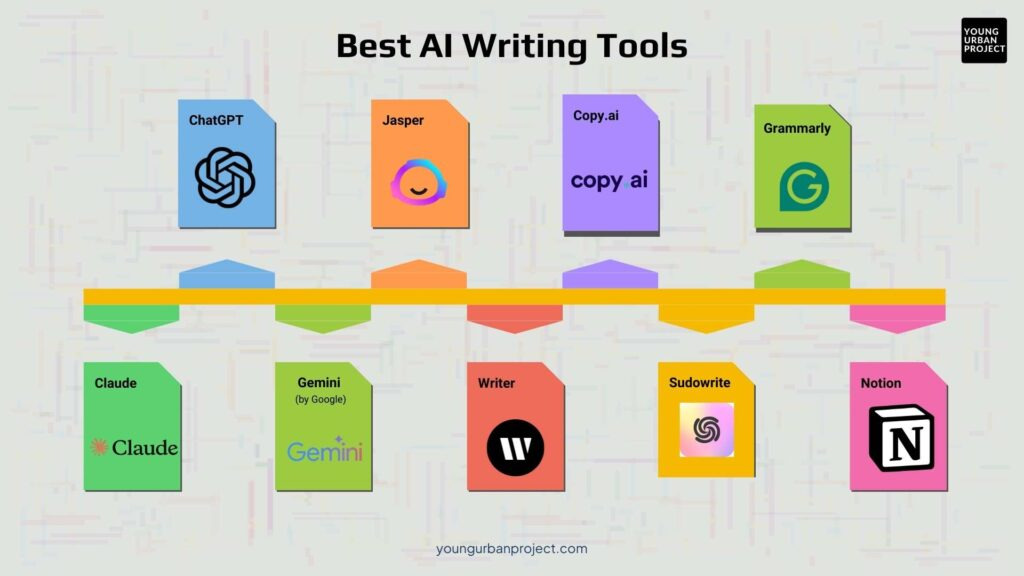
There are plenty of AI tools out there, and many can be incredibly useful. But they only make a difference if you know how to use them well.
The real cost of unguarded AI content creation
At first, your content just sounds a little off. No one calls it out. By the next review cycle, inconsistencies start to show in tone, phrasing, and word choice. Give it a few more months, and your team isn’t sure what on-brand even means anymore. A year later, you sound just like everyone else.
Each AI draft becomes a new baseline. Writers adjust to it. Editors approve it. Systems reinforce it. What began as a shortcut slowly became the standard. The distinction in your voice starts to blur.
By the time you realize what’s changed, it’s not just your content that’s shifted. It’s your culture. How your team thinks, edits, and decides what good looks like.
Getting that voice back takes more than a few tone tweaks. It takes structure—clearer guidelines, tighter reviews, and the discipline to protect what makes your brand sound like you.
Declining competitive advantage
While some companies let AI flatten their voice, others are doing the opposite—they’re using it to sharpen what makes them distinct.
They’re training custom models on their best work, building guardrails that protect their tone, and giving their teams tools that amplify consistency instead of eroding it. They’re treating AI as an extension of their brand, not a replacement for it.
Two kinds of brands are emerging from this shift: those whose voice is getting stronger, and those whose voice is disappearing.
Your audience is catching on. They may not articulate it as “brand voice erosion,” but they feel it—in the lack of personality, the sameness across touchpoints, the sense that no one is really behind the words anymore.
The gap widens every quarter. And the longer you wait to address it, the more ground you’ll need to recover.
Deteriorating content standards
AI-generated content affects more than how the world sees you. It reshapes how your team approaches their work.
The more writers depend on AI, the less they engage with the actual work. Instead of wrestling with how to express an idea, they’re just cleaning up what the machine produced. Instead of making deliberate choices about tone or structure, they’re accepting whatever sounds passable.
This becomes the training ground for everyone on your team. New hires watch AI drafts get approved and assume that’s the standard to meet. They never learn what made your best content perform in search. Experienced writers stop trusting their own instincts because the AI always has something ready, and pushing back feels like unnecessary friction.
Over time, no one on your team can explain what makes your brand sound like itself anymore. They can produce content, but they’ve lost the ability to shape it with real intention. The muscle memory of good writing—knowing when something feels right, understanding why it matters—weakens from disuse.
Loss of customer trust
As your competitive edge fades, the impact shows up where it matters most: in how customers perceive you.
An inconsistent brand voice creates doubt. When your sales emails sound nothing like your marketing content, and your support replies use a completely different tone, customers sense something’s off—even if they can’t name what it is.
They start asking themselves: Who are these people, really? What do they actually stand for? Can I trust what they’re saying?
Trust builds through repetition. People need to hear the same voice, see the same values, feel the same presence across every interaction. When your voice shifts depending on who’s writing or which AI tool generated the draft, that thread breaks.
The brand that once felt familiar and credible starts to feel fractured. And customers don’t stay loyal to brands that feel like they’re still figuring out who they are.
False efficiency
AI made writing incredibly fast. But speed was never the point.
The goal was to help teams perform better, not just faster. Somewhere along the way, that got lost. Efficiency became measured in volume and turnaround time instead of impact.
Real efficiency isn’t about how quickly you can publish. It’s about whether what you publish actually works.
You can generate ten blog posts in an hour. But if that content doesn’t:
- Reinforce your brand positioning
- Strengthen customer relationships
- Set you apart from competitors
- Move your business forward
Then you haven’t gained efficiency. You’ve just created more content to manage, more messages that don’t land, more work that doesn’t matter. Again, speed only matters if it leads to the right results.
The wake-up call
The companies that see this clearly now will pull ahead while others are still catching up.
They’ll protect what makes their brand recognizable while competitors chase volume. They’ll sharpen their voice while others let theirs blur into the background. They’ll use AI as a tool for extension, not a replacement.
AI has already changed how content gets made. What hasn’t been decided yet is whether you’ll control that process or just react to it.
Brand voice erosion happens quietly, but the signs aren’t hard to spot:
- Content that feels slightly off, even when nothing is technically wrong
- Different teams writing in noticeably different tones
- Generic phrases showing up where your distinct language used to be
- Customers mentioning that you “sound different lately”
- Your own team unable to describe what your voice actually is
If you’re seeing any of these, the erosion has already started. But you’re not past the point where you can recover.
The answer isn’t to stop using AI. It’s to stop using it carelessly.
Train it on your best work, not your average output. Build guardrails that protect your tone. Create systems that enforce consistency instead of assuming it will happen on its own. Give your team the tools and judgment to know when AI is helping and when it’s hurting.
Your brand voice is one of the few things competitors can’t copy. Don’t let it become the thing you accidentally gave away.
Read: Protect your brand voice: Build a custom GPT
Your next step
If you’re ready to stop watching your brand voice slip and start regaining control over how you sound, CXL’s Advanced ChatGPT Online course is designed exactly for that. In just 54 minutes across 2 lessons, it shows you how to transform your unique tone, best content, and brand strategy into an AI writing assistant that always lands on voice.
You’ll learn to build a custom Brand GPT trained on your messaging and customer profiles, use it to create on-brand drafts across emails, blogs, landing pages, and social copy, and set clear rules so your team never drifts off-brand again.
For brands serious about restoring their sound (and protecting it), this course is the toolkit you need.
Learn more: Standardize and Scale On-Brand Content with a Custom Brand GPT
Your brand voice is your competitive advantage. Don’t let an algorithm take it away.
Build practical, real-world capability by developing hands-on skills through AI in Marketing courses
Related Posts
-

Your relationships and reputation are intangible assets. Foster your personal brand, and you’ll build perceived…
-

By creating Content IP around the problems their customers face, Growth Sprints achieved 9M impressions…
-
You and your competitors are publishing more content than ever. So is everyone else. From…
-

Branding is everything. But, do you really understand how hard it is to build a…