Most email marketing courses still teach the easy part: sending campaigns, testing subject lines, and reading basic engagement metrics.
The harder part is building email into a channel that actually drives revenue. The latest email marketing data puts ROI at 10:1 to 36:1, with top-performing programs exceeding 50:1. Yet only 13% of teams use advanced personalization, despite 93% saying personalization improves leads or purchases.
These seven courses go beyond campaign basics and teach the strategy, automation, segmentation, measurement, and execution skills that matter in 2026.
TL;DR
- Best overall email marketing course: CXL Email Marketing Fundamentals
- Best free email marketing certification: HubSpot Email Marketing Certification
- Best for learning email within wider digital marketing: Google Think Outside the Inbox
- Best free practical course: Brevo Email Marketing Course
- Best for monetizing an existing email list: DigitalMarketer Email Marketing Mastery
- Best short free course: Simplilearn Advanced Email Marketing
- Best for Mailchimp users: The Complete Mailchimp Email Marketing Course for 2026
Table of contents
- Email marketing courses compared
- Best email marketing courses
- 1. Email Marketing Fundamentals — CXL
- 2. HubSpot Email Marketing Certification — HubSpot Academy
- 3. Think Outside the Inbox: Email Marketing — Google (via Coursera)
- 4. Brevo Email Marketing Course — Brevo Academy
- 5. Email Marketing Mastery — DigitalMarketer
- 6. Advanced Email Marketing Certification Training — Simplilearn
- 7. The Complete Mailchimp Email Marketing Course for 2025 — Udemy
- How did we choose the best email marketing courses?
- FAQs
Email marketing courses compared
| Course | Skill level | Format | Format |
| CXL Email Marketing Fundamentals | Beginner to intermediate | On-demand | Marketers who want deep, revenue-first frameworks |
| HubSpot Academy Email Marketing Certification | Beginner | Self-paced | Marketing generalists needing a strong base with certification |
| Google “Think Outside the Inbox” | Beginner | On-demand | Those who want email plus broader digital marketing context |
| Brevo Academy Email Marketing Course | Beginner | Free on-demand | Budget-conscious learners needing tactical foundations |
| DigitalMarketer Email Marketing Mastery | Intermediate | On-demand + certification | Marketers ready to monetise an existing list |
| Simplilearn Advanced Email Marketing | Beginner to intermediate | On-demand | Learners wanting structured certification with some depth |
| Udemy Email Marketing | Beginner to intermediate | On-demand | Tool-users who already know basics and want execution skills |
What should an email marketing course teach in 2026?
A good email marketing course should go beyond writing subject lines and building newsletters. It should teach you how to make email relevant, measurable, and scalable.
That means covering areas such as:
- Segmentation and personalization
- Lifecycle and triggered automation
- Copy and campaign strategy
- Deliverability and permission
- Testing and optimization
- Revenue attribution and measurement
- Privacy, accessibility, and changing inbox behavior
Those skills are more important as execution gets faster. Litmus’ State of Email 2026 found that 78% of teams can now produce and deploy an email in three days or less. Speed is no longer the differentiator; the quality of the system behind the send is.
CXL’s own B2B email marketing playbook makes the same distinction: strong email programs depend on disciplined execution across permission, deliverability, content, and design rather than simply sending more campaigns.
Best email marketing courses
1. Email Marketing Fundamentals — CXL
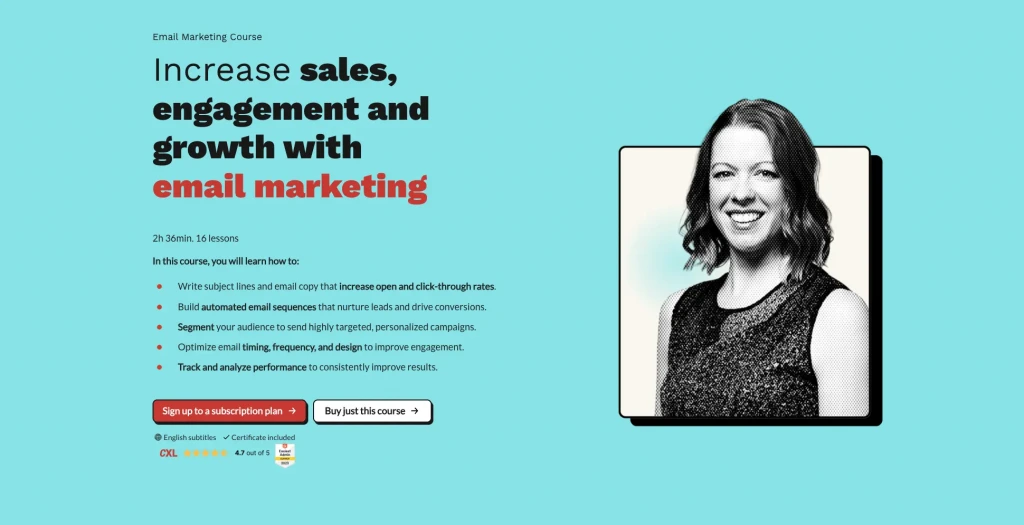
Best for: Marketers who want to turn email into a measurable revenue channel rather than simply send campaigns.
Course details
- Provider: CXL
- Instructor: Jessica Best, Owner and Chief Strategist at BetterAve
- Price: $299 standalone or included with CXL All-Access
- Format: On-demand
- Duration: 2 hours 36 minutes across 16 lessons
- Level: Beginner to intermediate
- Certification: Yes
What you’ll learn
- Write subject lines and email copy that drive opens, clicks, and action.
- Build automated sequences that nurture leads and increase conversions.
- Segment audiences for more relevant and personalized campaigns.
- Improve timing, frequency, design, and deliverability.
- Use campaign data to improve performance and email ROI.
- Adapt email strategy for newer changes including Apple Intelligence.
Why we picked it
Most introductory email courses teach you how to execute a campaign. CXL goes further into the systems behind one that performs.
Jessica Best covers copy, design, deliverability, privacy, list growth, segmentation, automation, measurement, and the data infrastructure supporting email. The focus throughout is on relevance and commercial outcomes rather than simply increasing send volume.
Pros and cons
| Pros | Cons |
|---|---|
| Covers the complete email marketing system | More depth than complete beginners may need immediately |
| Strong focus on revenue and measurable performance | Paid compared with several free options |
| Includes deliverability, privacy, automation, and data | Not built around one specific ESP |
| Updated for changes including Apple Intelligence | Shorter than broader multi-course programs |
2. HubSpot Email Marketing Certification — HubSpot Academy

Best for: Beginners who want a structured introduction to email marketing and a recognized free certification.
Course details
- Provider: HubSpot Academy
- Instructor: Christine Lee, with contributions from Christina Garnett
- Price: Free
- Format: Self-paced
- Duration: 3 hours 59 minutes
- Content: 12 lessons, 31 videos, 9 quizzes, and 1 practical exercise
- Level: Beginner
- Certification: Yes
What you’ll learn
- Build an email marketing strategy around clear goals.
- Use personalization and automation effectively.
- Create email copy, content, and design that drive action.
- Segment contacts and maintain healthier email lists.
- Analyze campaign metrics and run A/B tests.
- Apply data privacy principles to email marketing.
Why we picked it
HubSpot remains one of the strongest free starting points. The course covers enough of the full email process to give beginners a working foundation without locking the lessons entirely to HubSpot software.
It also includes assessments and a recognized certification, making it particularly useful for marketers building their first formal email marketing credential.
Pros and cons
| Pros | Cons |
|---|---|
| Completely free | Experienced email marketers will find parts basic |
| Recognized HubSpot certification | Influenced by HubSpot’s inbound methodology |
| Covers strategy, automation, testing, and measurement | Less depth on advanced lifecycle strategy |
| Includes practical assessment | Limited focus on sophisticated revenue automation |
3. Think Outside the Inbox: Email Marketing — Google (via Coursera)

Best for: Beginners who want to understand email marketing as part of a wider digital marketing strategy.
Course details
- Provider: Google via Coursera
- Instructor: Google Career Certificates
- Price: Available through Coursera; subscription and eligible free-access options vary
- Format: Self-paced
- Duration: Approximately 2 weeks at 10 hours per week
- Content: 5 modules
- Level: Beginner
- Certification: Yes
- Enrollment: 292,000+ learners
What you’ll learn
- Develop an email marketing strategy.
- Write subject lines, preview text, and campaign copy.
- Build and maintain email lists.
- Segment contacts and manage customer data.
- Create automation and email workflows.
- Measure campaign results and present performance to stakeholders.
- Build a complete mock email campaign from strategy through analysis.
Why we picked it
Google gives beginners something most short email courses don’t: context.
Email is taught as part of the wider customer journey rather than an isolated channel. The final module also requires learners to build and analyze a mock campaign, which makes the course more applied than a collection of video lessons and quizzes.
Pros and cons
| Pros | Cons |
|---|---|
| Google-backed curriculum | Designed primarily for beginners |
| Includes hands-on campaign work | Longer commitment than HubSpot or Brevo |
| Strong treatment of measurement and customer data | Less depth for experienced lifecycle marketers |
| Connects email to wider digital marketing | Certificate access may require payment |
4. Brevo Email Marketing Course — Brevo Academy

Best for: Beginners who want a free, practical introduction covering campaigns, deliverability, testing, and compliance.
Course details
- Provider: Brevo Academy
- Instructor: Charlotte Ganster / Brevo Academy
- Price: Free
- Format: Self-paced
- Duration: 2 hours
- Content: 8 modules, 63 videos, 4 ebooks, and 62 questions
- Level: Beginner
- Certification: Yes
What you’ll learn
- Develop an email marketing strategy.
- Build campaigns around clear objectives.
- Understand email deliverability.
- Run A/B tests.
- Work with email automation.
- Measure campaign performance.
- Understand GDPR requirements around email marketing.
Why we picked it
Brevo packs a surprising amount into a two-hour free course.
Deliverability and GDPR are particularly useful inclusions because many beginner courses focus heavily on copy and campaign creation while giving the technical and compliance side little attention. It makes Brevo a strong option if you want something more execution-focused than a broad digital marketing course.
Pros and cons
| Pros | Cons |
|---|---|
| Free with certification | Primarily foundational |
| Includes deliverability and GDPR | Less strategic depth than CXL |
| Short enough to complete quickly | Some examples naturally reflect Brevo |
| Mix of videos, ebooks, and assessments | Limited advanced lifecycle coverage |
5. Email Marketing Mastery — DigitalMarketer

Best for: Intermediate marketers who already have an audience and want to turn email into a stronger revenue channel.
Course details
- Provider: DigitalMarketer
- Price: $95 promotional price when checked; $495 standard price
- Format: Self-paced certification
- Duration: Approximately 6 hours
- Content: 10 modules, 74 video lessons, 4 handouts, and a final exam
- Level: Intermediate
- Certification: Yes
What you’ll learn
- Understand email’s role across the customer journey.
- Build and grow email lists using lead magnets.
- Create promotional and engagement campaigns.
- Write stronger email and subject-line copy.
- Structure email promotions and sequences.
- Measure the email metrics that matter.
- Create a repeatable process for testing and improving campaigns.
Why we picked it
DigitalMarketer is strongest once you move beyond simply sending campaigns and start asking how email contributes to revenue.
The course combines list building, copy, campaign architecture, measurement, and optimization in one process. It is more commercially focused than most of the free beginner certifications and is explicitly designed around making an existing email channel perform better.
Pros and cons
| Pros | Cons |
|---|---|
| Strong revenue and monetization focus | Some frameworks are specific to DigitalMarketer |
| 74 lessons and practical resources | Less technical depth on deliverability |
| Certification included | Standard $495 price is relatively high |
| Suitable after completing a beginner course | Promotional pricing changes frequently |
6. Advanced Email Marketing Certification Training — Simplilearn

Best for: Learners who want a short, structured email marketing course with a free completion certificate.
Course details
- Provider: Simplilearn SkillUp
- Price: Free
- Format: Self-paced
- Duration: Approximately 5 hours
- Level: Beginner to intermediate
- Certification: Completion certificate
- Learners: 19,000+
What you’ll learn
- Structure email campaigns around clear objectives.
- Improve subject lines and email content.
- Build campaign checklists and processes.
- Use automation to improve execution.
- Apply testing to campaign performance.
- Connect email campaigns with landing pages and conversion activity.
Why we picked it
Simplilearn has changed this course since the previous version of the article. It is now part of its free SkillUp catalog rather than being positioned as a paid advanced certification program.
That makes the value proposition much clearer: it is a free, five-hour structured course for marketers who want more depth than a very short introductory lesson without committing to a larger paid program.
Pros and cons
| Pros | Cons |
|---|---|
| Free | “Advanced” is slightly generous for the depth covered |
| Around five hours of structured learning | Certificate is a completion credential rather than a major professional qualification |
| More substantial than many short free courses | Less practitioner-led than CXL or DigitalMarketer |
| 19,000+ learners | Limited advanced lifecycle or CRM strategy |
7. The Complete Mailchimp Email Marketing Course for 2025 — Udemy

Best for: Marketers who specifically need hands-on Mailchimp skills rather than another general email strategy course.
Course details
- Provider: Udemy
- Instructor: Course Envy
- Price: Varies according to Udemy pricing and promotions
- Format: Self-paced
- Duration: 4 hours 20 minutes
- Content: 31 lectures across 4 sections
- Level: Beginner to intermediate
- Students: 29,000+
- Rating: 4.3/5
- Last updated: January 2026
- Certification: Udemy certificate of completion
What you’ll learn
- Navigate Mailchimp and configure audiences.
- Use groups, segments, and tags.
- Create signup forms and lead-capture assets.
- Build and optimize email campaigns.
- Run A/B tests.
- Analyze campaign data and key metrics.
- Build more targeted subscriber segments.
- Use Mailchimp to grow and monetize an email list.
Why we picked it
This is the most tool-specific option on the list, and that’s the point.
If you already understand why segmentation, testing, and automation matter but need to know how to execute them inside Mailchimp, a hands-on platform course is more useful than repeating email marketing theory. The course is still actively maintained, with a January 2026 update and almost 30,000 students.
Pros and cons
| Pros | Cons |
|---|---|
| Hands-on Mailchimp training | Much of the learning doesn’t transfer directly to other ESPs |
| Updated in 2026 | Less strategic than the broader courses |
| Nearly 30,000 students | Udemy certificate has limited credential value |
| Covers segmentation, testing, forms, and analytics | Price varies constantly |
How did we choose the best email marketing courses?
We looked for courses that teach more than the mechanics of sending an email.
Our selections were based on:
- Instructor credibility: Training led by experienced email, CRM, lifecycle, or digital marketing practitioners.
- Curriculum depth: Courses that cover meaningful parts of the email marketing process rather than stretching one tactic into an entire program.
- Current relevance: Training that still reflects how email works in 2026, including automation, personalization, privacy, deliverability, and measurement.
- Practical application: Frameworks, exercises, examples, or platform training marketers can use immediately.
- Certification value: Whether the credential adds useful professional proof rather than simply confirming course completion.
- Value: Free and paid courses judged against the depth of training and support they provide.
How do you choose the right email marketing course?
Start with the gap you’re trying to close. A beginner learning segmentation needs a different course from an experienced marketer trying to improve lifecycle revenue.
Then keep this list:
- Define your goal. Decide whether you need fundamentals, stronger campaign execution, automation, monetization, or platform-specific skills.
- Match the course to your level. Beginners should start with structured fundamentals such as HubSpot or Brevo. More experienced marketers can go deeper with CXL or DigitalMarketer.
- Prioritize frameworks over tool demos. Platforms change. Strategy around segmentation, customer journeys, testing, and measurement transfers between tools.
- Check instructor experience. Learn from people who actively run email programs, not just teach the interface.
- Look at the certification realistically. A certificate can support credibility, but the skill behind it matters more than the badge.
- Choose for business impact. The strongest course should help improve metrics that matter: conversions, revenue, retention, list quality, and customer lifetime value.
If you want one broad, practitioner-led course, CXL Email Marketing Fundamentals is our top overall pick. It covers the strategy behind segmentation, automation, copy, deliverability, and measurement rather than teaching email as a collection of isolated tactics.
If you’re completely new to email, start with HubSpot or Brevo. Both are free and give you enough grounding to understand how campaigns, lists, testing, and automation fit together.
Choose DigitalMarketer if your priority is monetizing an established audience, Google if you want email within a broader digital marketing framework, and Udemy if you specifically need hands-on Mailchimp training.
Go further: build the systems behind better marketing
Email is one channel. The bigger opportunity is connecting it to the research, content, campaigns, measurement, and AI workflows around it.
That’s the focus of CXL’s AI Native Marketer program. The six-week live cohort and has marketers build five working systems, including a reusable Marketing Brain, a campaign engine with quality controls, AI visibility measurement, and automated reporting.
You can also take individual CXL live AI workshops without joining the full cohort. Upcoming sessions cover building a team AI operating system, context engineering for a Marketing Brain, creating campaign workflows with quality gates, and measuring visibility across AI search.
If email marketing is the skill you’re fixing now, start with one of the courses above. If the next step is making the rest of your marketing operation faster and more connected, that’s where the AI-native training comes in.
FAQs
What is the best email marketing course for beginners?
HubSpot’s Email Marketing Certification is the strongest free starting point because it covers strategy, segmentation, automation, testing, and measurement in a structured beginner-friendly course. Brevo is another good option if you want something shorter and more execution-focused.
What is the best free email marketing course?
HubSpot, Brevo, and Simplilearn all offer free options. HubSpot is the strongest all-round certification, Brevo is particularly useful for practical fundamentals such as deliverability and GDPR, and Simplilearn offers a shorter structured course with a completion certificate.
What is the best email marketing certification?
For beginners, HubSpot offers one of the most recognized free email marketing certifications. CXL is better suited to marketers who want practitioner-led training with a stronger focus on performance and commercial outcomes.
Which email marketing course is best for B2B marketers?
CXL Email Marketing Fundamentals is the strongest fit for B2B marketers because it connects copy, segmentation, automation, customer data, and measurement to revenue rather than treating email as a standalone publishing channel.
Are email marketing courses worth it?
They can be if the course improves skills you can apply to live campaigns. Look for training that covers strategy, segmentation, automation, testing, and measurement rather than paying for a certificate built around basic platform tutorials.
Which email marketing course is best for freelancers or agency marketers?
CXL is a strong option because the frameworks around segmentation, campaign strategy, automation, and measurement can be applied across multiple clients and email platforms. HubSpot is useful if you need a free certification to establish foundational credibility.
Click the icons to ask AI to match the best course to your career goals
Describe your career goals and let AI personalize the courses shown here.