Meta ads are getting more expensive, and the platform is cracking down on the tactics advertisers used to pull.
Meta’s own numbers show it. In Q2 2026, the average price per ad rose 12% year over year, the second straight quarter at that rate, while impression growth cooled to 14% from 19% in Q1. Inventory is expanding more slowly and clearing at higher prices.
At the same time, broad targeting and automated placements have absorbed most of the manual work. Audience construction, the skill that used to separate good media buyers from bad ones, matters less every quarter.
What’s left is judgment. Which creative concept to test, which numbers to trust when the platform and your analytics disagree, and when to scale, hold, or kill. That’s what a Meta ads course should be teaching in 2026, and most still don’t.
The seven below do, at different levels and price points, from Meta’s own free training through to programs built for people already managing real budgets. We checked each one against its current provider page in September 2026.
TL;DR
- Best overall for marketers already spending: Validate and Scale Meta Ads (CXL)
- Best free foundation: 100-101 Meta Certified Digital Marketing Associate (Meta Blueprint)
- Best structured beginner course: Advertising with Meta (Coursera)
- Best low-cost broad coverage: Facebook Ads & Facebook Marketing MASTERY (Udemy)
- Best advanced credential: 410-101 Meta Certified Media Buying Professional
- Best for staying current: Power Hitters Club (Jon Loomer)
- Best for sourcing ad creative: Competitive research for ads using AI (CXL)
Table of contents
- Meta Ads courses compared
- Best Meta Ads courses worth your time
- 1. Validate and scale Meta Ads — CXL
- 2. Meta Blueprint (Meta’s official training)
- 3. Advertising with Meta — Coursera
- 4. Facebook Ads & Facebook Marketing MASTERY (Coursenvy – Udemy)
- 5. 410-101: Meta Certified Media Buying Professional (Meta)
- 6. Power Hitters Club (Jon Loomer)
- 7. Competitive research for ads using AI (Jack Paxton – CXL)
- How we chose these courses
- What should a Meta ads course teach you in 2026?
- Which Meta ads course should you choose?
- FAQs
Meta Ads courses compared
| Course | Best for | Level | Format | Price |
|---|---|---|---|---|
| Validate and Scale Meta Ads (CXL) | Marketers already spending on Meta who can’t make profitability hold | Intermediate to advanced | On-demand, 5h 33min | $299 or included with a CXL subscription |
| 100-101 Meta Certified Digital Marketing Associate (Meta Blueprint) | Learning the platform from the source, with a recognized entry-level credential | Beginner to intermediate | Self-paced modules plus proctored exam | Free coursework, paid exam |
| Advertising with Meta (Coursera) | Beginners who want structure and a campaign built by the end | Beginner | Self-paced, 5 modules with graded assignments | Free to enroll, paid certificate |
| Facebook Ads & Facebook Marketing MASTERY (Udemy) | Broad coverage of Meta ads and Pages at the lowest paid price point | Beginner to intermediate | On-demand, 12h 20min | Paid, one-off |
| 410-101 Meta Certified Media Buying Professional (Meta) | Proving advanced competence to clients and employers | Advanced | Self-study plus proctored exam | Paid exam |
| Power Hitters Club (Jon Loomer) | Working media buyers who need to keep pace with Meta’s changes | Advanced | Ongoing membership, live weekly sessions | From $29/month |
| Competitive research for ads using AI (CXL) | Sourcing better ad creative from competitor and ad library research | Intermediate to advanced | On-demand, five parts | $299 |
Prices checked September 2026 and may change.
Best Meta Ads courses worth your time
1. Validate and scale Meta Ads — CXL

Best for: Marketers already spending on Meta who can’t get profitability to hold. The course is built around auditing what’s broken in an account, then installing a repeatable process for creative, targeting, tracking, and scaling.
Course details
- Provider: CXL
- Instructor: Jack Paxton, founder of Top Growth Marketing
- Price: Included with a CXL subscription, or $299 as a single-course purchase
- Format: On-demand, self-paced
- Duration: 5 hours 33 minutes, 26 lessons across 6 modules
- Level: Intermediate to advanced
- Certification: CXL Meta Ads Course Certificate, shareable on LinkedIn
What you’ll learn
- Audit any Meta ad account for gaps in structure, creative, targeting, and tracking.
- Build customer avatars and map campaigns to where buyers actually are in their journey.
- Write hooks and creative that survive the scroll.
- Calculate ROAS, CAC, and breakeven so you know when to scale, pause, or kill.
- Set up server-side tracking with Meta’s Conversions API and pick the KPIs that matter.
- Diagnose high CPMs, build creative briefs, and run feedback loops with your creative team.
Why we picked it
Most Meta courses stop at the Ads Manager interface. This one starts after it. Jack Paxton walks through the decisions that separate accounts that scale from accounts that stall: unit economics, tracking you can trust, and creative processes a team can repeat without you in the room. The course ships with avatar builders, copywriting frameworks, budgeting calculators, audit checklists, and a swipe library, plus four Q&A sessions answering questions from working marketers.
Pros and cons
| Pros | Cons |
|---|---|
| Systems and unit economics, not interface walkthroughs | Assumes you already run campaigns |
| Templates, audit toolkit, and swipe library included | On-demand only, no live cohort |
| Taught by a practitioner managing real spend | Less useful if you’ve never launched an ad |
2. Meta Blueprint (Meta’s official training)
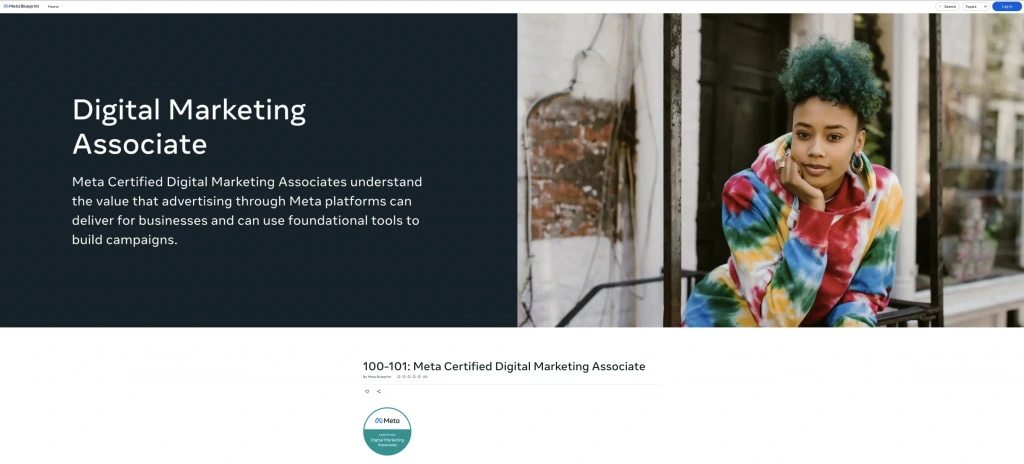
Best for: New marketers who want a structured foundation from the company that builds the platform, and a recognized entry-level credential at the end of it. The collection bundles the free coursework, a study guide, and a practice test into one certification path.
Course details
- Provider: Meta
- Instructor: Meta Blueprint
- Price: Free coursework; the certification exam is registered and paid separately
- Format: Self-paced modules, with a study guide, practice test, and a virtual instructor-led option
- Duration: Roughly four hours across 15 free courses; the exam itself runs 90 minutes
- Level: Beginner to intermediate
- Certification: 100-101 Meta Certified Digital Marketing Associate, which then unlocks the path to the Meta Certified Media Measurement Specialist badge
- Rating: 4.9 average across the collection
What you’ll learn
- Set up a business presence across Facebook, Instagram, Messenger, and WhatsApp, and manage it from Meta Business Suite.
- Get started with advertising on Facebook and Instagram in Ads Manager.
- Match campaign objectives to business goals and measure whether you hit them.
- Create audiences, then choose placements, budgets, and schedules.
- Customize ad creative across formats and placements.
- Set up the Meta Pixel and Conversions API to see what customers actually do.
- Analyze campaign results in Ads Manager and use opportunity score to find improvements.
- Stay inside Meta’s privacy, data protection, and ad policy requirements.
Why we picked it
Meta changes its own tools constantly, and this is where those changes get documented as training first. Working through the collection is the cheapest way to learn the vocabulary correctly, and the fastest way to check whether something you read elsewhere is still true. The certification is aimed squarely at entry-level marketers, students, and job seekers, which makes it a credible first credential on a CV. It teaches Meta’s recommended approach rather than independent judgment, so treat it as the floor rather than the ceiling.
Pros and cons
| Pros | Cons |
|---|---|
| All coursework is free and maintained by Meta | Teaches the platform’s view, not independent strategy |
| Study guide and practice test included in the same path | The exam carries a separate fee |
| Leads to a recognized entry-level credential | No scaling, account diagnosis, or unit economics |
3. Advertising with Meta — Coursera

Best for: Beginners who want structure and want to finish with something built rather than something watched. The course ends with a hands-on project where you construct a full campaign in Ads Manager.
Course details
- Provider: Coursera, offered by Meta
- Instructor: Daniel Kob
- Price: Free to enroll; a paid certificate is available and included with Coursera Plus
- Format: Self-paced, five modules with videos, readings, and graded assignments
- Duration: Roughly two weeks at 10 hours a week
- Level: Beginner
- Certification: Shareable Coursera certificate; part of the Meta Social Media Marketing Professional Certificate
- Rating: 4.8 from 2,840 learner reviews, with 154,701 enrolled
What you’ll learn
- Structure a campaign correctly across campaign, ad set, and ad level.
- Match objectives to goals and choose a bidding strategy.
- Build core, custom, and lookalike audiences using the Meta Pixel.
- Set budgets, placements, and schedules.
- Edit and troubleshoot campaigns that aren’t delivering.
- Read your results and act on them.
Why we picked it
Ten graded assignments and an Ads Manager simulation make this harder to skim than most free training, which is the point. Learners who finish have built a campaign, not just watched one. The volume of reviews also gives you an unusually reliable read on quality before you commit time.
Pros and cons
| Pros | Cons |
|---|---|
| Graded assignments and a build-a-campaign project | The certificate is paid |
| Large, consistent review base | Fundamentals only, no scaling or diagnosis |
| Free to audit the full course | Ten hours a week is a real commitment |
4. Facebook Ads & Facebook Marketing MASTERY (Coursenvy – Udemy)
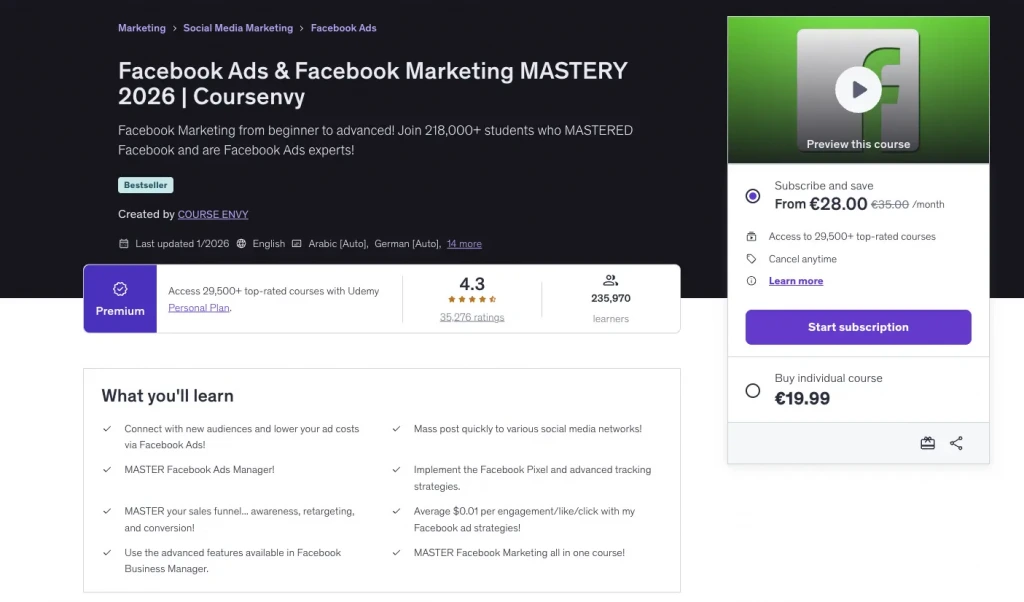
Best for: Marketers who want wide coverage of Meta advertising and Facebook Page marketing in one place, at the lowest cost of any paid option here.
Course details
- Provider: Udemy
- Instructor: Coursenvy
- Price: One-off purchase; Udemy pricing changes frequently
- Format: On-demand video with downloadable PDF guides
- Duration: 12 hours 20 minutes, 76 lectures across 12 sections
- Level: Beginner to intermediate
- Certification: Udemy certificate of completion
- Rating: 4.3 from 35,275 ratings, with 235,964 students enrolled
- Access: Lifetime, last updated January 2026
What you’ll learn
- Build a Meta ads funnel from awareness through retargeting to conversion.
- Install the Meta Pixel, define standard events, and set up custom conversions.
- Create custom, lookalike, and saved audiences.
- Run split tests across ad sets, ads, and dynamic creative.
- Choose between lead generation ads and landing page conversion ads.
- Plan budgets, bidding, and campaign schedules.
Why we picked it
It has more verified student reviews than any other Meta ads course on the open market, which tells you the material holds up across a very large and varied audience. The breadth is genuine: funnel structure, pixel work, audience building, split testing, ad formats, and reporting, plus a section on running ads for clients. For the price, it is the most complete self-paced overview available.
Pros and cons
| Pros | Cons |
|---|---|
| The largest verified review base of any Meta ads course | Some lectures are recorded on an older Ads Manager interface |
| Very broad coverage for a low one-off price | Marketing claims about $0.01 clicks set unrealistic expectations |
| Lifetime access with regular updates | Mixes organic Page marketing in with paid |
5. 410-101: Meta Certified Media Buying Professional (Meta)
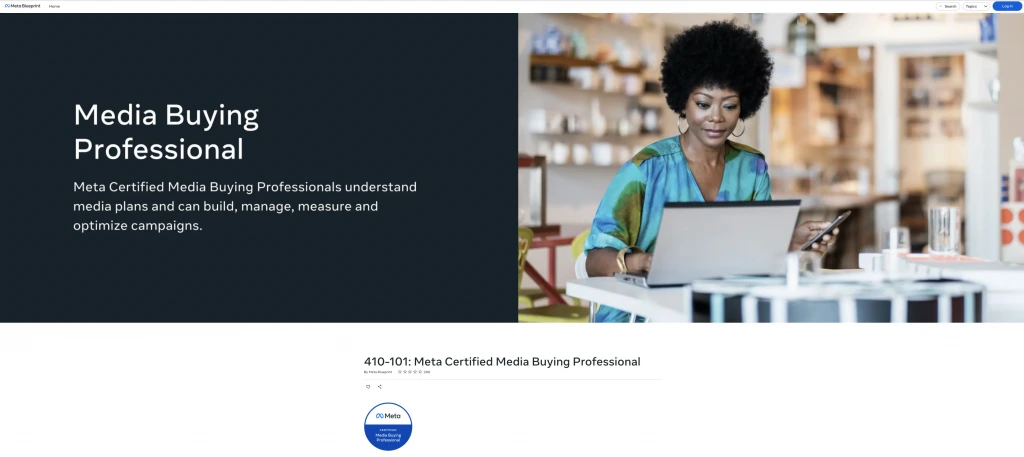
Best for: Media buyers and agency staff who need a credential that a client or hiring manager will recognize. This is Meta’s advanced certification for people who build, manage, and optimize campaigns rather than plan them.
Course details
- Provider: Meta
- Instructor: Self-study using Meta Blueprint materials, followed by a proctored exam
- Price: Paid exam; check the exam page for the current fee
- Format: Self-paced study plus a timed, proctored exam
- Level: Advanced
- Certification: Verified badge issued through Credly; a prerequisite for the Meta Certified Performance Marketing Specialist and Technical Implementation Specialist badges
What you’ll learn
- Meta’s advertising tools, policies, and best practices at a professional standard.
- Campaign management and optimization across Facebook, Instagram, and Messenger.
- Bid strategies including cost cap, and when each applies.
- How to align campaign builds to stated business objectives.
- The measurement and technical implementation concepts Meta expects a buyer to know.
Why we picked it
Every other entry on this list teaches. This one tests. If you already buy media daily, a certification from the platform owner is the fastest way to make that competence legible to clients and employers, and it unlocks two further specialist badges at no extra cost. Treat it as validation of skills you build elsewhere, not as a replacement for training.
Pros and cons
| Pros | Cons |
|---|---|
| Recognized credential issued by Meta itself | An exam, not a course, so it teaches you nothing directly |
| Unlocks two additional free specialist badges | Proctored and timed, with a fee to retake |
| Advanced level, aimed at working media buyers | Tests Meta’s recommended approach, not independent strategy |
6. Power Hitters Club (Jon Loomer)
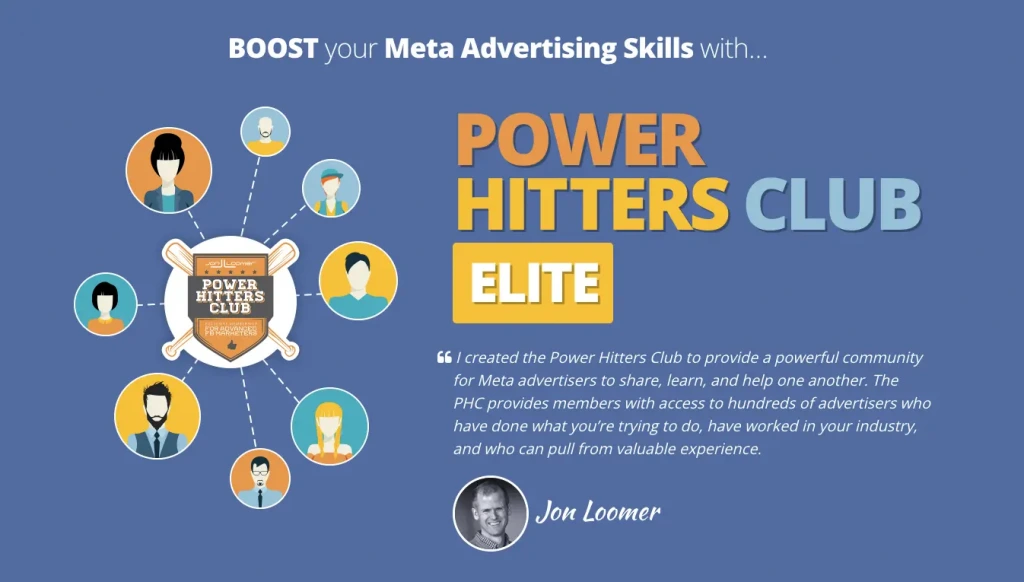
Best for: Working media buyers who need to keep pace with Meta’s changes week to week. This is an ongoing membership rather than a fixed course, built around live sessions, a reference library, and a community of advanced advertisers.
Course details
- Provider: Jon Loomer Digital
- Instructor: Jon Loomer, who has published Meta advertising training since 2011 and started the Power Hitters Club in 2014
- Price: Elite at $147/month, $1,176/year, or a $1,764 one-time Access Pass; Basic at $29/month for webinar replays and community access
- Format: Ongoing membership with live weekly sessions and recordings
- Duration: Continuous; live webinars run around 45 minutes
- Level: Advanced
- Certification: None
What you’ll learn
- What changed in Meta ads each week and what it means for your accounts, through a live Wednesday webinar and replay library.
- How an experienced buyer currently approaches core topics, through Ad Briefs, reference pages updated as the platform shifts.
- How other advanced advertisers are solving problems, through weekly Tuesday strategy sessions.
- Answers to specific account questions from a private community of practitioners across industries and countries.
Why we picked it
Meta ships changes faster than any fixed curriculum can absorb. Placement controls get removed, features get retired, and a course recorded eight months ago is already partly wrong. A membership solves a different problem than a course does: it keeps your working knowledge current instead of teaching you a snapshot. The Ad Briefs are the standout, because they are maintained as the platform changes rather than frozen at recording. Elite members also get discounted one-on-one sessions at $397 against a regular price of $897.
Pros and cons
| Pros | Cons |
|---|---|
| Updated weekly, so the material never goes stale | Recurring cost with no completion point |
| Ad Briefs are maintained as the platform changes | Assumes real hands-on experience already |
| Access to a community of advanced buyers | No structured curriculum or certificate |
7. Competitive research for ads using AI (Jack Paxton – CXL)
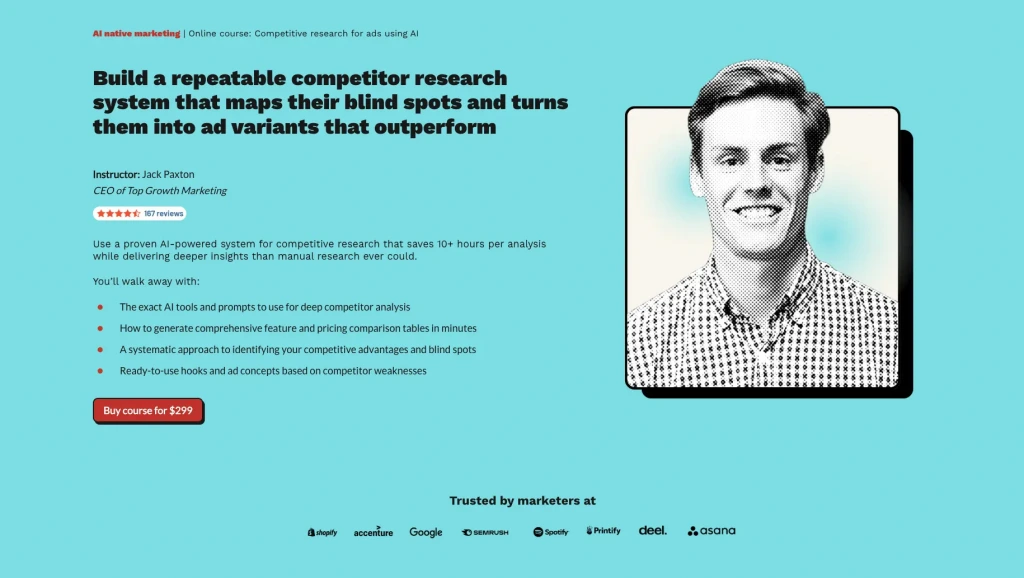
Best for: Advertisers who have the mechanics down and now need better inputs. The course builds a repeatable system for pulling competitor pricing, positioning, and creative out of ad libraries and review data, then turning the gaps into hooks and ad concepts.
Course details
- Provider: CXL
- Instructor: Jack Paxton, founder of Top Growth Marketing
- Price: $299, or included with a CXL subscription
- Format: On-demand, five parts ending in a hands-on build
- Duration: Part five is a 90-minute implementation workshop
- Level: Intermediate to advanced
- Best for: Media buyers, performance marketers, and growth teams responsible for ad creative
What you’ll learn
- Build AI-powered customer avatars in ChatGPT and Manus, then map them across the full journey from first touch to retention.
- Fact-check those avatars against post-purchase surveys and customer feedback rather than trusting the model.
- Extract competitor pricing, features, reviews, shipping policies, and social proof, and turn the gaps into positioning angles.
- Apply the long-running ad principle to spot which competitor creative is actually working.
- Use Foreplay and Adnova for deeper ad library research.
- Feed performance data to AI using the screenshot method, then generate day-by-day action plans and moving-average benchmarks.
- Validate conclusions across multiple models instead of trusting a single output.
Why we picked it
Every other course here teaches you to operate Ads Manager. This one addresses what you put into it. Creative is the main lever left in an increasingly automated auction, and most advertisers still source ideas by scrolling the ad library and guessing which ads are working. Paxton replaces that with a system: long-running ads as a signal of what converts, competitor gaps as a source of hooks, and multi-model validation as a check against confident AI nonsense. The fact-checking and validation steps are what separate it from prompt-library courses, and part five ends with you building the system rather than watching someone else build it.
Pros and cons
| Pros | Cons |
|---|---|
| Targets ad creative, the highest-leverage lever left | Research method rather than platform training |
| Ends with a build, not a summary | Applies across ad platforms, not Meta only |
| Fact-checking and multi-model validation built in | Assumes you can already run campaigns |
How we chose these courses
We checked every course against its current provider page in September 2026 and verified pricing, format, duration, and instructor directly at the source. Where a figure wasn’t published first-party, we left it out rather than guess.
Each course was assessed on five factors:
- Currency. Meta changes constantly. We checked when each course was last updated and flagged material that teaches retired features.
- Instructor credibility. We prioritized people running real budgets or, in Meta’s case, the platform itself.
- Practicality. Frameworks, templates, and processes you can apply to a live account beat theory.
- Range. The list spans free through to several thousand dollars, and beginner through to advanced.
- Verifiable track record. Review volume where a platform publishes it, and documented operating scale where it doesn’t.
What should a Meta ads course teach you in 2026?
Most courses still teach the interface. The interface is the easy part and Meta documents it for free. A course worth paying for should cover four things the platform won’t teach you.
- Creative as the primary lever. Broad targeting and automated placements have taken most of the levers away from the buyer. What’s left is the ad itself: the hook, the angle, the format. A course should give you a testing process, not a list of best practices.
- Numbers you can act on. ROAS, CAC, breakeven, and contribution margin, calculated for your own business. If a course never asks what a customer is worth to you, it can’t tell you when to scale.
- Tracking that survives. Pixel plus Conversions API, event setup, and what to do when platform-reported conversions disagree with your analytics. Attribution gaps are now a permanent condition, not a bug to fix.
- A decision framework. When to scale, when to hold, when to kill. Most wasted budget comes from indecision, not from picking the wrong objective.
Which Meta ads course should you choose?
Pick by where you actually are, not by what you’d like to be.
You’ve never run a campaign. Work through Meta Blueprint’s free courses, then take the 100-101 exam if you want the credential. Spend nothing else until you’ve launched something.
You’ve launched campaigns but results are random. Validate and Scale Meta Ads is the one to buy. It’s built around auditing what’s broken and installing a process you can repeat, which is the gap most self-taught advertisers hit at around six months in.
You manage spend daily and need to stay sharp. A Power Hitters Club membership keeps pace with Meta’s changes in a way no fixed course can.
Your accounts are structurally fine but the creative is flat. Competitive research for ads using AI works on the input rather than the account.
Check out this guide on the best paid social courses if you’re looking for more than Meta.
FAQs
Is a paid Meta ads course worth it when Meta Blueprint is free?
Blueprint is the best free training available and you should do it. It teaches Meta’s recommended approach, which is not the same as knowing when to ignore it. Paid courses earn their price on diagnosis, unit economics, and creative process, none of which Meta has an incentive to teach you.
Which Meta ads certification actually carries weight?
Meta’s own. The 100-101 Digital Marketing Associate signals foundational knowledge; the 410-101 Media Buying Professional signals you can run accounts. Both are recognized because Meta issues them. Course completion certificates from third parties are worth having on a profile but won’t do the same work in a hiring conversation.
How long before a course pays for itself?
Faster than most people expect at current prices. With Meta’s average price per ad up 12% year over year, a modest improvement in cost per result on a few thousand dollars of monthly spend covers a $299 course inside a month.
Do I still need to learn targeting?
Less than you used to, and that’s the point. Automated placements and broad targeting have absorbed much of what media buyers used to do by hand. Courses that still spend most of their runtime on audience construction are teaching a shrinking part of the job.
Can I learn Meta ads without spending money on ads?
You can learn the concepts, but not the judgment. Every course on this list assumes you’ll run something. Start with a budget small enough that losing it doesn’t matter.
Where Meta ads fit in a broader AI-native skillset
Rising costs are pushing the work upstream, into research, creative production, and reporting. Those are the parts of the job AI is changing fastest.
CXL’s AI Native Marketer program runs as a six-week live cohort where you build one working workflow a week, including a campaign engine with a quality gate and a reporting agent that reads your ad platforms, GA4, and CRM and posts a weekly summary. The next cohort starts 29 September 2026.
If you want a single session rather than a program, Marketing insight and reporting agent is the workshop closest to the reporting problem most media buyers have.
Click the icons to ask AI to match the best course to your career goals
Describe your career goals and let AI personalize the courses shown here.