As an optimizer, you might be thinking that user interviews fall outside your role. Or, perhaps, that they are a “nice to have” on the qualitative conversion research checklist. Worse, you might not be asking good survey questions because you’re rolling with an “I’ll just wing it” mindset.
User interviews are more complex and important than most optimizers realize.
Keep reading
As marketers, we’re all trying to improve the customer experience and increase conversions. We have these things in common.
However, some marketers are much better at understanding their customer personas and doing the right kind of research than others.
What is comes down to is that delivering a single message to your entire customer base is an inherently flawed strategy. High-value customers, frequent browsers, seldom purchasers, brand enthusiasts and first-time visitors are all differently characterized and must be engaged uniquely.
This is where customer micro-segmentation comes into play.
Keep reading
I have been part of some the best conversion optimization teams in the world, and they seem to have an intuitive sense on how to run the best experiments. People that are involved in these teams share a similar mindset.
I wanted to try to make this a process, one that could teach any organization how to run better experiments. I wanted to try to make this mindset more explicit in a way that is fun to use.
There’s no rocket science that follows, but this framework may well help your team drive a more efficient optimization culture.
Keep reading
Product page copy is something that, generally, gets ignored.
Not just the content, but how it is formatted.
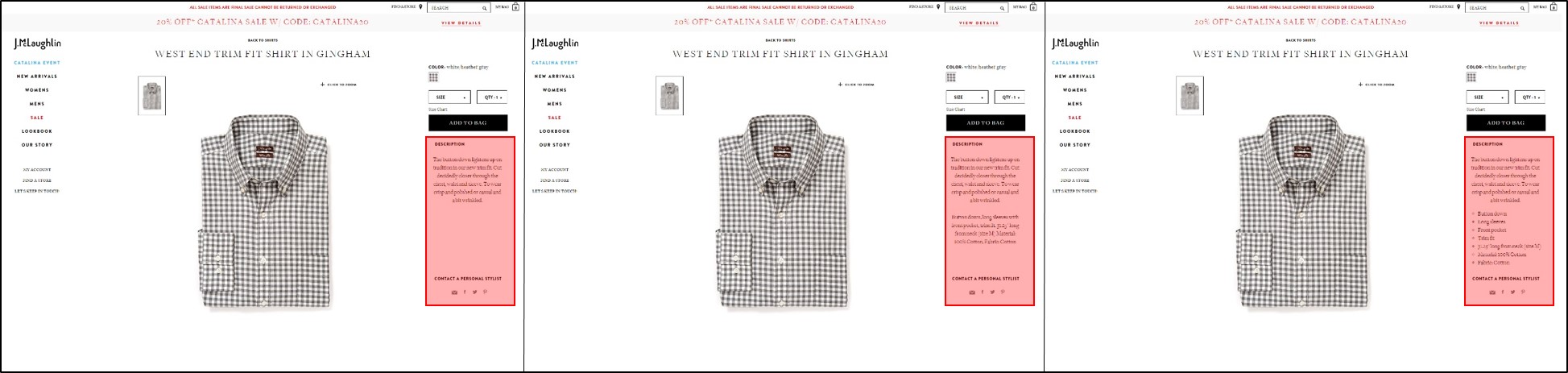
In this 3 part study from CXL Institute on eCommerce product pages (part 1 here, and part 2 here), we wanted to explore how elements of a product page affect users’ visual and value perceptions.
This experiment looks at how users view a page and read product text descriptions when the text format changes.
Keep reading
You can divide SEO tactics into two general categories: the black hat and the white hat.
I believe we can do a similar classification with conversion optimization. If we had two categories worth distinction they would be:
- BS CRO
- Intelligent CRO
Perhaps using the same concept of Black Hat and White Hat for conversion optimization is a step too far.
Keep reading
The grass is always greener on the other side of the fence, right?
That’s the mentality of comparison shoppers. If they look hard and long enough, they will find a better value. If they don’t look around, they’ll miss out on greener grasses.
Today, the term “comparison shopper” describes the majority of consumers, especially those online. If you’re running an eCommerce or SaaS company, you absolutely must be optimizing for comparison shoppers.
Keep reading
Do a quick Google search for “A/B testing mistakes,” and you’ll find a good amount of articles.
Common on those lists is the oft-repeated advice that you should “not make more than one change per test.”
As it turns out, like much of the advice in the conversion optimization world, it’s not so simple.
Keep reading
What makes a good product page?
Well, there are tons of elements that come together to make a successful product page. These include price, product image, product copy, layout, etc.
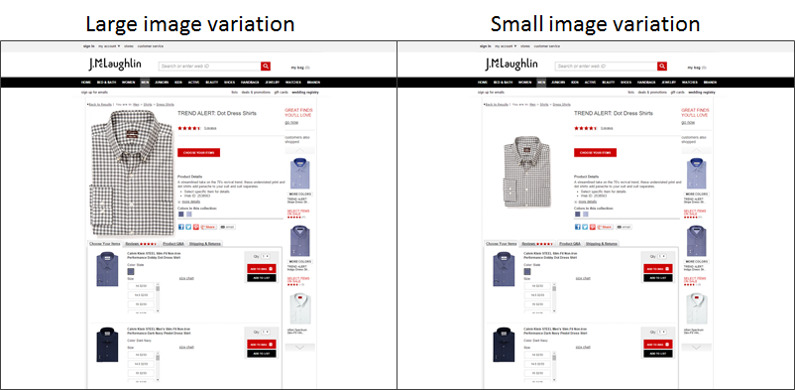
One element in particular, product image size, seems to affect the value perception of the product. In this study from CXL Institute (part one of three of a full eCommerce product page study, the others to come soon), we look at product page design, and in particular, how you can increase the value perception of your particular product.
Keep reading
It seems all technology is getting smaller and more efficient. It’s certainly true for computers, as smartphones are progressively overtaking their larger counterparts.
According to Dazeinfo research, there were about 1.13 billion smartphone users in 2012. This number increased by 27.1% in 2013 to 1.43 billion, and by 2017, nearly half of global mobile users are likely to own a smartphone.
Band-aiding a mobile experience is no longer a possible solution, as 70% of mobile searches lead to action on a website within 1 hour of searching.
Keep reading
If there were only one email campaign we could send for 350+ of our online retail and eCommerce customers for rest of their lives it would be this one….
The cart abandonment campaign.
Keep reading