Sales intelligence platform Cognism cut their lead generation efforts by 90% in 2021. Then they increased their revenue from $2M to $6M in six months.
Cognism saw this growth by ditching the linear funnel and delivering value upfront, replacing a traditional strategy that brought them low- or no-intent leads.
This value-based model bringing all the right customers to their yard is called demand generation.
In this article, you’ll learn why the traditional B2B funnel no longer works and how to build a demand generation funnel that fuels the pipeline, shortens the sales cycle, and generates revenue.
Table of contents
What is a demand generation funnel?
The demand generation funnel is a process with different stages that your users go through, in order to convert prospects into paying customers.
This funnel involves several steps ranging from building awareness to identifying customer intent, capturing that demand, and ultimately converting leads into customers.
TOFU, MOFU and BOFU stages in the demand gen funnel
Generally, the funnel can also be divided into three critical stages:
- TOFU (Top of the funnel): this stage of the demand gen focuses on creating awareness.
- MOFU (Middle of the funnel): this stage of the demand focuses on research, consideration and interaction with your prospects.
- BOFU (Bottom of the funnel): this stage focuses on the purchase decision, the conversion into customer and the development of buyer intent.
Why the traditional B2B funnel is broken (and what replaces it)
The classic B2B funnel runs on gated content, MQLs, nurture emails, and sales outreach. It assumes that downloading an ebook signals buying intent. It doesn’t. You can generate a flood of “leads” that way, and most of them are nowhere near ready to buy. Buyers don’t move through neat stages in a predictable order anymore, and they’re far less patient with vendors who try to force them.
A demand generation funnel starts from a different premise: most of your market isn’t buying right now, and your job is to be the obvious choice when they are.
Most of your market is out-of-market
Research from The B2B Institute and the Ehrenberg-Bass Institute (the “95-5 rule”) found that only a small slice of your total addressable market, roughly 5%, is actively in-market at any given time. The other 95% will buy eventually, but not this quarter.

That changes what marketing is for. If you only show up when buyers are ready, you’re usually too late. Research by Bain & Company and Google, reported in Harvard Business Review, found that 90% of B2B buyers choose a vendor that was already on their shortlist at the start of the buying process.
So the goal isn’t to push buyers through predefined stages. It’s to build familiarity and preference with future buyers, so you’re already on the shortlist the day they enter the market. That means running two motions in parallel.
Demand capture vs. demand generation

Demand capture targets the small group of buyers who are actively looking. The aim is to be present where they search and make choosing you easy:
- Search ads on solution and category keywords buyers use when ready to purchase.
- SEO for high-intent terms.
- Strong profiles on review and comparison sites like G2 and Capterra.
- Conversion rate optimization so interested visitors can act without friction.
- Direct outreach to accounts showing clear signs of active interest.
Demand capture is essential, but it’s crowded and expensive, because every competitor is fighting over the same small pool.
Demand generation targets everyone else. The aim is to build familiarity, trust, and preference before they need you:
- LinkedIn content, organic and paid, that shares genuinely useful insight.
- Newsletters and podcasts that keep you relevant over months, not days.
- Educational content that positions you as the trusted resource on the problem you solve.
- Speaking at industry events to build credibility before buyers start evaluating vendors.
Companies that pour everything into capture end up fighting for scraps. The six stages below are about building the generation side without neglecting capture.
Align sales and marketing around demand, not MQLs
In the old model, marketing hands MQLs to sales and hopes they convert. In a demand model, marketing builds mental availability with future buyers while sales focuses on the accounts that are in-market now. Instead of chasing every form fill, sales engages when buyers show real intent signals, such as:
- Repeat visits to high-intent pages like pricing or integrations.
- Attending a webinar or requesting a demo.
- Deep engagement with content across several people from the same account.
- Research activity on your brand or competitors, which intent data tools like 6sense and Demandbase can surface.
Two refinements make this work in practice. First, segment your ideal customer profile by buying maturity, not only firmographics. A fast-growing SaaS company replacing legacy tools needs different messaging from an established enterprise optimizing an existing process, even if they’re the same size and industry. Second, plan for the buying committee. The CFO, the technical evaluator, and the end user each need a different case for you, delivered through different channels at different points in the evaluation.
Finally, measure demand generation by pipeline, not lead volume: marketing-sourced and influenced pipeline, opportunity creation rate from engaged accounts, win rate and sales cycle length by source, branded search trends, and what buyers tell you when you ask “How did you hear about us?” Much of this demand is created in channels that click-based tools can’t see, so pick your marketing attribution models with that blind spot in mind.
And don’t forget the finish line. The same HBR research also found that product demos weigh heavily in buyers’ final decisions. Months of brand building won’t save a bad demo.
How to build a demand generation funnel: 6 steps
Let’s look at 6 stages you need to work on in order to build a demand gen funnel that generates revenue while shortening sales cycle:
Stage 1: Target the right metrics for an effective long game
Like SEO, demand generation is a long game. But when executed right, it pays dividends.
In today’s market (8,000 martech products alone), it’s easier to attract the right customer with material they value than it is to chase down and convert a prospect who isn’t ready to buy.
Here’s an example of how engaging a lead traditionally worked:
- You give them 20% of your value up front (e.g., an ebook);
- Then you blast them with sales messaging (e.g., email, ads, retargeting, etc.) hoping to scoop up that small percentage of your audience who is ready to buy.

However, due to B2B market saturation, customer acquisition costs are rising; this digital marketing strategy of giving a little and getting a lot no longer works.
Here’s what we know now:
- B2B buyers have done up to 70% of their research before they even get to sales;
- Buyers prefer not to talk to the sales team;
- Buyers need to be enabled with information before making a purchase decision.
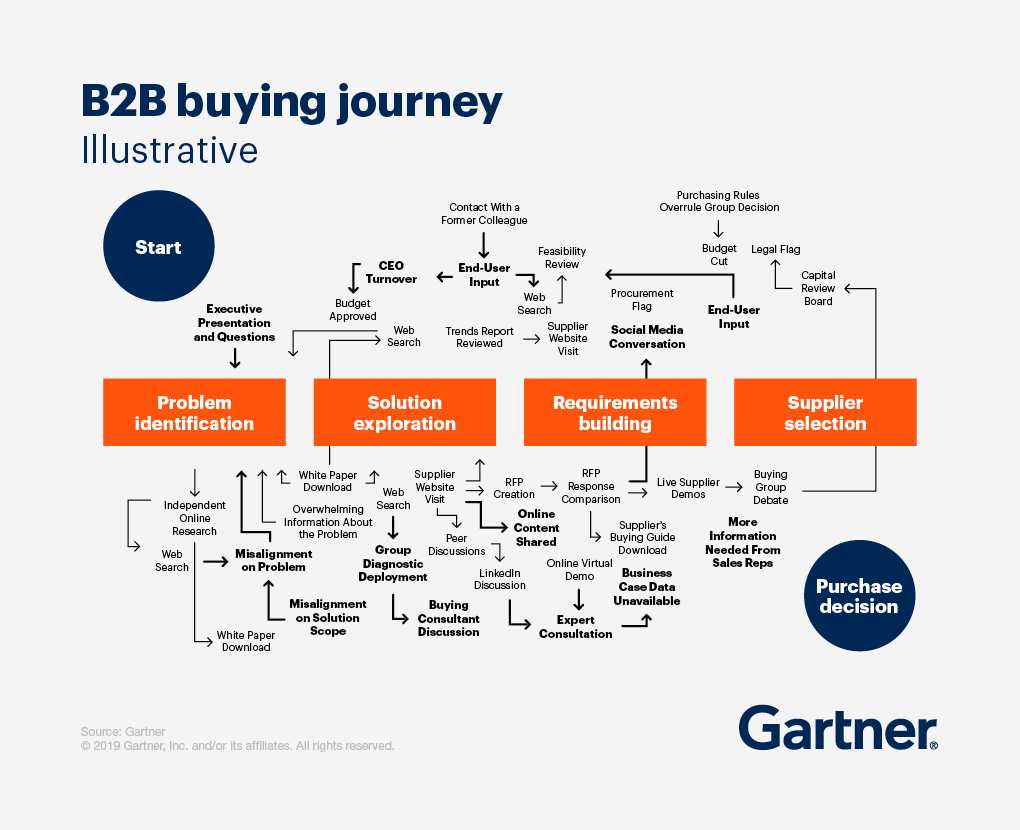
Demand generation meets this new market behavior and places much more emphasis on providing value before potential buyers ever see a sales message.
When prospects come to weigh up who to choose for their purchase, the brand that consistently delivers value upfront will have the upper hand.
Here’s what the engagement continuum looks like for a demand generation strategy:

Based on this change, we need to rethink how we strategize (with attraction instead of casting a wide net) and how we’ll measure our marketing efforts.
Metrics for your demand generation funnel
Your number one metric for any marketing initiative should be revenue. Demand generation is no exception.
Rather than thinking in terms of X amount of high-quality leads to obtain this quarter, set demand generation expectations around metrics like:
- Number of marketing-qualified leads (MQLs) generated from a program (instead of per month or per quarter);
- Cost per MQL;
- The dollar-value of MQL (to align sales and marketing);
- Conversion rates per program;
- Conversion rates per stage of the funnel;
- CAC;
- Sales cycle length;
- Qualitative feedback (e.g., comments, interviews, emails, etc.).
Being data-driven doesn’t matter if you’re driven by the wrong data. Build a picture over time that tells you which metrics lead to revenue versus those that just make you feel good (i.e. do those “likes” translate into shares and follows?).
Pay attention to your close rate per channel. Use this only if you’re willing to dig into qualitative data.
Attribution software will tell you if your website visitors come to you through direct traffic or organic. The reality is, the highest-quality leads may find you through podcasts, or Slack when a colleague screenshots your LinkedIn post, or countless other ways.
This is called the dark funnel. It’s an incredible brand-builder and a key player in demand generation, but it’s also hard to measure.

Activity in the dark funnel can inflate your direct traffic numbers without telling you where those visitors heard of you. Context matters, and attribution software is still limited.
To get more of this missing context, Chris Walker of Refine Labs suggests adding a required qualitative data field to your contact form: “How did you hear about us?”
You can then organize this data in a CRM to pick up on key words, like “podcast” or “colleague.”
Qualitative data isn’t impossible to measure. Taking the time to understand where to focus your demand efforts will put you several steps ahead of the competition.
Mistakes to avoid when targeting metrics
As with any new strategy, there will be a teething period. Avoid these costly mistakes in the first stage of your demand generation strategy:
Not adjusting your KPIs
If you change your strategy, you need to change your metrics.
Clicks and conversions are typical KPIs for paid media. Using this metric on your white papers, case studies, and videos is setting yourself up to fail.
The point of demand generation is to educate your customer and spread brand awareness—not to gain an email address.
If high-value prospects are reading, watching, saving, and sharing your content, you’re doing it right.
Focus on content engagement metrics, such as how long someone watched your video, instead of click-throughs.
“What do people like me do late at night? I spend time on social media sites, like Instagram. Companies like Clearbit have found ways to advertise to people like me late at night. Why am I mentioning Clearbit? Because their ads are memorable.
[They’re] an example of marketing to the 90% of people who are not thinking about them and who don’t want to buy Clearbit right now. The day will come where I will need some kind of data enrichment solution and I’m probably going to go to Clearbit.” – Gaetano DiNardi, VP Growth at Aura [via B2B Growth podcast, Nov 2021]
Not adjusting your paid media strategy
Where you might have optimized paid ads for conversions in a lead generation strategy, in a demand generation paid media strategy, you’re aiming for the top of the funnel too.
Cognism previously operated a leads-based paid media model. Now, they optimize for impressions in-feed to get their content “seen, enjoyed, and shared.”
Cognism’s Global Head of Demand Generation, Liam Bartholomew, shares the paid media strategy that helped lead to their 3X revenue increase:

Stage 2: Identify buyer personas. Don’t “create” them.
If your product was developed to solve a real-world problem, your ideal customers already exist. You don’t need to “build” or “craft” personas. You need to identify them.
Kayako launched in 2020 as a customer service live chat platform to replace support tickets. They ticked a lot of pre-launch boxes, including testing their messaging.
But their initial launch failed because they tested their messaging with executives, not the decision-makers a level or so down, and not its users. Their value proposition ended up being too high-level to resonate with budget-holding leaders.
“Why are personas fluffy pictograms of faux customers, when we have tons of data and insight at our fingertips? Why are buyer personas ‘built’ through internal workshops, rather than ‘discovered’ through qualitative interview and quantitative survey research?” – James Dornan-Pipe, product marketing consultant [via Building Momentum]
Kayako managed to right their wrongs and established a $2M ARR product within 18 months—but not before they experienced low trial conversions, negative feedback, account cancelations, and a steep drop in their contracted monthly recurring revenue (CMRR).
Dornan-Pipe, who helped turn it around, suggests validating quantitative survey findings with qualitative research. Discover who your buyers are, then back up your positioning with interviews and open-ended questions to validate your hypotheses.
This way, you can find out who is responsible for that final decision and uncover their specific motivations.
Uncovering such information took Kayako’s messaging from this:

To more practical, benefit-driven copy infused with the voice of their customer:

Mistakes to avoid when identifying personas
People are dynamic, which is why establishing buyer personas is so difficult. Here are three mistakes to watch out for as you identify your product’s buyers.
Not revisiting personas after you implement them
Buyer personas are never set in stone. Customers’ priorities, pain points, job responsibilities, etc., change often—especially in disruptive times.
Regularly check the status of your buyer personas with small polls, real-time feeds, and regular evaluations. By consistently checking in, you’ll catch disconnects before they turn into failures.
Doman-Pipe’s team does this with a dedicated feedback Slack channel and an internal “Voice of the Customer” report.
Not including everyone involved in the buying journey
Target your buyers and anyone involved in the decision-making process, and include the people who will use your product.
This isn’t just to streamline decision-making. It can be felt as a snub to leave people out:

Doman-Pipe’s team started with two personas: “Sienna,” a growth-minded customer experience leader, and “Gary,” a technical IT support desk manager.
Taking a step back after the failed launch, they added five more personas and validated them with interviews. Conversions, engagement, and revenue increased across the board.
Not tailoring your messaging
Employees want to know how your product will improve their day-to-day. Execs want to know how much money you’ll make them.
Your messaging in emails, on landing pages, and in meetings will change depending on which persona you’re talking to. Keep that in mind as you create your demand generation content. Draw up a messaging strategy for each persona to align your organization.
Stage 3: Build your content on a foundation of customer research
Funnels are a simplified reality. This stage is evidence of that because it’s one you’ll revisit as you iterate on your product, buyer persona, and strategy.
Creating content is the backbone of your demand generation strategy. It’s what will draw in your buyers and get them excited enough to share and keep coming back for more.
It begs a significant amount of your efforts to determine what content will create that kind of magnetism.
Choosing which customers to reach out to
You’ve completed customer research for your product development and positioning strategy. Now you need to know what type of content they want.
Interview the customers you want more of. If you’re targeting new markets, you might need to partner with a third-party data company, like Snowflake, to learn about your potential customers.
If you want more of a segment you already have (e.g., customers with the lowest CAC or highest CLTV), look into your owned data to discover patterns. What types of roles do they hold? What kind of solutions are they already using?
Get your sales team involved in this step and ask them which customers to interview.
Knowing someone’s work experience, past roles and companies, where they went to college and what they studied can help with small talk and provide context to their answers.
What to ask during your interviews
Narrow down your best customers, and ask them what they’ve achieved with your product. Record the interview, and note how they talk about your product or service (add this to your voice of customer research).
Other questions to fuel your demand generation material might include:
- What problem(s) were you trying to solve when you bought our product or service? (This tells you their pain points);
- What information do you wish you knew about our product or service that would have caused you to make a faster decision? (This fills in content gaps);
- Why did you choose us? (This highlights product walk-through opportunities);
- What types of content are most useful to you to do your work? (This reveals content types, channels, and possible themes);
- What kinds of content do you share most often? (This reveals dark funnel activity);
- What areas of the industry are you most interested in? (This uncovers more themes).
Find patterns within their responses and pinpoint three to five themes to brainstorm content around.
Alternatively, founder of contentlift.io Ryan Paul Gibson ditches questions altogether.
“In customer interviews, a list of questions can be a crutch. Our brain gets distracted, wanting to ask the next question. When that happens, the brain stops listening. And that’s the easiest way to miss something. So instead I map out objectives & topics. Outline what’s important to understand. This leads to organic discoveries, [but] is still focused.”
Use tools like Descript or Reduct.video to transcribe your call so conversation flows naturally, without stopping for note-taking.
A mistake to avoid when sourcing customer research
Don’t put too much emphasis on sales call recordings. While they’re helpful for sales reps, they can be dangerous for B2B marketers because they can make you think you’re doing research when you’re not.
Your sales rep spends less than 5% of the buyer journey with your customer. Sales calls are a smaller fraction of that time.
Customer research for your demand gen strategy requires understanding what your customers were doing in the first 95% of the journey to get them on the call in the first place.
When you rely on sales calls, you’re relying on a small snapshot to inform your content.
Lastly, you can’t ask questions to dig deeper into a topic. Start fresh with real-time customer interviews.
Stage 4: Creating content people want to consume
Content generates awareness and relevance. Awareness and relevance drive demand. To nail demand generation, nail your content.
Ignore the infographics telling you what type of content will resonate at each stage of the marketing funnel. Remember, the dark funnel hides a lot of the activity customers take to get to you, and the B2B customer journey is rarely, if ever, linear.

Find out what your customers want.
One of the benefits of demand generation is that it’s flexible and friendly to experimentation. Once you’ve created your list of potential themes, test them in front of your audience.
Blog posts are one way to do this. They don’t require post-production, and you can repurpose articles into smaller pieces of content for LinkedIn posts, email newsletters, and Twitter threads.
Mistakes to avoid when creating your content
If producing high-quality demand generation material was easy, there would be more of it. Here is what to watch out for as you create your content:
Worrying about the channel
Channel and format do matter. Your customers told you their preferred channels in your research. If you’re not comfortable on that channel, outsource the help. This is where your customers want to consume your content, so be there.
The channel you publish on won’t be as important as the value in your content. So, focus your efforts on delivering high-quality content, publishing it where your customers want it.
“The thing to think about before getting into ‘What channel is it going to be?’ is ‘How do I create something that people want?’ I see people skip this step all the time. [Nobody] cares if it’s on Reddit if it’s not good.” – Chris Walker, CEO of Refine Labs [via: State of Demand Gen]
Focusing on your competitors
Focusing too much on what your competitors are doing is distracting. The way to beat your competition is to know your customers better than anyone else.
If you’re going to spend any time on your competitors, do it in the customer research stage. Read the comment sections of their posts. See what their customers are saying and how they’re saying it, what questions they’re asking, what’s delighting them, etc. Then add it to your voice of customer insights.
Using keyword research to inform your content
Keyword research tools are built to help you rank, not convert. Focus on answering your customer’s questions thoroughly to generate demand.
Find out what questions your customers need answered before making a purchase with you, answer those questions with your content, then open up tools like Ahrefs and Clearscope to work in relevant keywords.
Obsessing over going viral
Don’t focus on this at all.
Creative agency founder Dan Kelsall has helped many of his clients go viral. Curious about the impact of virality on revenue, he dug into demand generation campaign data. In most cases, viral posts generated less demand.
Going viral means a larger percentage of people who will never buy your product see your content (in other words, a smaller percentage of your target audience).

Save yourself from this baseless obsession and create content your target audience wants and needs.
Stage 5: Maximize your content’s ROI with well-oiled distribution
For effective demand generation marketing, you need two things: high-value content creation and well-planned distribution.
Great content doesn’t matter if you’re not distributing it properly, and bad content that’s well-distributed won’t make an impact.
Content distribution can be difficult.
Based on their owned data and customer research, Cognism knew its audience liked its gated lead generation content about cold calling.
Instead of just un-gating its cold calling material and calling it “demand generation,” Cognism created a series of live broadcasts based on the content called “Cold Calling Lives.”
Its content distribution strategy looked like this:
- Repurpose videos into paid and organic content;
- Repurpose audio into podcast episodes;
- Create blog posts, including video snippets and access to full recording;
- Turn ebooks into interactive web pages with relevant video snippets, optimized for SEO and site conversion.
“[Generating demand] is about getting into the mindset of creating content in all formats, best optimized for the social feed or openly available on your website—to be easily consumed, shared and interacted with.” – Cognism’s Global Head of Demand Generation, Liam Bartholomew
Mistakes to avoid with your content distribution strategy
Between repurposing the content into different formats and finding an efficient, scalable process, content distribution can be a bigger investment than content creation.
Avoid these mistakes so you don’t burn out your budget.
Thinking you need to be everywhere at once
Start with one or two channels based on your customer research. Hypothesize and test content to find out what works in one space. Then, move onto the next channel and start the process of optimizing content again.
What works for one channel doesn’t necessarily work for another.
Don’t spread yourself too thin by trying to be everywhere at once. You’ll only end up underdelivering across the board instead of leveraging the potential of that high-value content one channel at a time.
Relying too much on scheduling tools
Scheduling tools can help you plan content in advance, but it’s not a “set it and forget it” application.
Check in regularly (daily if you can) to make sure the content you’re publishing today is relevant and appropriate.
The world can change in an instant and your regularly scheduled posts might appear tone-deaf in the middle of a crisis, hurting your brand equity.
CXL posted about it and wrote about it in their newsletter.

Recognize that these times aren’t business as usual. People aren’t likely to be as receptive to what you’re distributing.
Plus, content works best when you can engage with commenters immediately around its posting time, so aim for someone to be present even if your posts are automated.
Use a scheduling tool, but check in regularly to rearrange and pause content if needed.
Blaming the channel instead of your content
If you’re seeing low results after consistent distribution, it’s easy to blame the channel. B2B customers are everywhere (even TikTok), so the problem typically lies with your content or distribution.
Head back to your customer research to decide if you’re really hitting those pain points and meeting your audience in the right place. Run further qualitative interviews to learn where you’re falling short. Then iterate and test again.
Thinking you’ve mastered a channel
The only guarantees in life are death, taxes, and social media algorithm updates. Keep a beginner’s mindset and continue to experiment, even when you’re comfortable.
Demand gen is a long game. It will continue to mature alongside your product and channels.
Stage 6: Make it easy to buy
Imagine an app designer shopping for a new laptop. She walks into the computer store, and one of the following happens:
- The salesperson shows her an option and then forces her to watch their latest advertising campaign before telling her the price;
- The salesperson keeps insisting she tries the laptop for two weeks;
- The salesperson tries to sell her on a PC instead;
- The salesperson asks her to wait and never returns;
- There is no salesperson.
This plays out every day online. A poorly optimized sales funnel will hamper any demand generation efforts.
Once you’ve generated and secured the demand, you have to make it easy to buy.
Before the pandemic, martech consultant Dan McGaw was doing a lot of speaking engagements. He noticed two issues:
- Capturing qualified leads at conferences is tough because the conference typically owns the customer data and meeting people in person is hard to scale;
- Getting people the slides afterwards can be disjointed.
McGaw and his marketing team leveraged technology to solve these issues, landing on Autopilot to collect contact information, provide slide access, and deliver a free copy of his book.
Interested attendees texted an Autopilot-generated number, which set several activities in motion. It automatically created a segmented record in McGaw’s CRM while a textbot gathered email addresses and shipping information. Attendees were then sent to McGaw’s website, enabling follow-up ad retargeting.
Here are the key takeaways from McGaw’s execution:
- They generated demand. McGaw delivered a talk that generated demand for his slides and his book.
- Customers opted-in. Talk attendees had to act before receiving anything from McGaw.io. Opt-ins might mean slower growth in the short-term, but conversion rates are typically higher.
- It was easy to convert. Through text, a widely available channel, McGaw delivered a painless demand capture experience (verified in post-event feedback).
Alignment between all departments, but most notably sales and marketing, is critical for a smooth sales funnel after lead capture. Make sure the people enlisted to close the deal know how the lead got there, so messaging and offers are consistent.
Mistakes to avoid with capturing demand
Don’t fall at the last hurdle. Make it easy for your customers to buy by avoiding these mistakes:
Prematurely expanding your sales team
Many companies are worried about a problem they don’t have yet. Put resources towards getting to know your customers, creating content that resonates with them, and distributing it effectively before worrying too much about sales.
Jumping the gun with marketing automation
Demand generation’s slow start can be frustrating. Use it to your advantage to fine tune your processes before investing in expensive software.
Conclusion
Before demand generation can see success, you need to know your target audience. Start by getting to know them and finding out the content they crave.
Build your demand generation funnel on top of a solid customer understanding, distribute it where they want to see it, and then make it easy to close the deal.
Learn how to create your demand generation funnel from industry experts in CXL’s Growth Marketing Minidegree.
Related Posts
-

You know that feeling in the pit of your stomach when you get a calendar…
-
Bootstrapped startup Omnisend carved out a $19 million niche in an already saturated vertical. How…
-
There’s a building. In a back room, a guy peels potatoes. Out front, two people…
-

The average B2B buyer has 27 brand interactions before deciding. Very few, if any, of…