Last week, as part of our AI Native Marketer program, we ran a live workshop on building an AI-powered AEO and GEO research pipeline.
There’s increasing pressure on marketers to keep up with AI search. Follow the right people, read the latest studies, monitor LinkedIn, subscribe to every newsletter, and spot the next tactic before everyone else does.
But here’s the problem: marketers are also expected to ship more than ever before. How are you supposed to move faster when you’re still spending hours every week manually scanning articles, case studies, and social posts just to figure out what’s actually worth paying attention to?
So during the workshop, we built a system to do that scanning for us: an AI research engine that monitors the sources we trust, extracts new AEO and GEO tactics, scores them against a validation framework, and only surfaces the ones worth our attention.
Table of contents
Map the workflow before you automate it
Before writing a single prompt, we mapped the process as it happens manually, end to end: track trusted authors, check their posts for new tactics, validate the results, cross-reference against official guidelines, log the tactic as valid or not, then decide whether to turn it into an experiment.
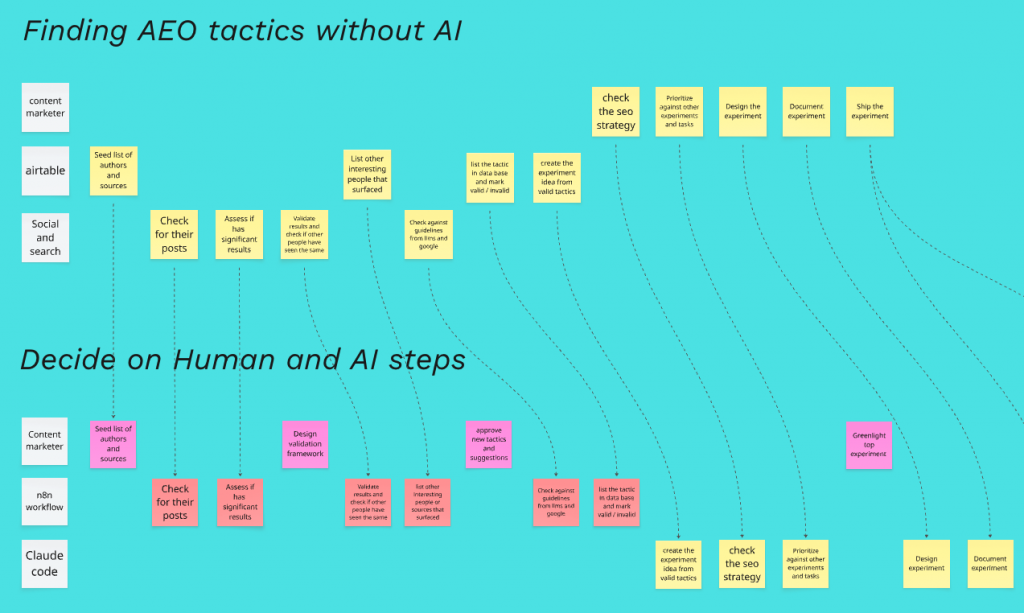
We used a swim lane diagram to lay this out, one lane per actor (a content marketer, a social search, an AI agent) so it’s clear who or what owns each step.
This step matters more than it looks. Skip it and you end up automating a workflow you never actually defined, which is how you get an AI agent doing three jobs badly instead of one job well. Map it first, then decide which steps are repetitive enough to hand off and which need a human.
The research engine: two tools, three agents, human gates
Once the workflow was mapped, we split it into two pieces.
n8n runs the parts that repeat on a schedule: scraping sources, running the validation framework, logging results. Claude Code runs the parts that need judgment and iteration: turning a validated tactic into a prioritized, documented experiment.
Inside the workflow: three agents, one job each
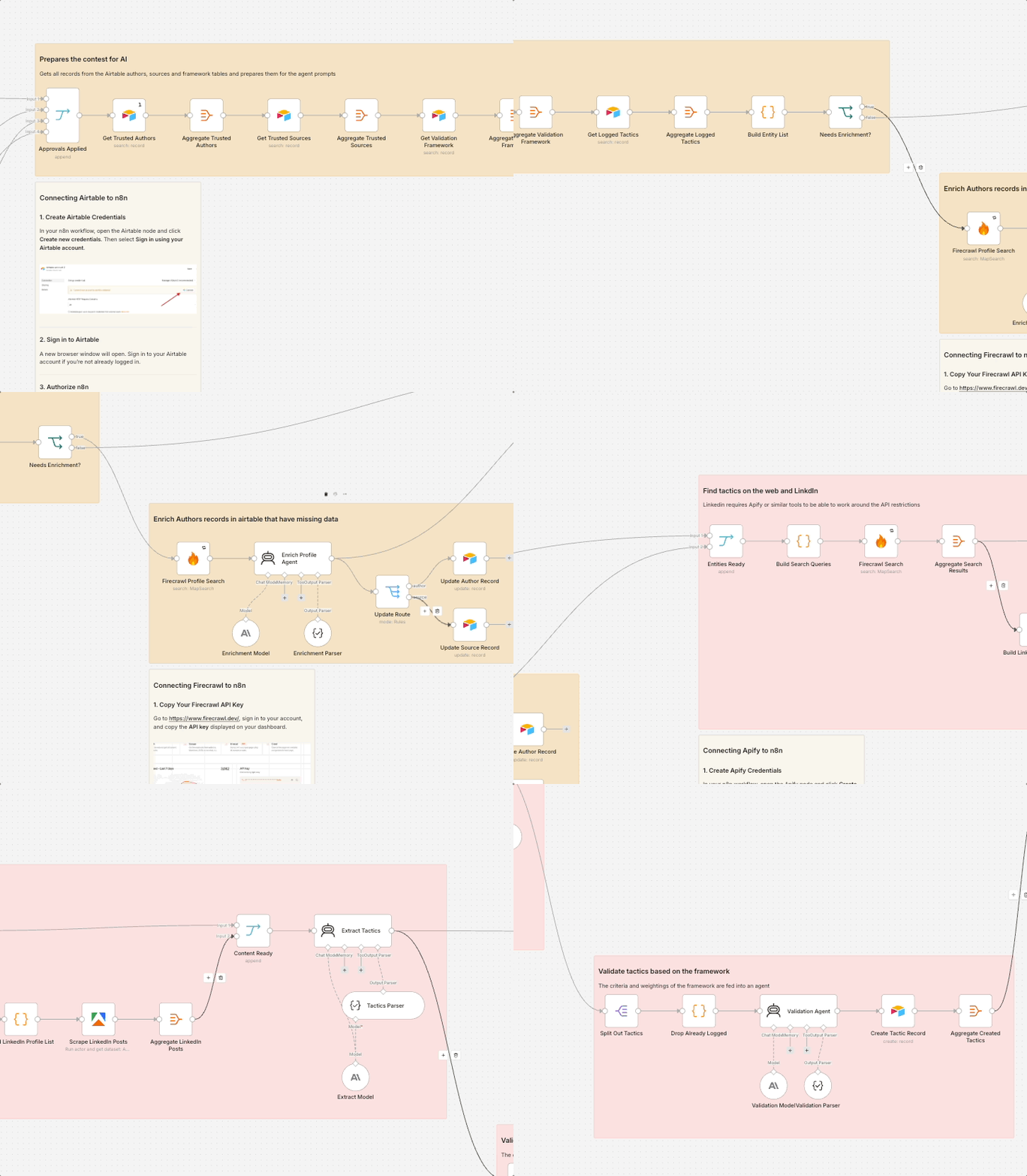
Inside the n8n workflow, three agents do the work:
- An extraction agent pulls tactics from trusted sources using Firecrawl (a free-tier scraper) and Apify (for LinkedIn, where API access is otherwise restricted).
- A validation agent scores each tactic against the framework.
- A reference scout suggests new authors and sources worth adding to the list.
Critically, the review points aren’t at the end. They’re built into the flow: a curated seed list of trusted sources up front, a human-defined validation framework in the middle, and a Slack message at the end where every suggested tactic and source needs a yes or no before it gets added.
The build wasn’t clean, and that’s normal
This took about 2 days of on-and-off building and 22 test runs, 17 of which failed. 9 of those failures were silent (a suggestion would just look slightly off) and only surfaced on manual review.
Building an agentic workflow like this isn’t a five-minute prompt. It’s iterative, and most of the value comes from the failed runs, not the first draft.
PXL beats ICE for ranking which tactics to test
The engine can easily surface more tactics than you can act on. In our own build, it had already logged 58 in the first two weeks. The question isn’t whether a tactic is interesting, it’s whether it’s worth the engineering time to test.
Most teams reach for ICE (Impact, Confidence, Ease) here. It’s simple, and that’s also its weakness: all three scores are opinion. There’s no evidence requirement built in, so ICE tends to reward whoever pitches an idea most confidently.
Instead, we adapted CXL’s PXL framework, originally built for CRO experiment prioritization, into 8 evidence-based questions for AEO and GEO tactics. Each tactic gets scored 0 or 1 on every question, and the questions themselves force you to check for proof rather than assume it:
- Does it align with our existing strategy, and can it scale if it works?
- Is there credible evidence this could work (multiple studies, real sample size)?
- Has it been observed working in the wild, by more than one source?
- Can it be implemented in under a day?
- Does it require minimal engineering effort?
- Is it easy to roll back if it doesn’t work?
- Can success be measured within 2 to 4 weeks with clear KPIs?
- Can the impact be isolated from other changes?
From tactic to experiment brief, in one command
The last piece turns a validated, prioritized tactic into something you can actually hand to a team. Because the prompt for this is basically the same every time, it didn’t need to be a full agent. It’s a Claude Code custom slash command: type /tactics, and Claude pulls the logged tactics from Airtable, scores them against the PXL framework, and returns a ranked list with the reasoning for each score.
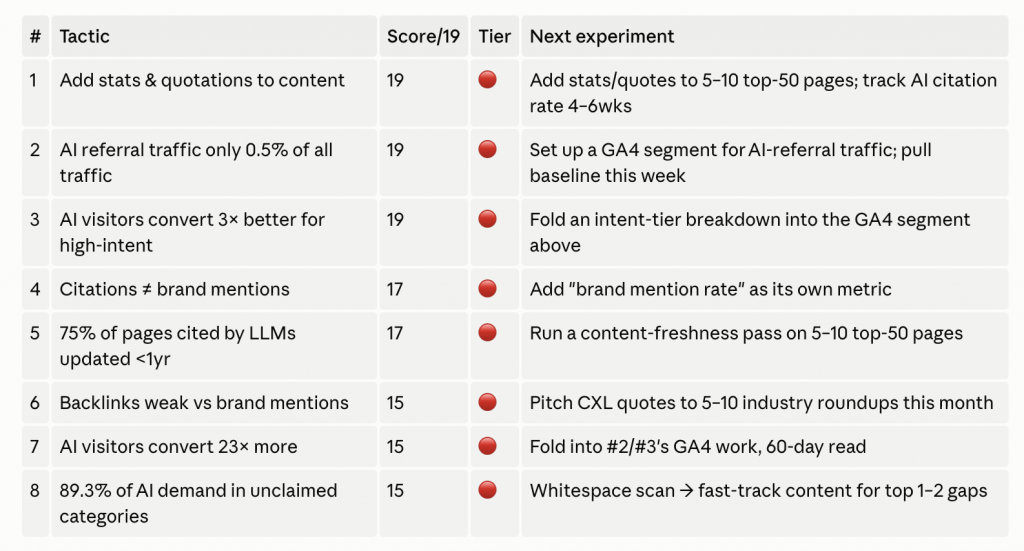
From there, you can ask it to go deeper on any single tactic, and it drafts a full experiment brief: background, hypothesis, method, success metrics, implementation plan, effort, risk, even which of our own blog pages to test first, based on our actual traffic data.
What’s next
This workshop is part of our new AI Native Marketer program. By the end of the 90-minute session, everyone walked away with a template of the research engine, the prompts, and step-by-step instructions for setting up the custom Claude Code commands and connecting everything together.
But this workshop is just one piece of the bigger picture. We built the AI Native Marketer program because marketing is changing fast. There’s more pressure than ever to ship faster, wear more hats, and deliver better results, often with the same team or even fewer resources. Throughout the program, you’ll build practical AI systems you can immediately apply to your own roles.
Want to see where you stand? Take our AI skills assessment to benchmark your current level and discover what to focus on next.
