
Claude Code for marketing: 4 builds you can run without writing code
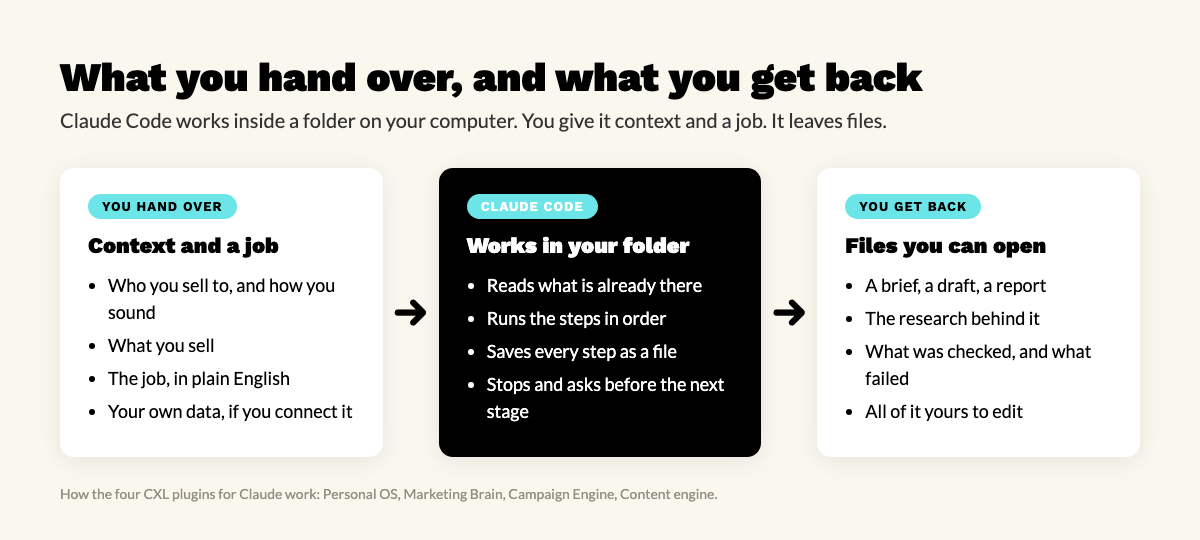
Claude Code for marketing is Claude working inside a folder on your computer. Anthropic’s Claude Code docs describe a tool that reads your files, edits them and runs multi-step jobs, and you direct it in plain English.
You don’t need to code. You install a packaged build, called a plugin, and answer its questions. This article covers four of those builds. For each one you get the command to type first, what members of CXL’s programme reported after running it on their own companies, and where the tool breaks.
What is Claude Code, in marketing terms?
Claude Code is an AI agent that works on the files in a folder you point it at, instead of answering in a chat window. Anthropic’s own description is narrower. The page description of its Claude Code docs calls it “an agentic coding tool that reads your codebase, edits files, runs commands, and integrates with your development tools”, available in the terminal, IDE, desktop app and browser. Swap “codebase” for “a folder of briefs, customer research and drafts” and you have the marketing use.
Three facts that matter if you don’t code
All three come from the same Claude Code docs page:
- You don’t need the terminal. The desktop app “includes Claude Code, so you don’t need to install the CLI separately”.
- You need a paid plan. A paid subscription is required for the desktop app.
- It reads your tools through MCP. The Model Context Protocol is “an open standard for connecting AI tools to external data sources”. That’s how Claude Code reads a CRM or an analytics account instead of an export you made by hand.
The folder is the part most marketers skip
CXL’s guide to GitHub for marketing, published on 7 May 2026, puts it this way: “a GitHub repository (or repo) is a project folder”. When a tool like Claude Code connects to it, it reads those files as context.
Can you use Claude Code for marketing if you don’t code?
Yes, and the skill that replaces coding is checking the result. Anthropic’s own example, published on 26 January 2026, is growth marketer Austin Lau, who “had never written a line of code in his life” before Claude Code. He built a Google Ads copy workflow, and Anthropic reports that “what used to take 30 minutes per ad now takes 30 seconds”.
That is the vendor’s own case. Read it as the ceiling, not the average.
Two first-person accounts show why you check
Two accounts are worth reading alongside this one:
- MKT1 collected five builds from four marketers on 2 March 2026.
- Firecrawl’s SEO lead, Hiba Fathima, described her own stack on 17 February 2026.
Both are useful, and each build in them is one person’s setup. What follows here is the other view: the same four builds, run by different marketers, with what the builds caught.
The common advice is to keep a human in the loop. The evidence for it is more specific. Fathima writes that she pushed what she thought was a “performance optimization” that “completely broke mobile rendering”, and that an engineer caught it in staging. MKT1’s Emily Kramer built two skills “without writing a single line of code” and still calls Claude Code “a bit rough around the edges” for a non-technical person.
The division of labour, in one line
CXL’s Marketing Engineer certification page, read on 26 November 2026, states the division of labour in one line: “You describe what you want, AI writes the code and the SQL, you check the result”.
Employers have noticed
The same page reports on job ads. Of the 709 ads CXL’s Marketing Engineer radar has found since 21 October 2026, 62% ask for code skills, listed as “Python, APIs, Claude Code”. The page says the count is refreshed every two weeks, so it will move.
It also names the role: a marketing engineer is “a marketer who builds the agents, automations and pages their marketing runs on”. CXL has a longer piece on what a marketing engineer is.
A plugin is how a non-coder gets a build
A plugin is a packaged build you install once, not a prompt you paste every time. The Claude Code plugin docs define it as “a directory of skills, agents, hooks, MCP servers, or other components that Claude Code installs and loads as one unit”, and say of a marketplace: “It’s a catalog, not a hosted store”. In marketing terms: someone else wrote the steps, the checks and the file layout. You bring the inputs.
Install any plugin in four steps
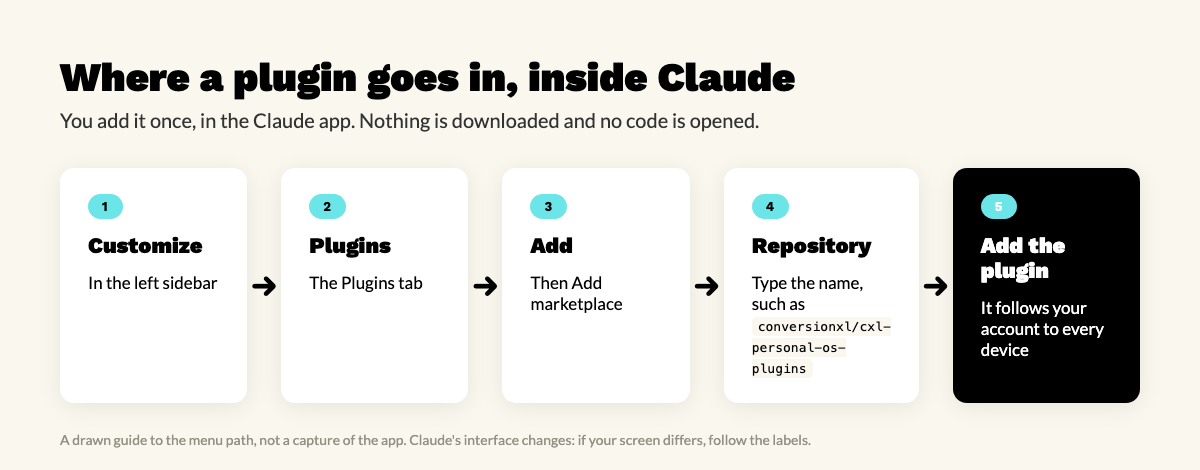
The route is the same for every plugin, and it needs no terminal. Claude’s plugin docs say you add a plugin from Customize, then Plugins, in claude.ai or the Claude desktop app. In the current app the full route is:
- Get a paid Claude plan and install the desktop app. The Claude Code docs say the desktop app includes Claude Code and that a paid subscription is required.
- Make an empty folder, such as
Documents/personal-os, following the Personal OS README. - Add the plugin. Open Customize in the left sidebar, then Plugins, Add, Add marketplace, Add from a repository, and enter the repository, for example
conversionxl/cxl-personal-os-plugins. Then click Add next to the plugin itself. The Marketing Brain README warns that the plugin isn’t installed until you do, and that “this step is easy to miss”. - Open your folder in the desktop app’s Code tab, with Environment set to Local and the folder picked as Project folder. This step is also from the Personal OS README.
CXL’s four public plugins
CXL has four public plugins on GitHub (READMEs read on 26 November 2026). Each one has its own repository and its own setup command:
| Plugin | Repository to enter | You give it | You get back |
|---|---|---|---|
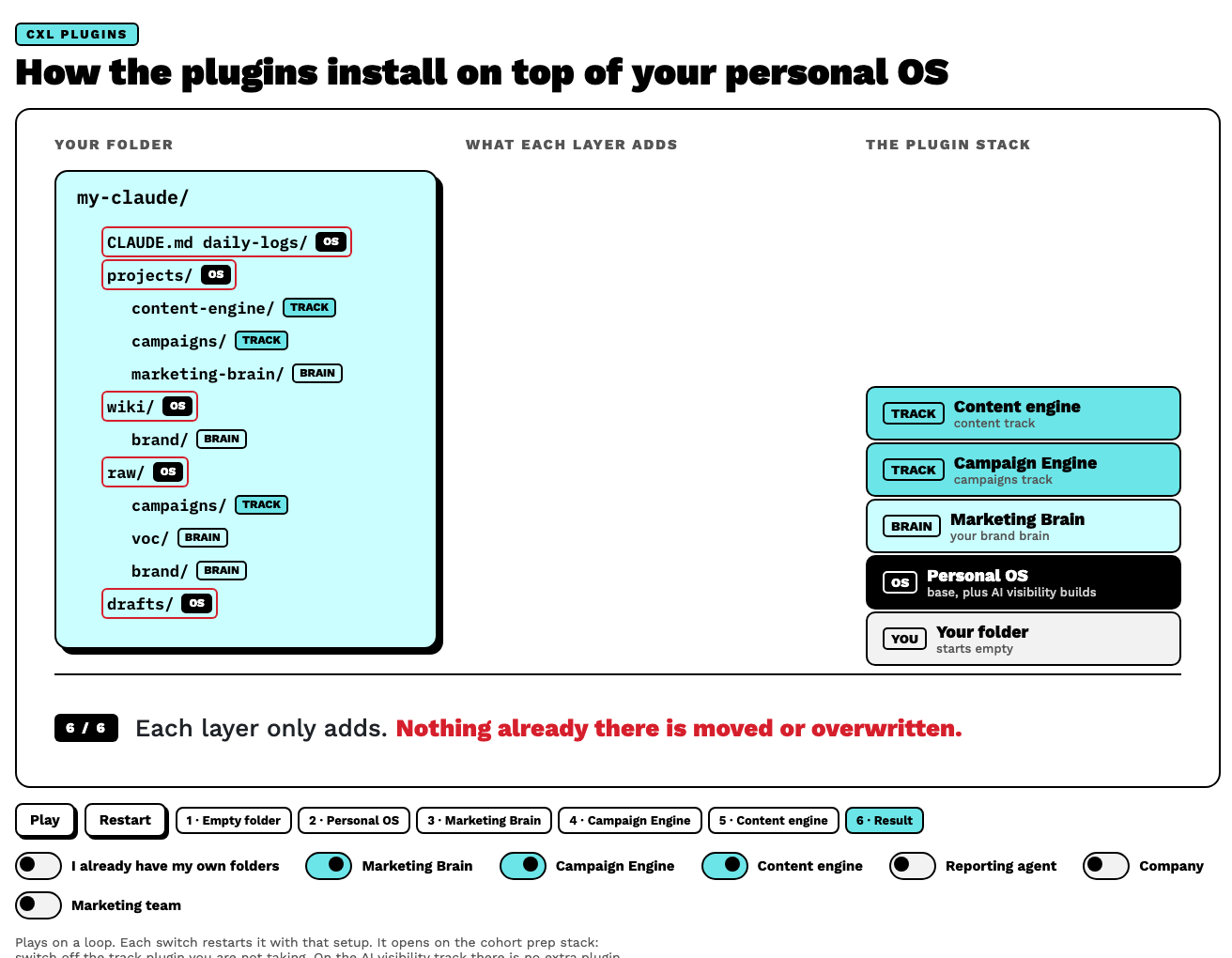
| Personal OS | conversionxl/cxl-personal-os-plugins | An empty folder | Project folders, daily logs written automatically, memory that travels with the folder |
| Marketing Brain | conversionxl/cxl-marketing-brain | Your answers and data in three exercises: ICP, positioning and messaging, brand voice | Four brand files Claude reads before it writes anything customer-facing |
| Campaign Engine | conversionxl/cxl-campaign-engine | A campaign brief you approve, and your channels | A draft per channel, each scored against the brief, with what to fix |
| Content engine | conversionxl/cxl-content-engine | A topic, a keyword or a published URL | Research, an outline, a draft in your voice, a fact-check and an article ready to review |
One folder for all four
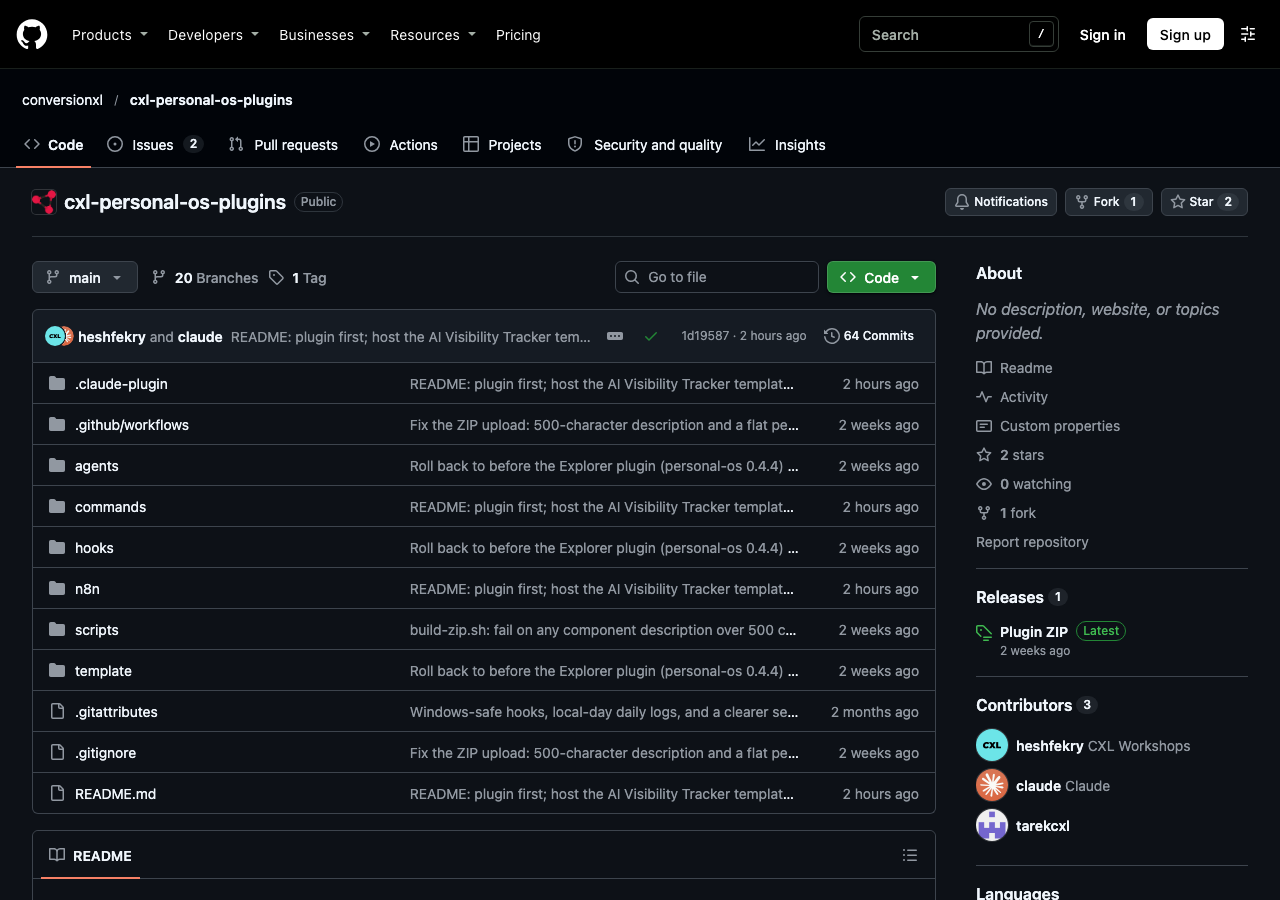
All four work in the same folder. The Marketing Brain README and the Campaign Engine README say it in the same words: “Use the same folder for every module”.
Personal OS gives Claude a memory of your job
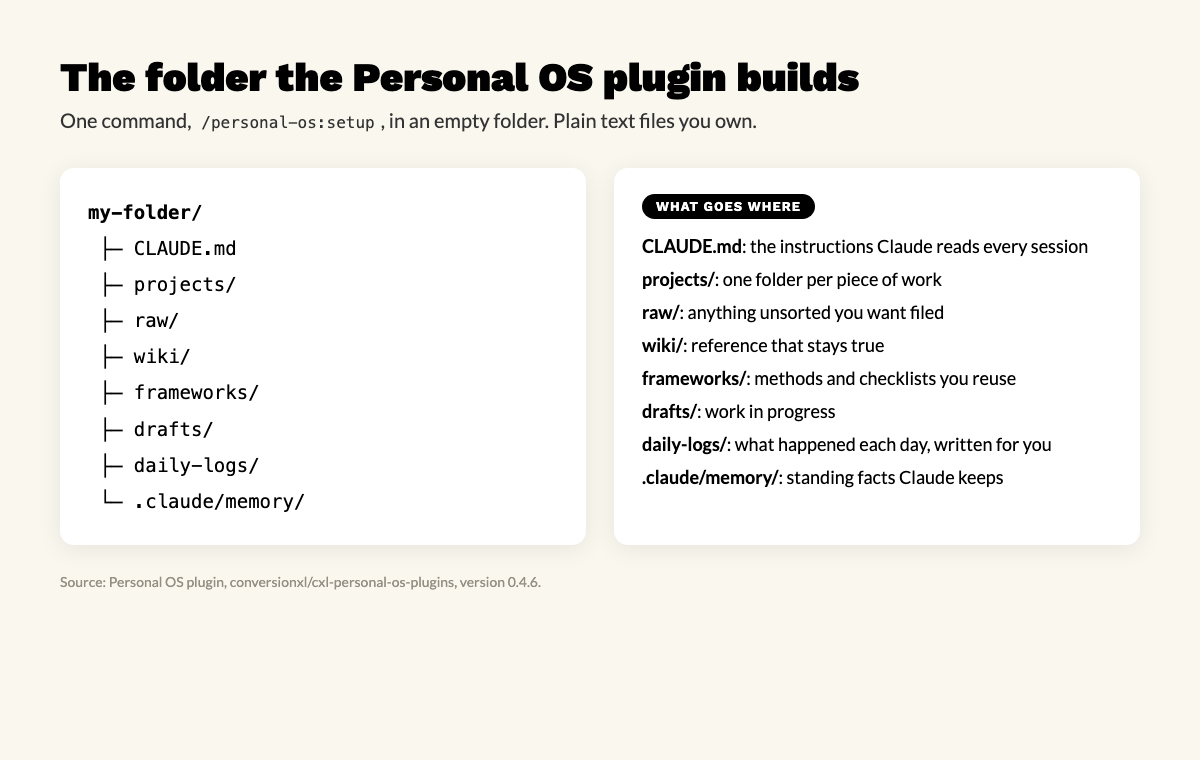
Personal OS fixes the first problem every marketer hits: Claude starts each session knowing nothing about the last one. Per the Personal OS README, the plugin builds project folders, daily logs written automatically and memory that travels with your folder. The files are plain Markdown that you own, as the Marketing Brain README notes.
Build it first if you want that memory. The other three run in any folder, and their READMEs call Personal OS “recommended, not required”, in the words of the Campaign Engine README.
Run it
- Repository:
conversionxl/cxl-personal-os-plugins - Command:
/personal-os:setup, typed in your empty folder - When it finishes: the folders are built, your setup is checked, you’ve had an explanation of how the folder works, an “About me” section is filled in and your first projects exist. It never overwrites a file.
Two limits, both from the README
Daily logs begin in your second session, because setup is what switches them on. So close the setup session and start a new one. On Windows the logs need Git for Windows and jq installed once, and setup checks for both.
CXL’s guide to a second brain for marketing explains the idea behind it: a folder of plain text files that gives your AI assistant persistent memory of your projects, your voice and how you work.
Marketing Brain makes Claude read your customer before it writes
Marketing Brain adds four files that Claude reads before it writes anything customer-facing. Per the Marketing Brain README, you fill them in three exercises: your ICP, your positioning and messaging, and your brand voice. The files are icp.md, positioning-messaging.md, voice-guide.md and vocabulary.md, in a wiki/brand/ folder.
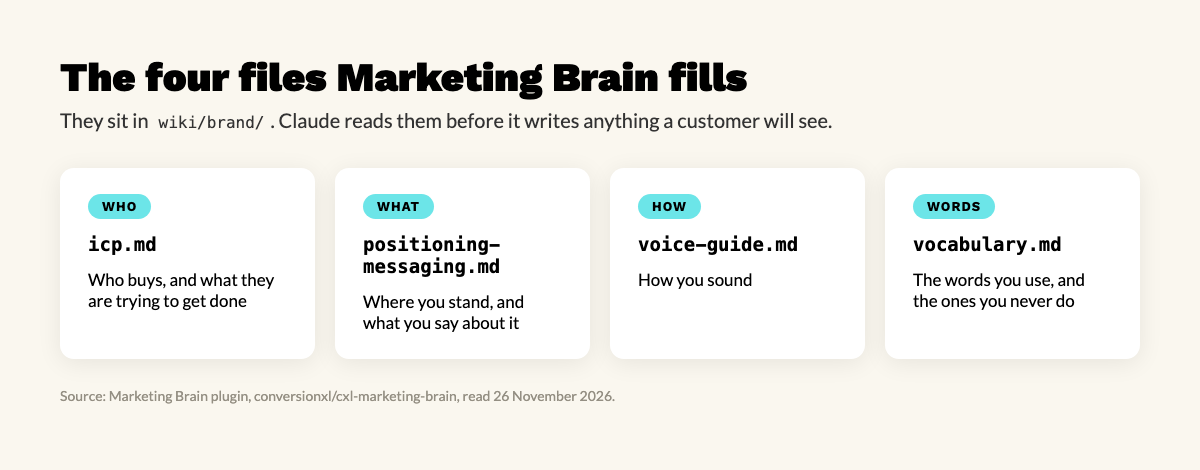
Anything Claude can’t trace to a source is tagged “(inferred)”, and the README says metrics, customers, quotes and case studies “are never made up”.
Run it
- Repository:
conversionxl/cxl-marketing-brain - Command:
/marketing-brain:setup, typed in the same folder - When it finishes: you’ve been coached through the three exercises “on the Acme example, a public brand, or your own data”.
Acme Deals is a fictional brand with customer data and brand samples included, so you can learn the method before you bring your own. Type the command again any time: it picks up where you left off.
What members found: the gap in what they knew
The common assumption is that this step is about tone. Three members of CXL’s programme describe it as finding out what you don’t know.
Read these for what they are: testimonials and demo summaries that CXL publishes on its certification page, read on 26 November 2026. They are the members’ own reports. The page gives no measurement method, and it does not say which Claude app each member ran the build in.
- Attallah Wilson, Marketing Communications Manager at TXI, ran it on HubSpot deals and Semrush data. Her finding: “The ICP built from deal data didn’t match our own brand guidelines.” (Demo in the CXL community, 9 October 2026.)
- Murillo, who runs a marketing agency for health clinics, had a brand book that described the buyer in detail. Per the page, it rested on 2 cases and 0 recorded conversations, and every line about the buyer came back tagged hypothesis or blank.
- Ignacio Basello, co-founder of a two-person positioning studio, rebuilt the studio’s client content workflow on it: “we have reduced working files from up to 20 per article to two”. (Demo, 2 November 2026.)
One studio’s file count is not a benchmark. The pattern across the three is the useful part: the build showed each of them a gap between what they assumed about the buyer and what their evidence supported.
Campaign Engine turns a brief into a reviewed campaign
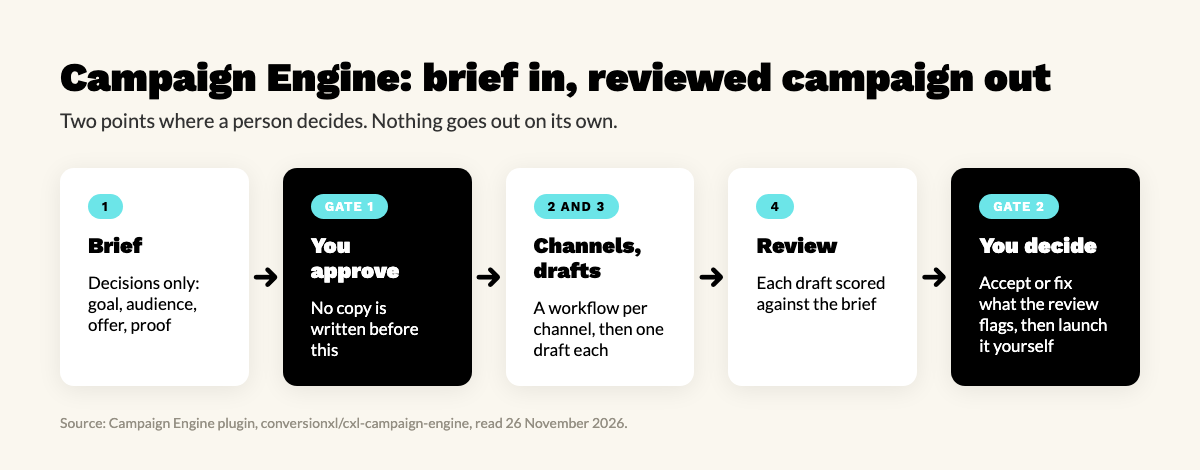
Campaign Engine takes a brief you approve and returns a draft for every channel, each one scored against that brief, with two human approvals on the way. CXL built it with Tyler Durman.
Claude drafts each channel by following a step-by-step workflow and pauses wherever a person decides. By the count in the Campaign Engine README, 30 of the 121 steps in the starter workflows are marked as yours.
Run it
- Repository:
conversionxl/cxl-campaign-engine - Command:
/campaign-engine:setup, typed in the same folder - When it finishes: you’ve been coached through brief, channels, drafts and review “on the Acme example, a campaign you make up, or your own”.
If your folder already holds the Marketing Brain’s brand files, the engine reads them. If not, the brief collects the minimum itself. The README puts a fast run at about 90 minutes from brief to review, and a full run at about two hours.
What members reported
Three member reports from the same certification page, with the same limits as above: self-reported, no measurement method, no Claude app named.
- Alejandro Serrano, co-founder of Feral MKT, built a campaign engine for a two-person business. In his words: “That alone used to take me a whole day working in AI-assisted mode (more days without AI), since I had to write all the copy from scratch because I didn’t like what Claude used to give me. This time it took me about an hour.” (Demo, 16 October 2026.)
- Ilaria, at a clinic management software company: per the page, the review caught ads that promised a free trial the landing page never mentioned. That was before launch.
- Alfonso von Ziegler, founder of Mesh Creative Studios: “the review forced me to stop claiming things I hadn’t proven yet.”
A day down to an hour is the headline, and it is one person’s estimate of his own time. The mismatched free trial is the value: it’s the error that costs money once the ads are live.
Content engine takes a keyword to a fact-checked draft
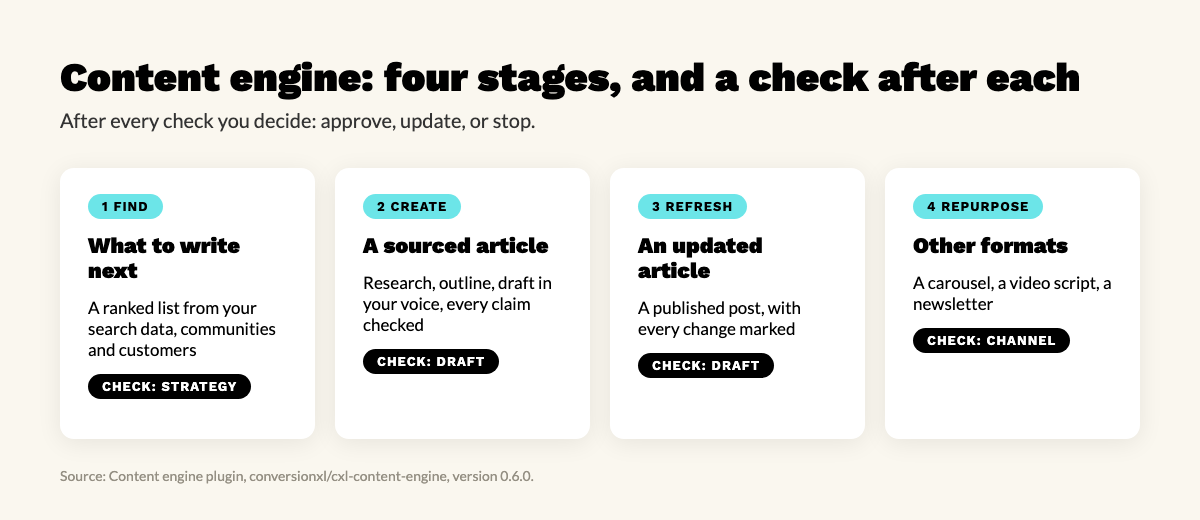
Content engine takes a topic, a keyword or a published URL and returns a researched, fact-checked article in your voice, ready for you to review. That is how the Content engine README describes it. It runs in four stages: find what to write, create it, keep it current, repurpose it.
The README is blunt about the skill level needed: “You type plain English. You don’t need to code.”
It will not write on placeholders
The plugin comes with placeholder brand, voice and product information, and the README says “it will not write until those are yours”. That rule is the point. A draft written on placeholders is the generic output everyone complains about.
Every stage works on web search alone. Ahrefs, Google Search Console, Google Analytics 4 and a Reddit scraper are optional, and setup talks you through each one.
Run it
- Repository:
conversionxl/cxl-content-engine - Command:
/content-engine:setup - When it finishes: it has asked for documents you already have, such as a brand guide, an ICP or a product one-pager, and asked questions only for the gaps.
To try it before you set up your own brand, add example as the first word after a command:
/content-engine:setup example/content-engine:blog-pipeline example "white label software for agencies"
For your own article, run /content-engine:blog-pipeline "your keyword".
No member result yet
The limit, stated plainly: as of 26 November 2026, CXL’s certification page lists no member result for this plugin. There is no before and after to report yet.
Where does Claude Code for marketing break?
Claude Code for marketing breaks in five places, and most of them are your side of the work.
- No inputs, generic output. The Content engine README refuses to write on placeholders for this reason. Murillo’s brand book had 0 recorded conversations behind it, and the build said so, per the certification page.
- Unchecked changes. In Hiba Fathima’s account, the broken mobile rendering at Firecrawl was caught by an engineer, not by the author. If a build touches a live site or sends anything, a person reviews it first.
- Double installs. The Personal OS README warns: “Installed twice, every hook runs twice”. Add each plugin one way only.
- The wrong environment. In the desktop app’s Code tab, Environment has to be set to Local. The same README says cloud sessions do not load plugins.
- Plan limits. The Claude Code docs require a paid plan, and one of MKT1’s builders, Aditya Vempaty, describes “running into credit limits in Claude”.
Few marketers are at this stage
CXL’s 2026 AI maturity benchmark, reported in a CXL post from 28 July 2026, found that in operations (workflows, automations, agents), 90% of marketers who completed CXL’s assessment are still at the assisted stage and 2% have reached native capability. The post does not state the sample size.
What should you build first?
Build Personal OS first, then the one plugin that matches a job you do by hand every week.
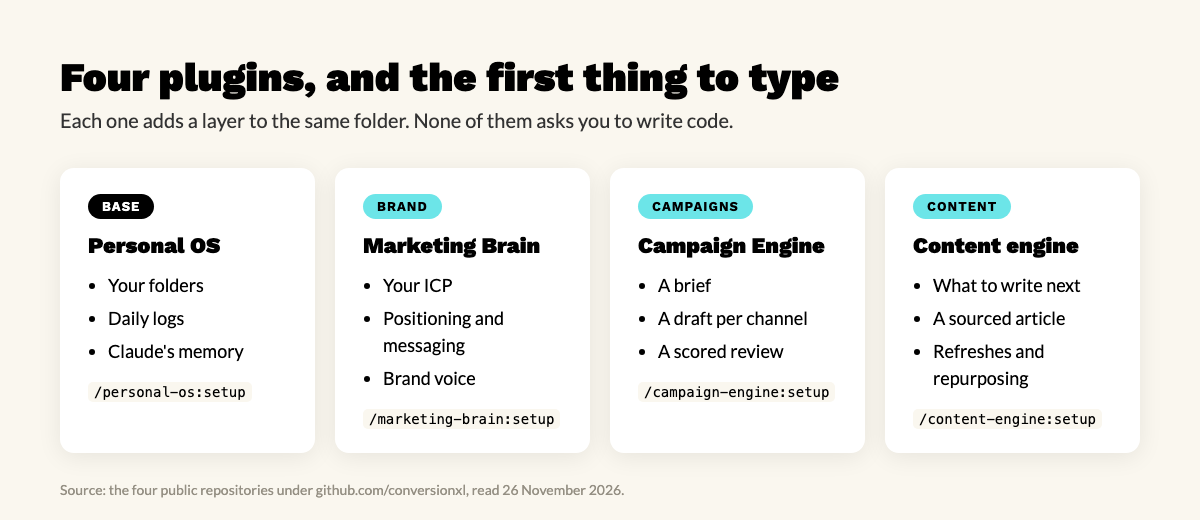
| Plugin | The job it does | Command to type first |
|---|---|---|
| Personal OS | Gives Claude a memory of your job | /personal-os:setup |
| Marketing Brain | Makes Claude read your customer before it writes | /marketing-brain:setup |
| Campaign Engine | Turns a brief into a reviewed campaign | /campaign-engine:setup |
| Content engine | Takes a keyword to a fact-checked draft | /content-engine:setup |
One member described her weekly job on the certification page:
“Currently I’m pulling reports from GA4, SourceWhale and Linkedin manually” Tegan Heneke, freelance marketing executive
Hers is a reporting job. Yours might be the brief, the draft or the ICP.
Would you rather build with a group?
If you’d rather build with a group and be assessed on the result, CXL runs the Marketing Engineer certification. CXL is a B2B marketing training company focused on AI and conversion optimization.
The details below are from the certification page, read on 26 November 2026.
- Length: eight weeks plus a setup week.
- Setup opens: Monday 11 January 2027.
- Live sessions: Tuesdays from 19 January to 9 March, at 3 PM UTC.
- Week 5: Tuesday 16 February, “Build an app with Claude Code”.
- Price: it comes inside a year of CXL, listed at $1,199 until 10 January against the usual $1,599.
- What you need: a paid Claude account and no prior Claude Code experience.
