Live workshop: AI visibility and AI-era measurement
AI visibility: measure it, then plan the content that raises it.
AI brand monitoring you rerun weekly, an AI channel group in GA4, and a prioritized plan of content to write to get cited more often.
- Tell the difference between being named and being cited
- Group AI referral traffic in GA4 so it stops reading as direct
- Ask buyers directly how they found you, since zero-click behavior left no referrer
- Rank the buyer questions the engines answer without you
- Replaces: The SEO specialist’s monthly report, which misses where buyers now shortlist.
On-demand released soon. Included when you join.
Black Friday offer: 25% off, already applied. A year of CXL, January cohort included.
From CXL, trusted by 90,000+ marketers at companies like these:


Meet your instructors:
4x’d efficiency & leads CXL’s growth, experimentation & product. Trained 25k+ marketers with 80+ courses, 4000+ blogs & playbooks.

Content Lead at CXL, focused on practical applications of AI in marketing. Trained 2000+ marketers from Unilever, Red Bull, Heineken and more.

Your buyers are asking an engine, not a search box. Most marketing teams cannot say whether the answer mentions them.
In Wynter’s January 2026 panel of 100 B2B marketing leaders, attribution and measurement is the number one pain, named by 46%. Every budget conversation is already defensive, and the newest channel is the one nobody can account for.
Being named in an AI answer and being cited as its source are different outcomes with different fixes, and neither one shows up in a rankings report. Meanwhile the traffic that does arrive lands in GA4 as direct, so the channel that is growing fastest is the one your reporting is blindest to.
You leave with the baseline running, the GA4 grouping live, and the pages to write next in priority order.
Black Friday offer: 25% off, already applied. A year of CXL, January cohort included.
Part 01: Being named versus being cited
The distinction decides what you do next, and most teams collapse the two into one number. You start by separating them.
- How mentions, citations, and links differ across ChatGPT, Perplexity, Gemini, Claude and AI Overviews
- Why a high mention rate with zero citations is a content structure problem, not a PR problem
- Outcome: A clear definition of what you are measuring, and why
Part 02: Build your share-of-model baseline
You build the baseline itself: a prompt library run against all five engines, scored and logged in a tracker so you can watch it move week to week.
- Build the prompt library from the questions your buyers ask before they know your category
- Run it across the five engines and log mentions, citations, and competitor share
- Outcome: A prompt library and a weekly tracker holding your share-of-model baseline
Part 03: Group AI traffic in GA4
AI referral traffic mostly lands as direct or gets scattered across referrers. You fix the grouping so the channel becomes reportable.
- Build the channel group and regex that captures AI referrers reliably
- Separate the engines that pass a referrer from the ones that do not
- Outcome: An AI channel grouping live in your GA4 property
Part 04: Ask the buyer directly, with self-reported attribution
When the referrer is missing and the click never happens, the only first-party signal left is the buyer telling you. You add that to the forms you already run.
- Add a self-reported attribution question to your forms without hurting conversion
- Reconcile what buyers say against what GA4 recorded, and trust the gap
- Outcome: Self-reported attribution live on your primary form
Part 05: Close the citation gap
A baseline you do not act on is a dashboard. You turn the gaps into a prioritized content plan, then structure the pages so an engine can lift the answer.
- Identify the questions where engines answer confidently and never cite you
- Score the gaps by buyer proximity and the effort to close them
- Mark up the pages with schema so an engine can parse the answer cleanly
- Outcome: A prioritized content plan, and schema on the pages you write first
Who this is for and what you need
- This is for you if: you have at least 2 years in ops, growth, demand gen or content, and you run campaigns and read your own performance data. No hand-coding.
- You do not need: prior Claude Code or n8n experience. Every build starts from a template.
- A paid Claude account, Claude Code preferred, plus a free Miro account. The reporting agent and AI visibility builds also use n8n.
- Prep before your first session in the app, suited to all levels. It counts toward your average of 1 hour a day. If you get stuck, we help you through it.
- Any other tool is explained live, with alternatives. You are not locked into one stack.
Ready for the next step?
Eight live weeks to build AI systems that run your marketing, certified on what you build.
Marketing Engineer: eight-week cohort, starts 11 January
Live Tuesdays, 3 PM UTC, to 9 March. With Diane Wiredu, Ann Smarty, Tyler Durman and Nick Christensen. Included in the annual plan.
This is what marketers said after our live workshops and courses
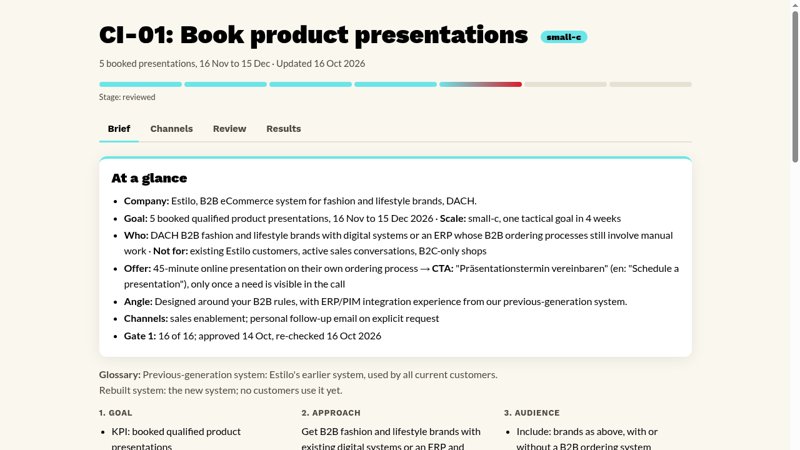
B2B eCommerce platform
Sales signed off the target in writing before the brief passed Gate 1. Five review rounds took the drafts to 87% and 96%.
Campaign engine

Co-Founder, Feral MKT
“That alone used to take me a whole day working in AI-assisted mode (more days without AI), since I had to write all the copy from scratch because I didn’t like what Claude used to give me. This time it took me about an hour.”
Campaign engine

Fractional CMO & GTM Strategist
“I fixed the site and Crunchbase last week and reran Build 1 this morning with the same questions, tools and judge. Accuracy went from 53% to 71%, and wrong answers went from three to none.”
AI visibility tracker
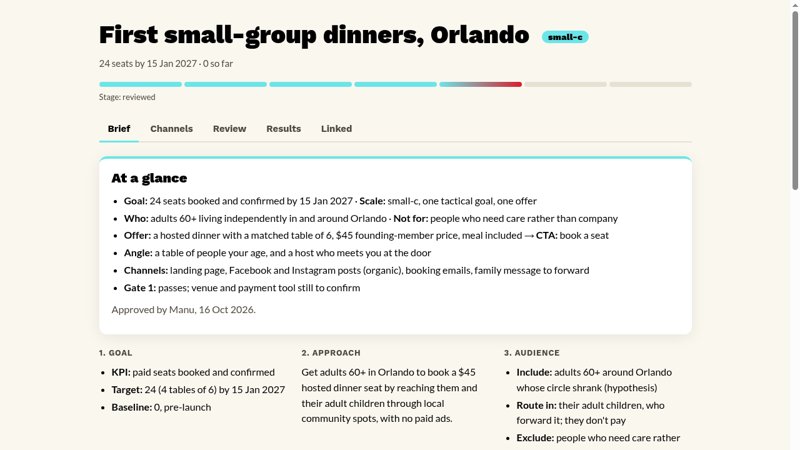
Social club for people 60+, pre-launch
A paid first dinner, to test whether older adults will pay for it themselves. All four channels reached ship after 9 fixes.
Campaign engine

Senior copywriter, elective healthcare agency
“I was really impressed with how it handled the copy, including adding a medical compliance check due to the industry I work in … I loved all of the quality checks and scoring, since I usually do that type of QA work manually.”
Campaign engine
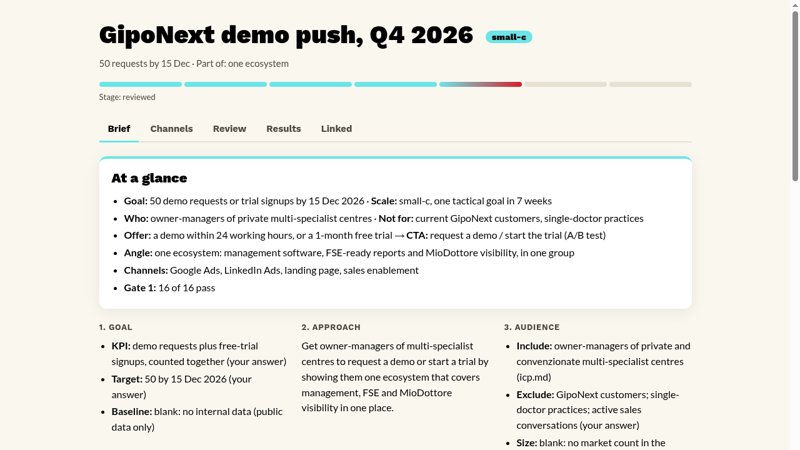
Clinic management software
A campaign to win 50 demo or trial requests in 7 weeks: five channels, all drafted and through Gate 2.
Campaign engine

E-commerce & Brand Strategist
“I built a visual plugin on top of your Marketing Brain, two actually: Visual Brain for the brand’s visual direction and Product Visual for product image storyboards … I put my own brand through it and it already gives me something I can work with.”
Own plugins on Marketing Brain

AI-Forward Marketing Executive
“I was in your workshop 12 hours ago. I already have a workflow live… I feel like a freaking WIZARD!”
Last cohort
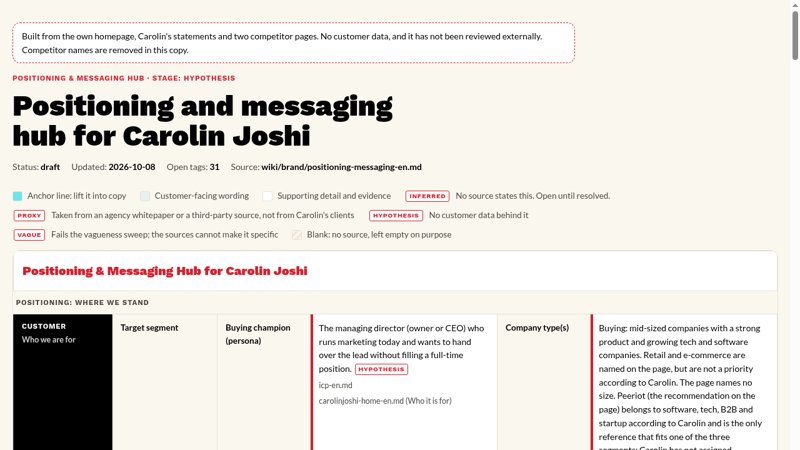
Fractional CMO practice, launching
Tested a new fractional CMO offer on her own website, using public data only.
Marketing Brain
Marketing Communications Manager, TXI
“Connecting my systems made the biggest difference. Pulling deals straight from our HubSpot CRM, plus Semrush data on our content, gave the ICP and the messaging real evidence instead of guesses.”
Marketing Brain

Director of Messaging
“Being able to identify valuable work to be done, build a workflow/agent to do it effectively and consistently, and deploy it across my team will be a skill that sets my team and I apart within the org.”
Workflows
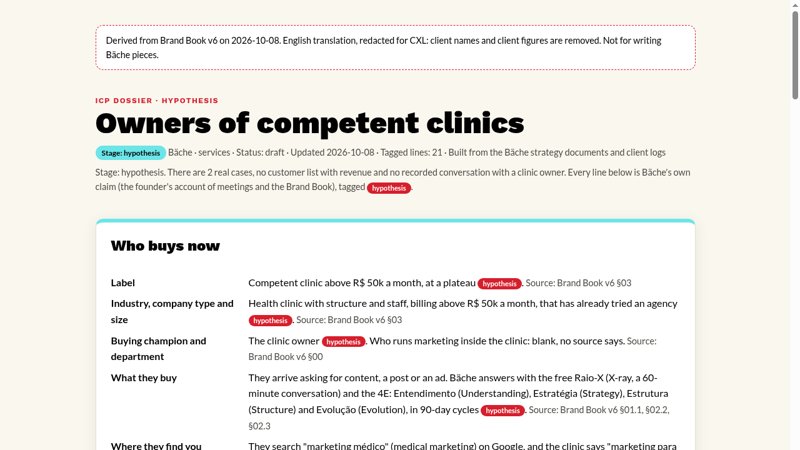
Marketing agency for health clinics
Ran the brand book through it: every claim about the buyer came back tagged hypothesis or blank.
Marketing Brain

Content Strategist
“This course got me to take writing instructions seriously and tailor them to how I work. Before, I was mostly just chatting with AI. Now I’m trying to build actual workflows.”
Workflows

Founder, Mesh Creative Studios
“Biggest learning: the review forced me to stop claiming things I hadn’t proven yet.”
Campaign engine
Here is what other marketers said
The newsletter for the marketing engineer.
Free, weekly, on AI and B2B marketing.
AI changes how marketing works every week. We help you keep up and grow into the marketing engineer role: practical AI tactics, B2B playbooks, and the workflows teams are running right now.